
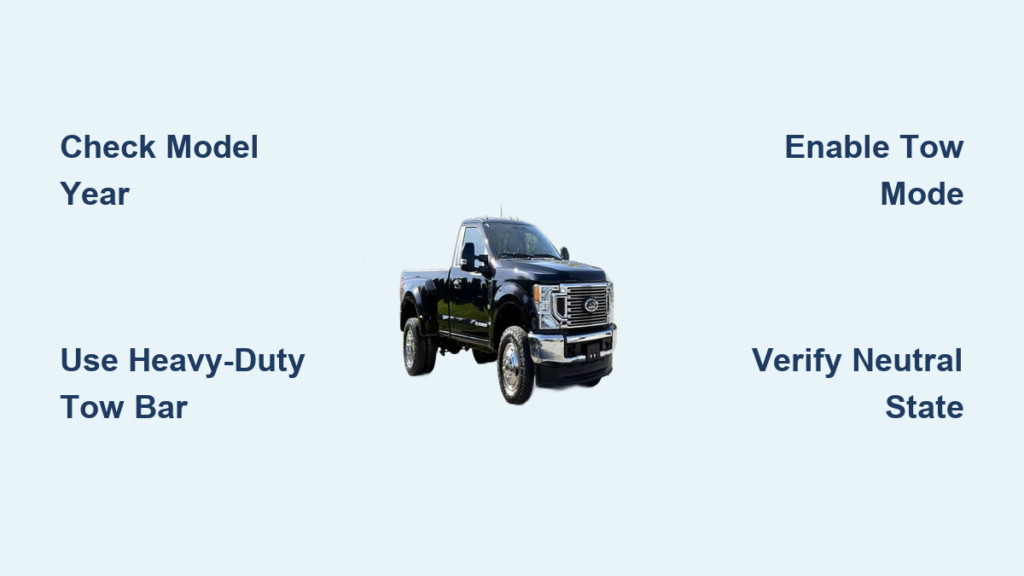
Towing a Ford F-350 dually requires precise steps to avoid destroying your transfer case or transmission during the move. You cannot simply hook up this heavy truck and drive without risking catastrophic drivetrain failure or dangerous road instability.
This guide details exactly how to tow a F350 dually using verified methods for both modern and vintage models. You will learn specific equipment needs, safety sequences, and critical checks to ensure your truck arrives in working condition.
Verify If Your F350 Dually Model Allows Flat Towing
Not every Ford F-350 dually handles flat towing the same way due to major differences in transfer case design. You must identify your specific model year because the procedure for a 2017 differs vastly from a 1990s OBS truck. Ignoring these distinctions often leads to expensive mechanical repairs.
Check Model Year Restrictions
Modern 2017 models are not officially approved by Ford for flat towing despite having a hidden neutral mode. Using this unofficial method voids dealer support and places all liability on you if damage occurs. Older 1992–1996 OBS models can be flat towed but only if you modify the transfer case or manage lubrication carefully.
Confirm Drivetrain Configuration
Safe towing demands that your F-350 sits in 2H mode with the transfer case fully in neutral. This specific setup disconnects the transmission from the rear wheels to prevent internal rotation damage. Four-wheel-drive models especially require this step to avoid binding the driveline while moving.
Select Heavy-Duty Towing Equipment for Duallys
Standard passenger car tow bars will fail under the massive weight of a dually truck configuration. You need specialized gear rated for heavy loads to maintain stability and safety on the highway. Cutting corners on equipment choice invites disaster during your trip.
Choose a Rated Tow Bar
The Roadmaster Blackhawk 2 All-Terrain Tow Bar stands out as a top choice for F-350 dually applications. It features self-centering arms that pivot on a central pin to maintain a safe gap during sharp turns. While it lacks included shock absorbers, its robust construction handles heavy loads effectively over long distances.
Install Proper Base Plates
You must use OEM steel brackets or custom adapters designed specifically for your bumper type. Aftermarket bumpers often have D-rings that cannot handle direct towing forces without failing under stress. Proper brackets distribute the immense weight evenly across your frame to prevent structural damage.
Set Up Lighting and Power Systems
Your towed truck needs active tail lights and a charged battery to function safely upon arrival. Modern F-350s suffer from parasitic drain when lights stay on, so you must run an auxiliary power wire from the tow vehicle. Route this wire through the bed and connect it directly to the positive battery terminal to maintain charge.
Enable Tow Mode on 2017 Ford F-350 Models
Owners of 2017 F-350s can manually activate a hidden tow mode to place the transfer case in neutral. This process bypasses the factory restriction but requires strict adherence to a specific sequence of actions. Deviating from these steps will leave the vehicle in gear and ready for drivetrain destruction.
Execute the Neutral Sequence
Follow this exact order to engage the hidden neutral state in your 2017 F-350 transfer case.
1. Engage the parking brake just enough to light the dashboard indicator.
2. Turn the ignition to the Run position without starting the engine.
3. Press the brake pedal and shift the transmission lever to Neutral.
4. Cycle the 4WD selector from 2H to 4L five times within ten seconds.
5. Return the selector to 2H and shift the transmission back to Neutral.
6. Release the parking brake to complete the activation process.
7. Verify the dashboard displays “Tow Mode Enabled” before moving.
Confirm System Readiness
Check that the front driveshaft does not spin when you rotate the rear wheels by hand. If the shaft turns, the transfer case is not fully disengaged and will cause damage during towing. Ensure auto-locking hubs are unlocked to prevent binding in the front axle assembly.
Prepare Legacy 1992–1996 OBS Models for Towing
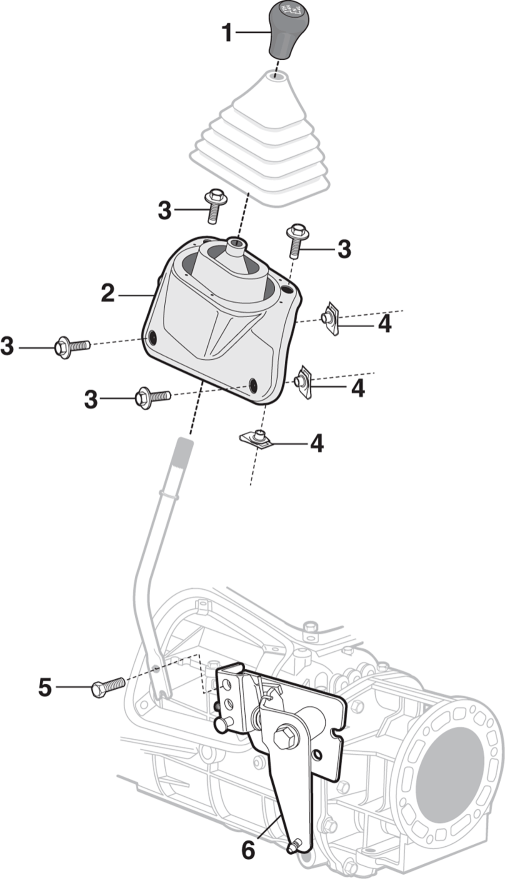
Vintage OBS trucks lack the electronic neutral features of newer models and require mechanical intervention. The transfer case in these older 4×4 systems does not naturally allow free-wheeling without modification. You must address lubrication and gear engagement before attempting any long-distance tow.
Modify the Transfer Case
You have three main options to make a legacy F-350 safe for flat towing without engine power.
* Install a gear-driven tow adapter known as a neutralizer kit.
* Use a tow bar system with a built-in bypass mechanism.
* Physically remove the transfer case output shaft as an extreme measure.
Maintain Transmission Lubrication
The transmission pump in older models relies on engine rotation to circulate fluid and prevent overheating. You must run the engine for five to ten minutes every hour if you lack a bypass kit. Failure to circulate oil will starve the transmission and lead to rapid component failure.
Use a Tow Dolly as a Safe Alternative
Flat towing is not the only option for moving your F-350 dually safely across long distances. A heavy-duty tow dolly lifts the front wheels off the ground to eliminate drivetrain concerns entirely. This method is ideal if your transfer case cannot achieve a true neutral state.
Select a Heavy-Duty Dolly
Choose a dolly like the Blue Ox model that explicitly rates its capacity above your truck’s front-end weight. Verify the curb weight of your specific F-350 configuration before renting or buying equipment. Using an under-rated dolly creates a severe safety hazard on the road.
Load and Secure the Front End
Proper loading ensures your truck stays stable and secure throughout the journey.
1. Position the dolly directly behind the truck with ramps aligned.
2. Raise the front wheels using the dolly hydraulic system or ramps.
3. Roll the tires onto the dolly rollers and center them carefully.
4. Lock the wheels in place using the provided heavy-duty straps.
5. Attach safety chains to the tow vehicle using secure quick-links.
6. Connect the lighting harness and test all signal functions.
7. Double-check that the hitch ball size matches the receiver requirements.
Perform Critical Pre-Trip Diagnostics
Never start a long tow without verifying the mechanical health of your F-350 dually first. Underlying engine or drivetrain issues can turn a simple move into a total loss scenario. A thorough inspection saves you from compounding existing problems during transit.
Test Engine Health
Check for signs of internal engine wear that could lead to failure under tow conditions. Look for pulsating oil caps indicating blow-by or listen for tapping noises suggesting worn pistons. Perform a coolant pressure test to rule out head gasket issues before departure.
Inspect Drivetrain Components
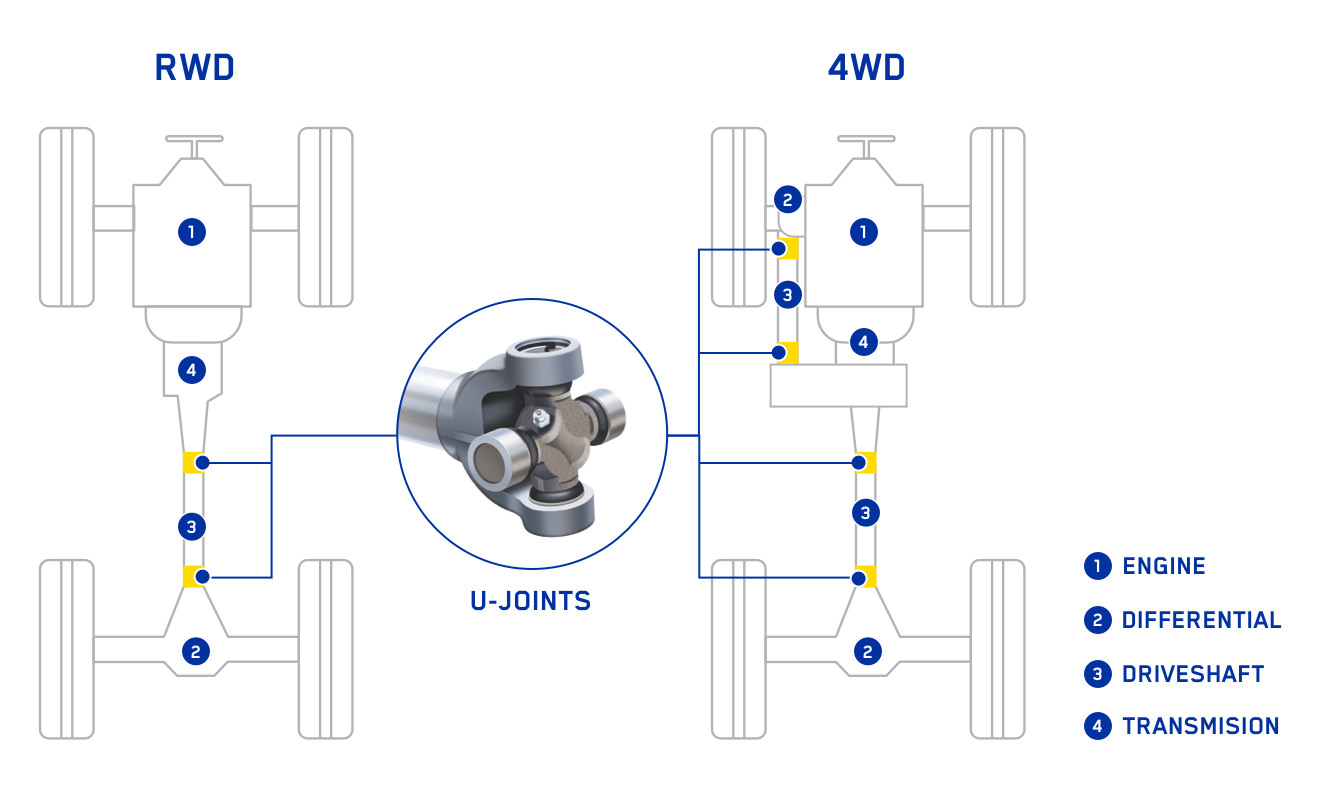
Examine transmission bolts to ensure they are torqued correctly, especially after recent seal repairs. Check U-joints for any play or binding that could cause a driveshaft to detach at highway speeds. Mark alignment points with paint before removing any components to ensure correct reinstallation.
Check Tires and Alignment
Ensure all tires on both the truck and dolly are inflated to the manufacturer specifications. Misalignment of the hitch beyond three inches causes violent vibrations known as chucking. Correct alignment is essential for a smooth ride and to prevent premature wear on your tow bar.
Execute the Tow with Stability and Care
Driving dynamics change significantly when towing a heavy dually compared to lighter vehicles. You must adjust your speed and monitoring habits to maintain control and safety on the road. Proper technique reduces stress on both the tow vehicle and the F-350.
Maintain Highway Speeds
Stability improves dramatically when towing at highway speeds above 65 mph on interstates. Low-speed driving between 45 and 55 mph often feels nervous and causes the dually to push into curbs. Plan your route to maximize time on open highways where the setup tracks better.
Monitor Fuel and Handling
Expect your tow vehicle fuel economy to drop significantly during the trip. Real-world data shows averages around 15.6 mpg on open roads but lower figures in wind or traffic. Watch for steering feedback or swaying and stop immediately if the towed truck begins to pull violently.
Avoid Common Towing Pitfalls
Many owners make simple mistakes that lead to battery drain or mechanical failure during the tow. Awareness of these common errors helps you avoid costly repairs and dangerous situations on the road. Prevention is far easier than fixing a broken drivetrain miles from home.
Prevent Battery Drain
Failing to connect an auxiliary charge line often results in a dead battery upon arrival. This leaves you unable to move the truck off the dolly or disconnect the tow bar safely. Always secure a power source or disconnect the battery entirely before starting your journey.
Avoid Transfer Case Damage
Towing legacy models without a neutralizer kit or fluid bypass risks catastrophic transfer case failure. The lack of internal lubrication causes gears to overheat and seize quickly. Do not skip this critical modification step if you plan to flat tow an older truck.
Don’t Ignore Misalignment
Hitch misalignment beyond the three-inch tolerance creates excessive vibration and stress. This “chucking” effect wears out components rapidly and makes for a terrifying driving experience. Use alignment guides to center the hitch perfectly before you leave your driveway.
Follow Post-Tow Procedures
Your work is not done simply because you have reached your destination safely. Proper disconnection and inspection ensure your F-350 dually remains ready for future use. Skipping these final steps can leave hidden damage undetected until it causes a breakdown.
Safely Disconnect and Inspect
Lower the truck carefully if using a dolly or detach the tow bar according to manufacturer instructions. Reconnect the battery if you disconnected it and start the engine to verify normal operation. Check for any new scratches, loose brackets, or fluid leaks around the drivetrain components.
Reset and Test Systems
Ensure the front hubs engage and disengage properly after the tow. Take a short test drive to confirm smooth shifting and check for any warning lights on the dashboard. For legacy models, verify transmission fluid temperature and levels immediately after the trip.
Frequently Asked Questions About Towing F350 Duallys
Can I flat tow a 2017 Ford F-350 dually officially?
Ford does not officially approve the 2017 F-350 for flat towing, though a manual tow mode exists. Using this unofficial method voids dealer support and places full liability for damage on the owner. Proceed with caution and understand the risks involved.
How do I prevent transmission damage in older F-350 models?
You must install a neutralizer kit or run the engine every hour to circulate transmission fluid. Older transfer cases do not lubricate properly when towed without engine power. Neglecting this step leads to overheating and total transmission failure.
What tow bar is best for a Ford F-350 dually?
The Roadmaster Blackhawk 2 All-Terrain Tow Bar is highly recommended for its heavy-duty construction and self-centering arms. It handles the weight of a dually effectively and maintains stability during turns. Ensure you use proper custom adapters for your specific bumper.
Why does my tow setup feel unstable at low speeds?
Heavy dually setups often feel nervous and pushy at speeds below 60 mph due to weight distribution. Stability typically improves significantly when driving at highway speeds above 65 mph. Avoid prolonged low-speed towing on two-lane roads if possible.
How do I keep my battery from dying during the tow?
Connect an auxiliary power wire from the tow vehicle to the F-350 positive battery terminal. This setup powers the tail lights and keeps the battery charged throughout the journey. Alternatively, you can disconnect the battery completely before towing.
Key Takeaways for Safely Towing Your F350 Dually
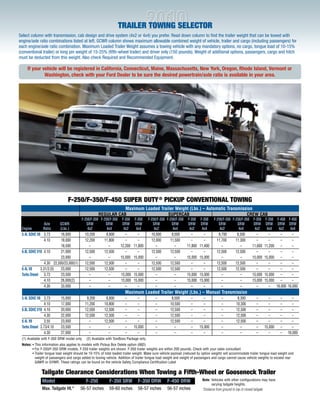
Towing a Ford F-350 dually requires strict adherence to model-specific procedures to avoid drivetrain destruction. Modern 2017 models need a specific manual sequence to engage neutral, while legacy 1992–1996 trucks demand mechanical modifications or frequent engine idling. Always use heavy-duty equipment like the Roadmaster Blackhawk 2 and verify your hitch alignment before every trip.
Perform thorough pre-trip diagnostics on your engine and drivetrain to prevent compounding existing issues during transport. Maintain battery charge with an auxiliary wire and drive at highway speeds for the best stability. Follow these steps carefully to move your dually safely across any distance.


