

If your Ford F-150 starts squealing on startup or you notice sluggish power steering, dimming lights, or overheating, it might be time to replace the serpentine belt. This single belt (or dual belts on certain models) powers critical components like the alternator, water pump, power steering pump, and A/C compressor. Left unchecked, a worn or broken belt can leave you stranded. The good news? Replacing it is a manageable DIY job that takes under an hour with the right tools and guidance.
This guide covers all key F-150 engine types from 2004 to 2024, including the 5.0L V8, 3.5L EcoBoost, and PowerBoost engines. You will learn about dual-belt systems, tight-clearance challenges, proper routing, torque specs, and pro tips from real technicians. Whether you drive a work truck or a high-end Platinum model, you will discover exactly how to remove, inspect, and install serpentine and A/C belts safely and correctly.
Identify Your F-150 Belt System

Before grabbing tools, confirm your F-150’s belt configuration. This determines your entire approach and prevents confusion during the job.
5.0L V8 Uses Dual Belts
From 2011 onward, the 5.0L Coyote V8 uses two separate belts. The main serpentine belt drives the alternator, water pump, and idler pulleys. The A/C belt operates independently for the air conditioning compressor. These belts share the crankshaft pulley but run on independent tensioners. The A/C belt is especially tricky to access, and most DIYers must remove the serpentine belt and its tensioner first to create enough working space.
3.5L EcoBoost Has Tight Clearance
The 3.5L EcoBoost and PowerBoost engines from 2011 to present often use a compact dual-belt layout with closely spaced pulleys. Newer models from 2022 onward have extremely limited clearance near the crankshaft, making belt installation difficult without specialty tools.
5.4L and Older V8s Use One Belt
For 2004 to 2008 5.4L V8 models, a single serpentine belt drives all accessories. Tension releases using a ½-inch drive tool on the tensioner. You may need to remove the radiator hose bracket (13 mm nut) for full access.
Check Belt Condition and Timing
Replace Every 100,000 Miles
Ford recommends replacing serpentine and A/C belts every 100,000 miles, even if they look fine. Rubber degrades from heat, ozone, and constant flexing over time.
Inspect Every 30,000 Miles
Look for these warning signs during inspections. Cracks or fraying along the ribs indicate advanced wear. Glazed or shiny surfaces signal past slippage. Dry rot or flaking edges mean the rubber is breaking down. Discoloration, especially yellowish-orange, can indicate aging.
Even if the belt appears intact, replace tensioners and idler pulleys every 100,000 miles. Labor to access them is the same, and replacing all at once prevents repeat jobs.
Gather the Right Tools
Essential Tools List
You will need these tools for the job. A 3/8″ drive ratchet fits tight engine bays better than larger drives. A 15 mm socket releases the serpentine tensioner. A 10 mm socket or wrench removes the A/C tensioner bolt. A breaker bar (18″ length) adds leverage for stuck tensioners. A torque wrench ensures correct bolt tightness. A flashlight or headlamp illuminates dark engine compartments. A universal joint and extension reach recessed bolts. A phone or camera captures belt routing before removal.
Pro-Grade and Improvised Tools
Certain tools make the job easier. A stretch belt tool is critical for 2022+ PowerBoost models with no slack. Heavy-duty zip ties hold the tensioner open during installation. A bungee cord secures the tensioner in release position. A flexible 10 mm wrench reaches the A/C tensioner bolt when blocked by hydraulic lines.
The serpentine tensioner has a square drive nub on the back. Insert your 3/8″ ratchet directly into it. No socket needed.
Prepare the Vehicle Safely
Park on level ground and engage the parking brake. Turn off the engine and let it cool for 30 minutes or more. Open the hood and secure it with the prop rod. Disconnect the negative battery terminal, especially if your truck has remote start. Remove the engine cover if equipped. Take out the air intake tube by loosening 8 mm clamps on all hoses, pressing the gray quick-release knob, sliding the tube off the air filter housing and throttle body, and rotating it out of the way.
Removing the intake gives you 4+ inches of extra room on newer models where the intake duct blocks access to the crankshaft pulley.
Find the Correct Belt Routing
Check these spots for the routing diagram. The radiator support often has an under-hood sticker. The fan shroud sometimes contains the diagram. The top of the engine bay may have the information. The owner’s manual always includes routing details.
If no diagram exists, take multiple high-resolution photos from different angles before removing any belt. Draw a sketch showing the path over each pulley.
Choose Your Work Position
Top-Down Access
Working from above is best for removing the A/C belt, using stretch tools, and performing initial inspection. This method requires air intake removal and good overhead lighting.
Under-Vehicle Access
Working from below is best for releasing the serpentine tensioner, removing the tensioner entirely, and tight-clearance models. Raise the front end using ramps or jack stands. Crawl under and work legs-first with arms reaching up.
Crawling under gives perfect leverage. Using a 15 mm breaker bar, you can remove the belt in 2 minutes.
Remove the Serpentine Belt
Method A: From Above
Locate the serpentine tensioner at the bottom-right of the engine. Insert a 15 mm socket on a ratchet or breaker bar. Rotate counterclockwise to release tension. While holding tension, slide the belt off the crankshaft pulley first, then remove from water pump, alternator, and idler pulleys. Slowly release the tensioner.
Method B: From Below (Recommended)
Position yourself under the truck. Use a 3/8″ breaker bar with 15 mm socket. Rotate the tensioner counterclockwise. Remove the belt in the same sequence as above.
On some 5.0L models, you must remove the serpentine tensioner to get the belt past the crank pulley due to tight clearance.
Remove the A/C Belt
On 5.0L V8 models, remove the serpentine belt and tensioner first. This creates the space needed to access the A/C belt.
Locate the A/C tensioner at the upper-left of the engine. Use a 3/8″ ratchet or 10 mm wrench on the bolt. Rotate clockwise to release tension, which is opposite of the serpentine tensioner direction. Slide the belt off the crankshaft pulley and idler, then remove from the A/C compressor pulley.
A hydraulic line may block the 10 mm bolt. Use a box-end or flexible-head 10 mm wrench in this situation.
Replace Worn Tensioners and Idlers
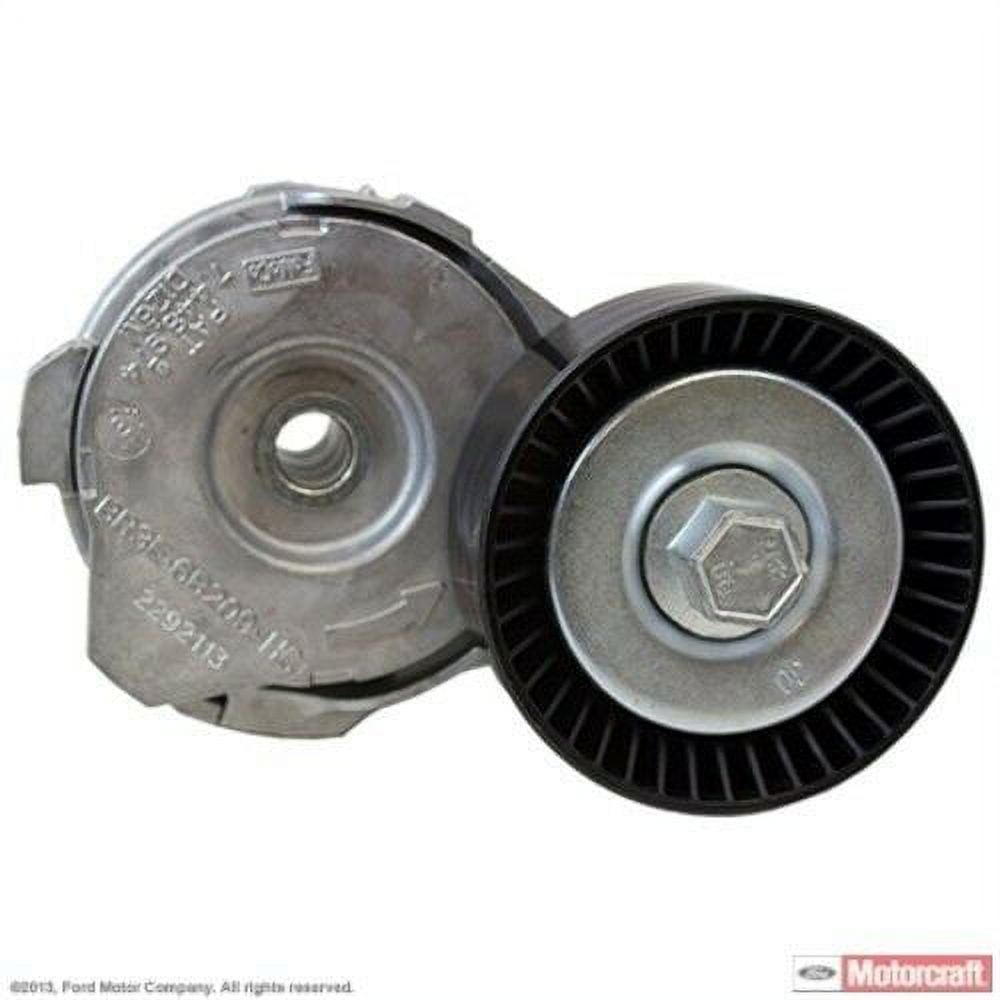
Replace tensioners and idlers together with the belts. Labor to access them is identical, and a failed tensioner causes immediate belt loss.
Replace the serpentine tensioner with Motorcraft BT-103 (OEM). The bolt is 13 mm, and torque is 35 ft-lbs. Align the notch on the back with the engine groove (only fits one way). Apply thread locker to prevent loosening from vibration.
Replace the A/C tensioner with OEM Motorcraft (includes new bolt and O-ring). The bolt is 10 mm, and torque is 18 ft-lbs. Ensure the O-ring is seated and undamaged.
Replace idler pulleys at 18 ft-lbs torque. Spin by hand; should be smooth and silent. Replace if any grinding, wobble, or resistance exists.
Install the New Belts
Install A/C Belt First
Route the new belt behind the A/C tensioner pulley, around the crankshaft pulley, up to the A/C compressor, and back over the idler pulley. Use a 3/8″ ratchet to rotate the tensioner clockwise. Guide the belt onto each pulley, fully seating it in the grooves. Check for centering and no edge riding.
Install Serpentine Belt Second
Route the new belt around the crankshaft pulley, through the tensioner pulley, up to the water pump, down to the alternator, and back to the crankshaft. Use a 15 mm ratchet to release tension. Slide the belt onto the alternator last.
For tight spots, temporarily slip the belt off the tensioner pulley to gain slack, then re-engage after routing.
On 2022+ PowerBoost models, use a stretch belt tool or zip ties to hold the tensioner open. This gives you both hands free for routing.
Reassemble and Secure
Reinstall the serpentine tensioner if removed and torque to 35 ft-lbs. Reconnect the air intake by sliding the tube back into place, pressing the gray release knob until it clicks, and tightening all 8 mm clamps. Reconnect the negative battery terminal. Replace the engine cover if removed.
Final Checks and Testing
Visual Inspection
Confirm both belts are fully seated in all pulley grooves. Look for twists, pinching, or misalignment. Use a flashlight to check from below.
Manual Rotation Test
Use a socket on the harmonic balancer bolt to rotate the crankshaft. Watch the belts move smoothly. Listen for rubbing, grinding, or binding.
Engine Start Test
Start the engine and let it run for 30 to 60 seconds. Listen for squealing (misrouting or oil contamination), grinding (bad pulley), or flutter or wobble (misalignment).
Road Test
Take a short drive. Turn on the A/C; the compressor should engage. Check that the dash battery light stays off. Recheck belt tension after 50 to 100 miles, especially with new tensioners.
OEM vs Aftermarket Parts
Stick With Motorcraft (OEM)
OEM parts ensure correct tension, fit, and durability in extreme conditions. The serpentine belt is Motorcraft JK6-645-1X. The A/C belt is Motorcraft JK4-540. The serpentine tensioner is Motorcraft BT-103. The A/C tensioner is OEM Motorcraft.
Aftermarket Alternatives
TRQ belts are a trusted aftermarket brand backed by warranty. Always compare dimensions and rib count to your old belt. Avoid cheap no-name belts; premature failure is common.
Solve Common Problems
Cannot reach the A/C tensioner bolt. Use a box-end 10 mm wrench or flexible-head tool.
Tensioner bolt is stuck. Apply PB Blaster, wait 15 minutes, and use a breaker bar.
Belt slips during install. Use zip ties to hold the tensioner open.
Squealing after install. Check for twist, oil, misrouting, or a bad pulley.
Belt will not fit on new models. Use a stretch tool or zip tie method.
Special Tips for 2022+ PowerBoost Models
Why It Is Harder
Dual tensioners are packed near the crank pulley with minimal slack. Even when released, the belt will not stretch over the last pulley manually.
Proven Solutions
Use a stretch belt tool designed for confined spaces. Work from below for better angle and leverage. Hold the tensioner open with zip ties to route slowly. Refer to Ford Workshop Manual Section 0330 for exact diagrams and torque values.
Torque Specs at a Glance
The serpentine tensioner bolt is 13 mm at 35 ft-lbs. The A/C tensioner bolt is 10 mm at 18 ft-lbs. The idler pulley bolt is 13 mm at 18 ft-lbs. Always double-check specs in your model-year service manual.
Model-Specific Notes
2004–2008 5.4L V8
This model uses a single serpentine belt. The tensioner releases with a ½-inch drive tool. You may need to remove the radiator hose bracket (13 mm nut). Unplug the electronic fan-clutch connector and move it aside. Routing goes from crank to water pump, to idler, to A/C, to power steering, to alternator.
Final Thoughts on Changing Your F-150 Serpentine Belt
Replace belts at 100,000 miles. Do not wait for failure. Inspect tensioners and idlers every time; replace if questionable. Use OEM Motorcraft parts for guaranteed fit and longevity. Document routing before removal; photos save hours. Use correct tools, especially the torque wrench and 15 mm socket. Test thoroughly by listening, watching, and road testing.
With the right preparation, changing a serpentine belt on your F-150 takes 15 to 45 minutes and saves $150 or more in labor. More importantly, it keeps your charging, cooling, and A/C systems running strong for another 100,000 miles.
Frequently Asked Questions About Changing a Serpentine Belt on Ford F-150
How often should I replace the serpentine belt on my F-150?
Ford recommends replacing serpentine and A/C belts every 100,000 miles, even if they appear undamaged. Rubber degrades from heat, ozone exposure, and constant flexing regardless of visual condition.
Can I replace just the belt, or should I replace the tensioners too?
While you can replace just the belt, it is smart to inspect tensioners and idler pulleys at the same time. These components wear similarly, and labor to access them is identical. A failed tensioner can cause immediate belt loss and leave you stranded.
What tools do I need to change a serpentine belt on a F-150?
You need a 3/8″ drive ratchet, 15 mm socket, 10 mm socket or wrench, breaker bar, torque wrench, flashlight, and extensions. For 2022+ models, a stretch belt tool is essential. Heavy-duty zip ties help hold the tensioner open during installation.
Why is my F-150 squealing after belt replacement?
Squealing usually indicates misrouting, a twist in the belt, oil or coolant contamination, or a faulty tensioner. Double-check the routing diagram and ensure the belt is fully seated in all pulley grooves. Inspect for leaks that could contaminate the new belt.
How do I know if my F-150 has a dual-belt system?
The 5.0L V8 (2011-present) and 3.5L EcoBoost/PowerBoost engines use dual belts. The 5.4L V8 (2004-2008) uses a single belt. Visually inspect the front of the engine to confirm how many belts your truck has.


