

If your Ford F-150 tailgate won’t close smoothly, leaves a gap, or makes a loud pop when opening, it’s likely out of alignment. Fortunately, adjusting the tailgate on a Ford F-150 is a manageable DIY task across nearly all model years. Whether you’re dealing with a manual tailgate from the early 2000s or a modern power-assist version on a 2024 Lightning, the fix usually starts with adjusting the striker bolts or fine-tuning internal components.
This guide walks you through every method, from mechanical adjustments to electronic diagnostics, with step-by-step procedures and pro tips to ensure a flush, quiet, and secure fit.
Adjust Striker Bolts on Bed Frame
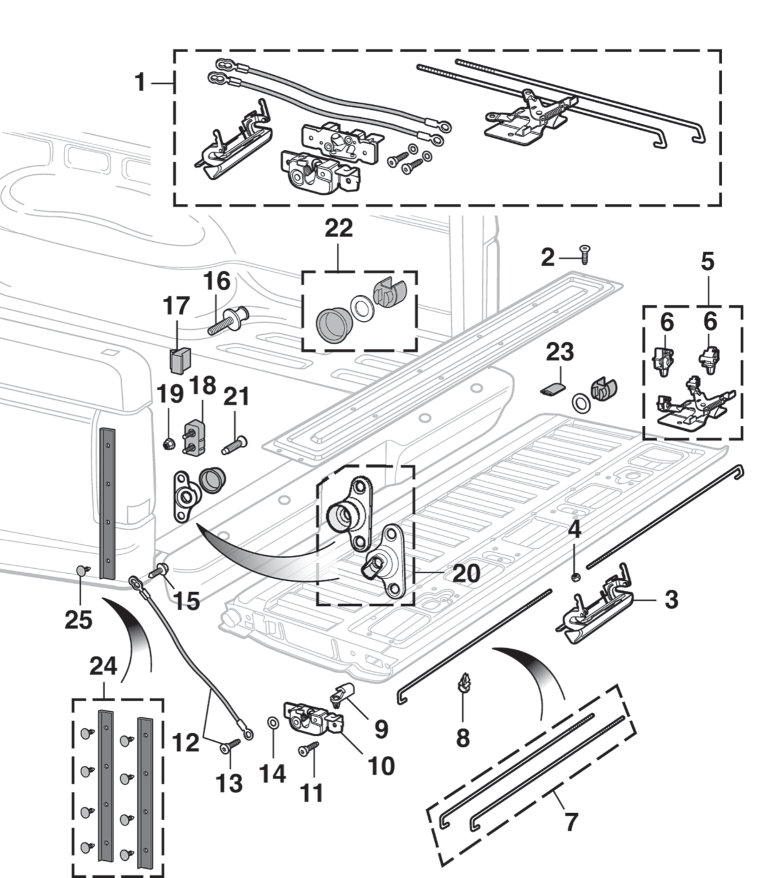
Striker bolts are the primary adjustment point for tailgate alignment on all F-150 models. These bolts, mounted on the truck bed, guide the tailgate latches into place and control how deeply the tailgate seats.
Fix Gaps or Excessive Closing Force
If your tailgate doesn’t sit flush or slams shut too hard, the striker bolts are likely misaligned.
- Locate the striker bolts on both sides of the truck bed, just above the frame rails.
- Loosen the mounting bolts using a 10mm or 13mm socket wrench. Do not remove them fully.
- Reposition each striker:
* For a gap: Move the striker outward, away from bed center, to pull the tailgate tighter.
* For hard closure or loud noise: Shift the striker inward to reduce latch tension. - Retighten bolts once alignment feels correct.
- Test the tailgate by closing and opening it 5 to 10 times.
Pro Tip: Adjust one side at a time. A 1/8-turn adjustment can make a noticeable difference.
Why Striker Position Matters
Striker position controls latch depth and pressure. Moving the striker outward creates a tighter seal. Moving it inward makes closure easier. This adjustment doesn’t affect tailgate height, only how it engages with the bed.
User Report: A 2023 F-150 Lightning owner reduced loud release noise but created a 1/4-inch gap by moving strikers too far inward. Fine-tuning restored balance.
Disable Power-Assist for Manual Testing
On 2015 through 2024 models, the auto-close feature can mask alignment issues by forcing the tailgate shut, leading to wear and false confidence.
Enter Manual Mode via Touchscreen
- Tap the center infotainment screen.
- Go to Vehicle Settings, then Doors, then Tailgate.
- Select Manual Mode to disable auto-lowering and closing.
Result: You must now close the tailgate by hand, allowing you to feel resistance, detect gaps, or identify misalignment.
Best Practice: Always disable power assist before diagnosing or adjusting. The system can override minor misalignments, hiding the root problem.
Perform the Lipstick Contact Test
Visual inspection isn’t enough. Use a transfer method to confirm if the tailgate actually touches the bed bumpers.
Check Bumper Contact With Lipstick
- Apply lipstick, grease pencil, or tape to the rubber bumper stops on the bed frame, driver and passenger sides.
- Close the tailgate normally. Use manual mode if equipped.
- Reopen and check for mark transfer on the tailgate.
- No mark means the tailgate isn’t making contact. Adjust strikers and repeat.
Purpose: Provides objective evidence of contact. Critical for models with power-assist that may pull closed without full bumper engagement.
Adjust Latch Rods on 1998-2004 Models
Older F-150s rely on mechanical rods to synchronize left and right latches. Slack or binding here causes uneven closure or hard opening.
Access the Interior Panel
- Remove eight fasteners from the plastic tailgate cover.
- Take out two T30 Torx bolts securing the steel backing plate.
- Set both aside carefully.
Realign the Latch Rods
- Use a flat-blade screwdriver to gently lift the retaining tabs holding the rods.
- Pull slight slack in the rods while keeping the latch mechanism still.
- Re-engage rods into tabs, ensuring even tension on both sides.
Caution: The plastic tabs are fragile. Apply even pressure to avoid breakage.
Test and Fine-Tune
- One side won’t latch? Back off the rod slightly on that side.
- Hard to open? Increase slack to reduce latch tension.
Reinstall the steel plate and cover. The entire process takes under 15 minutes with the right tools.
Tune Internal Latch Mechanism on 2009-2014 Models
These models allow direct access to the latch arms inside the tailgate for precise depth control.
Remove the Interior Panel
- Take out all screws, Torx or Phillips.
- Gently pry the panel off, watching for wiring like a reverse camera.
Adjust the Latch Tabs
- Locate two metal tabs with threaded bolts connected to the latch arms.
- Pop the tab upward to release.
- Slide the bolt inward, toward center, to reduce hook extension.
- Snap the tab back down to lock.
Purpose: Reduces how far the latch hooks extend, preventing over-tightening and easing closure.
Reinstall the panel and test the tailgate 5 to 10 times. Most effective after a latch replacement or service.
Fix Misaligned Step Trim on 2021+ Models
Newer F-150s with the integrated tailgate step can develop trim misalignment, causing one side to protrude or gaps to form.
Realign the Trim Step
Only the higher side can be adjusted via a single T25 Torx bolt.
- Use a T25 Torx screwdriver to loosen the bolt on the protruding side.
- Manually push or pull the trim upward into alignment.
- Retighten the bolt firmly.
- Verify both sides are flush, the spring latch engages securely, and no gaps remain.
Result: Restores even pressure and prevents snagging or accidental unlatching.
Clear Bed Liner Interference
Spray-in bed liners are a common but overlooked cause of tailgate issues due to buildup in critical areas.
Trim Excess Liner Material
Use a utility knife or rotary tool to carefully remove overspray from:
- Striker post pockets, where the pin enters
- Rubber bumper stops
- Top inner corners of the tailgate and bed rails
User Fix: One owner resolved a stuck tailgate by trimming liner blocking the striker pocket.
Owner Tip: A 2023 F-150 owner slightly shaved rubber bumpers to reduce pressure but warned against removing too much cushioning.
After trimming, repeat the lipstick test to confirm full contact.
Diagnose Electric Actuator Problems on 2015+ Models
If your tailgate is hard to open, especially in cold weather, the electric latch actuator may be failing.
Check for Slow or Partial Release
- Remove the interior tailgate panel.
- Press the open button and watch the actuator.
- Look for one side releasing but not the other, grinding noises, or delayed movement.
Common Complaints: Users report frustrating performance in winter months. Causes include weak motor, worn gears, or lack of lubrication.
Replace or Service the Actuator
If movement is inconsistent, replace the electric actuator assembly. It may be covered under warranty.
Best Practice: Lubricate moving parts with silicone-based grease in cold climates.
Follow a Symptom-Based Fix Guide
Use this quick-reference table to match your issue with the right fix.
| Symptom | Likely Cause | Solution |
|---|---|---|
| Loud pop when opening | Strikers too far out | Adjust inward; check liner |
| 1/4 to 1/2 inch gap at top | Strikers too far in | Move outward; use lipstick test |
| Won’t latch | Misaligned striker or debris | Clean pocket; realign striker |
| Power-assist slams shut | Strikers too far out | Disable auto-close; reposition |
| Tight but not flush | Bumpers not contacting | Trim liner; adjust striker depth |
| Hard to open in cold | Weak actuator | Inspect; lubricate or replace |
| Step trim protrudes | Misaligned panel | Loosen T25 bolt; reposition |
Best Practices for Long-Term Performance
- Start with striker bolts. They control most alignment issues.
- Disable power-assist during diagnosis to feel real resistance.
- Inspect for bed liner buildup. A frequent hidden culprit.
- Use the lipstick test. It’s the only way to confirm contact.
- Adjust in small increments. 1/8 turn can make a big difference.
- Test repeatedly. Cycle the tailgate 5 to 10 times after each change.
- For 1998-2004 models: Fix rod slack before replacing parts.
- For 2009-2014 models: Access internal latches if external fixes fail.
- For 2021+ models: Align step trim to prevent latching issues.
- For cold-weather owners: Check actuator function and lubricate.
Frequently Asked Questions About Adjusting Ford F-150 Tailgates
How do I know if my tailgate striker needs adjustment?
If your tailgate won’t close smoothly, shows gaps, makes loud popping sounds, or requires excessive force to latch, the striker bolts are likely out of position. The lipstick test confirms whether the tailgate contacts the bed bumpers.
Can I adjust the tailgate height on my F-150?
No user-accessible method exists to adjust F-150 tailgate height. Apparent misalignment usually stems from worn hinges, bed cover interference, or frame issues. Consult a dealer for structural assessment if the tailgate appears uneven.
Why does my power-assist tailgate slam shut?
The power-assist system pulls the tailgate closed forcefully when strikers are positioned too far outward. Disable Manual Mode via the infotainment screen and reposition strikers inward to reduce closing force.
What causes a gap between the tailgate and bed?
Gaps typically result from striker bolts positioned too far inward, preventing full engagement. Move strikers outward and perform the lipstick test to verify contact with both bumpers.
How do I fix a tailgate that won’t latch?
Clean striker post pockets of debris, realign striker bolts, and check for bed liner interference. If the issue persists after these adjustments, inspect the latch mechanism or actuator for damage.
Is the lipstick test accurate for diagnosing tailgate gaps?
Yes. Applying lipstick or grease pencil to the bumper stops and checking for transfer marks provides objective proof of contact. It’s the most reliable way to confirm the tailgate is fully seated.
Key Takeaways for Adjusting Your Ford F-150 Tailgate
Adjusting the tailgate on your Ford F-150 doesn’t require a dealership visit in most cases. Whether you’re working with a mechanical latch from 1998 or a smart power-assist system on a 2024 Lightning, the principles remain the same: align the strikers, eliminate interference, and verify contact.
Start with striker bolt adjustment, disable power-assist for accurate testing, and use the lipstick test to confirm full closure. Small incremental changes yield significant improvements. Most F-150 tailgate issues resolve in under 30 minutes with basic tools and a systematic approach.


