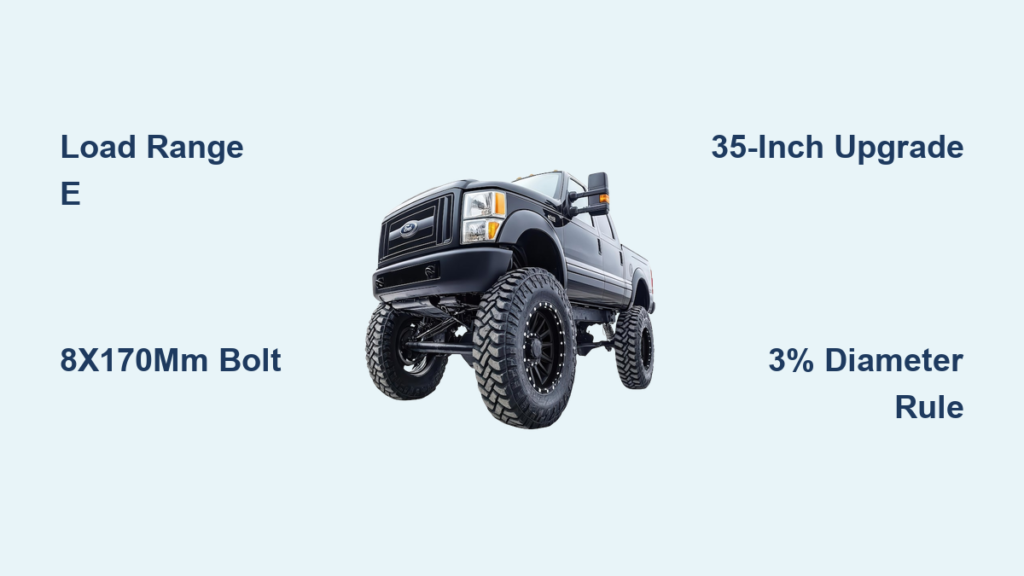
Choosing the wrong f250 tire size can hurt towing stability, throw off your speedometer, or even damage your wheel bearings. The F-250 Super Duty carries GVWRs near 10,000 lbs, which means tire selection is about far more than appearance. Every size, load range, and bolt pattern detail matters when your truck works for a living.
From 2017 onward, Ford standardized wheel sizes by trim: 17-inch on XL and XLT, 18-inch on Lariat and King Ranch, and 20-inch on Platinum and Limited. All F-250s since 1999 share an 8x170mm bolt pattern, but backspacing and load requirements vary. Most models ship with Load Range E (10-ply) tires. This guide breaks down factory sizes by generation, explains upgrade paths, and shows you how to safely fit 35-inch tires.
Factory Tire Sizes by Generation
Ford has refined its tire fitments across five generations, but core standards like the 8x170mm bolt pattern have stayed constant. Knowing your model year narrows down compatible sizes quickly.
1997–1999: Pre-Super Duty Models
These early trucks used lighter-duty setups but still required LT-rated tires for payload integrity.
- 16-inch wheels: LT245/75R16 (30.5”) or 255/70R16
- 17-inch wheels: LT245/70R17 (30.5”) or 265/65R17 (30.6”)
Even early models required the LT (Light Truck) designation for proper load capacity.
1999–2007: First Generation Super Duty
This generation expanded wheel options up to 20 inches and cemented LT tire use across trims.
- 16”: LT235/85R16 (31.7”), LT265/75R16 (31.6”)
- 17”: LT245/75R17 (31.5”), LT265/70R17 (31.6”)
- 18”: LT275/65R18 (32.1”), LT275/70R18 (33.2”)
- 20”: LT275/65R20 (34.1”)
This era introduced larger flotation sizes for improved off-road capability.
2008–2010: Second Generation Refinements
Fitments remained consistent with minor refinements in OE tire compounds.
- 17”: LT245/75R17, LT265/70R17
- 18”: LT275/65R18, LT275/70R18
- 20”: LT275/65R20
No major changes to bolt pattern or load standards.
2011–2016: Third Generation Stability
Ford maintained previous specs but began offering non-LT variants on select trims.
- 17”: LT245/75R17, LT265/70R17, and 265/70R17 (non-LT)
- 18”: LT275/65R18, LT275/70R18
- 20”: LT275/65R20 and 275/65R20 (non-LT)
Caution: Non-LT tires on heavier trims reduce load safety. Stick with LT if you tow.
2017–2023: Trim-Based Standardization
Ford locked in trim-specific wheel sizes starting this generation.
- XL/XLT: 17-inch standard
- Lariat/King Ranch: 18-inch
- Platinum/Limited: 20-inch
Stock sizes included:
- 17”: LT245/75R17 (31.5”), LT265/70R17 (31.6”)
- 18”: LT275/65R18 (32.1”), LT275/70R18 (33.2”)
- 20”: LT275/65R20 (34.1”)
DRW (Dual Rear Wheel) models typically use 17-inch wheels regardless of trim.
2023–2026: Off-Road Expansion
The latest F-250s now offer larger factory tires through the Tremor Off-Road Package.
- LT285/75R18 = approximately 34.8 inches tall
- Fits Lariat, King Ranch, and Platinum trims with Tremor
This marks Ford’s first factory 35-inch tire option, signaling a shift toward trail-ready configurations.
Trim-Level Fitment Breakdown (2017–2025)
Your F-250’s trim and drivetrain determine the exact tire size it left the factory with.
Base Trims: XL and XLT
These work-focused models prioritize durability over luxury.
- 4×4 models: LT275/70R18 (33.2”) or LT275/65R18 (32.1”)
- 4×2 models: LT275/65R18 standard
- DRW models: LT245/75R17 (31.5”)
OE tires include Goodyear Wrangler All-Terrain Adventure or Continental ContiTrac.
Mid to High Trims: Lariat and King Ranch
Luxury meets utility with 18-inch wheels and all-terrain capability.
- Standard 4×4: LT275/70R18 (33.2”)
- With Tremor Package: LT285/75R18 (34.8”)
- DRW: LT245/75R17 (31.5”)
Tremor-equipped trucks get Goodyear Wrangler DuraTrac, a studdable mud-terrain tire.
Top Trims: Platinum and Limited
These premium models run 20-inch wheels for a refined street presence.
- Standard: LT275/65R20 (34.1”)
- DRW: LT245/75R17 (31.5”)
- Tremor Option: LT285/75R18 (34.8”)
Despite the large wheels, top trims can still be equipped for off-road duty.
Decoding F250 Tire Markings
Understanding what’s on the sidewall is crucial when replacing or upgrading your f250 tire size.
What LT275/70R18 Means
- LT: Light Truck designation, built for heavier loads than P-metric
- 275: Section width in millimeters
- 70: Aspect ratio (sidewall equals 70% of width)
- R: Radial construction
- 18: Wheel diameter in inches
- Load Range E: 10-ply equivalent, rated for 80 PSI
Example: LT275/70R18 supports up to 3,415 lbs per tire at max pressure.
Why Load Range E Is Critical
- Load Range E is standard on most F-250s because it supports GVWRs near 10,000 lbs
- Load Range D tires may fit but lack the sidewall strength for heavy towing
- Dropping to D-range increases heat buildup and risk of blowouts under load
Pro Tip: Never downgrade load range if you tow or haul regularly.
Bolt Pattern and Backspacing Facts
- Bolt Pattern: 8x170mm (consistent since 1999)
- Factory Backspacing: approximately 4.75 inches
- Aftermarket Risk: Wheels with less backspacing (e.g., 3.5”) increase leverage on front bearings, leading to premature failure
Warning: A 2005 wheel may bolt on a 2025 F-250 but could rub or damage suspension due to offset differences.
Upgrading Your F250 Tire Size
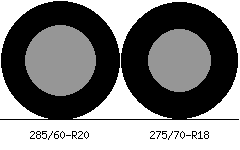
Many owners want a bolder look or better off-road performance, but upgrades require planning.
Plus-One Sizing Strategy
Increase wheel diameter by one inch while adjusting aspect ratio to keep overall diameter close to stock.
Recommended Swaps:
| Stock Size | Upgrade | Diameter Change |
|---|---|---|
| 265/70R17 | 285/65R18 | +0.4% |
| LT275/70R18 | 285/60R20 | -1.9% |
| 275/65R20 | 285/55R22 | -1.2% |
Benefits include a wider stance and improved stability. Drawbacks include a harsher ride and lower sidewall protection.
The 3% Rule
Keep diameter changes under 3% to avoid speedometer errors and ABS issues. Exceeding 3% requires a programmer or dealer recalibration.
Danger Zone: Jumping from 17” to 20” wheels (a “plus-two” move) drastically reduces ride comfort and increases wear.
Fitting 35-Inch Tires on Stock Suspension
35-inch tires (35×12.50R17 or R18) are the most popular off-road upgrade for the F250 tire size.
4×4 Models: 2-Inch Leveling Kit
- Clears front inner fender at full lock
- No trimming needed on most setups
- Maintains approach angle and fender alignment
Best Fit: LT285/75R18 (stock on Tremor models)
4×2 Models: Extra Clearance Needed
- Sits lower in front, so stock 4×2 trucks will rub with 35s
- Requires a 2.5–3 inch leveling kit or minor fender trimming
Tip: Check inner fender clearance at full lock before finalizing the install.
Installing 37-Inch Tires: Full Build Territory

37-inch tires are not plug-and-play. They demand major modifications.
Minimum Requirements
- 4-inch suspension lift
- Aftermarket fender flares or trimmed factory fenders
- Rear bump stop adjustments to prevent tire pinch
- Gear re-gearing (often 4.30:1 or higher recommended)
- Speedometer recalibration
Cost Estimate: $1,500–$3,000 for the lift plus $2,000–$3,500 for tires and wheels.
Rubbing Points to Watch
- Front inner fender at full lock
- Rear frame rail during compression
- Upper control arms on aggressive turns
Pro Tip: Test fit with suspension at full flex before driving off-road.
Tire Types and Performance Trade-Offs
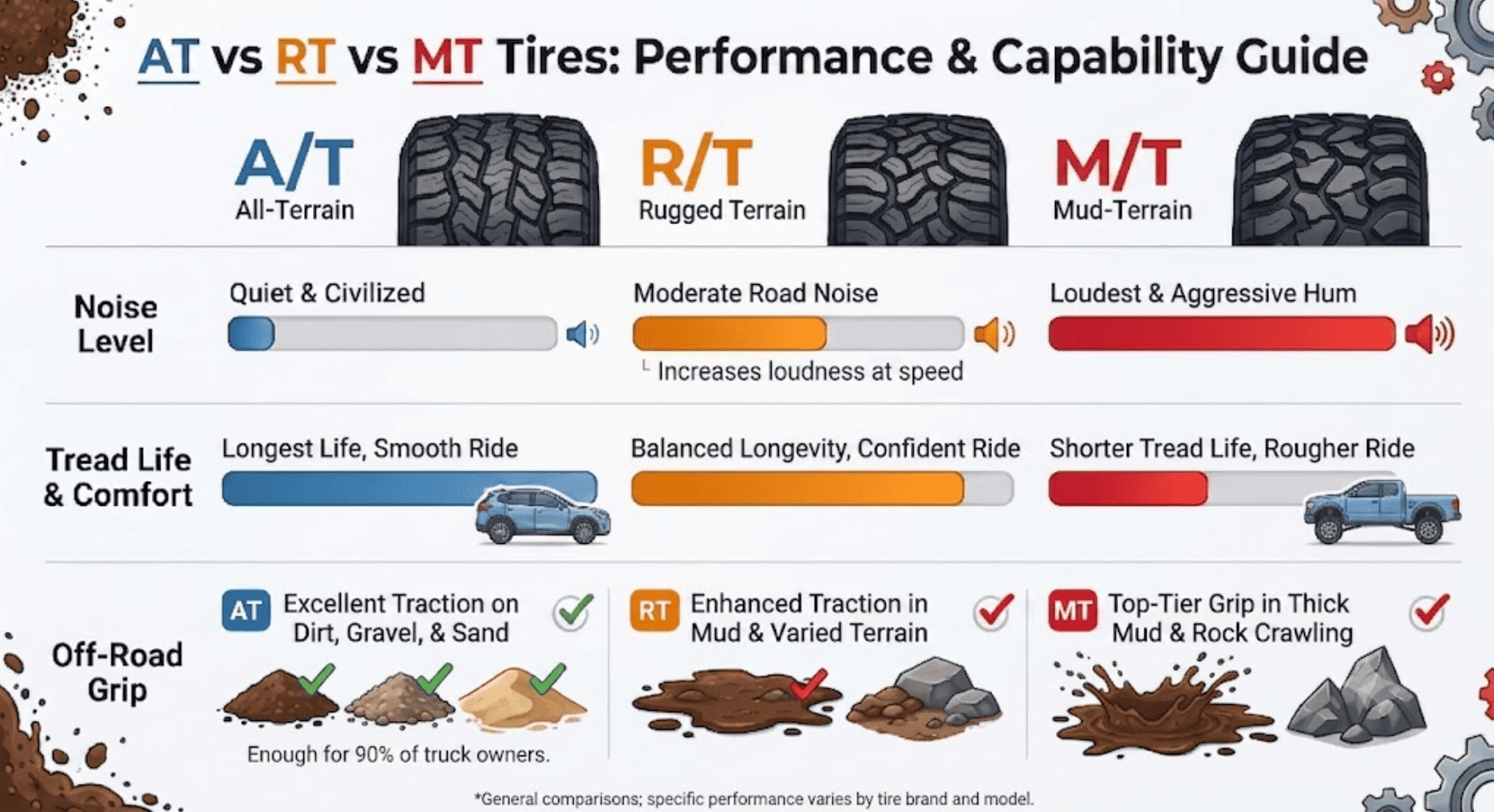
Your driving style should dictate tire type, not just aesthetics.
Highway and Towing Tires
Best for daily drivers who tow heavy trailers.
- Michelin Defender LTX M/S: Quiet, long-lasting, excellent pressure retention
- BFGoodrich Commercial T/A A/S 2: Fleet favorite, built for 5+ years of heavy use
Ideal for towing over 5,000 lbs weekly or long-haul trips.
All-Terrain (A/T) Tires
Balanced performance for mixed conditions.
- Toyo Open Country A/T III: Top-rated for noise, tread life, and off-road grip
- Falken Wildpeak A/T3W: Competitive pricing, but check sidewall stability
Warning: One verified 2022 Lariat owner reported excessive sidewall flex with A/T3W at highway speeds, feeling unsafe despite correct load range.
Mud-Terrain (M/T) Tires
For serious trail use, but expect trade-offs.
- BFGoodrich KM3: Industry standard for traction
- Nitto Trail Grappler: Quieter on pavement than most M/Ts
Downsides include a 1–2 MPG reduction, increased road noise, and faster wear on pavement. Only choose M/T if you spend more than 30% of your time off-road.
Real-World Pricing and Ownership Costs
Replacing F-250 tires is a major investment, so knowing what to expect helps you budget.
Replacement Cost Range
| Tire Type | Price per Tire | Total Set (4) |
|---|---|---|
| Highway (Grabber HTS60) | $245 | $980 |
| All-Terrain (A/T3W) | $245 | $980 |
| Mud-Terrain (KM3) | $350 | $1,400 |
| 35-inch Premium (DuraTrac) | $375 | $1,500+ |
Add $80–$150 for installation, balancing, and disposal.
Trim Impacts Cost
- 20-inch Platinum tires cost more than 17-inch XL options
- DRW setups require 6 tires, significantly raising total cost
Budget Tip: Buy commercial-grade tires since they last longer under load.
Maintenance and Safety Protocols
Proper care extends tire life and prevents dangerous failures.
Tire Pressure Best Practices
- Reference the yellow door-jamb placard, not the tire sidewall
- Front: 60–65 PSI
- Rear: 65–80 PSI (higher when towing)
Critical: Bump rear pressure to 80 PSI when near max payload.
Rotation and Lifespan
- Rotate every 5,000–7,500 miles
- Replace after 5 years regardless of tread depth (rubber degrades)
- Inspect for sidewall cracks, chunking, or heat damage
Fact: UTQG ratings don’t account for heavy loads, so actual life varies.
TPMS and Calibration
- Aftermarket wheels require transferred or replaced TPMS sensors
- A relearn procedure is required after sensor replacement
- Speedometer recalibration is needed if tire diameter changes more than 3%
Tool Suggestion: Use an SCT tuner for easy recalibration.
Special Use Cases and Constraints
Your F-250’s role affects tire choice more than you might think.
Towing and Hauling Needs
- Load Range E is non-negotiable
- Run full pressure (80 PSI) when loaded; do not use passenger-car pressures
- Underinflated LT tires overheat and fail
Myth: “I don’t feel a difference.” Heat buildup is invisible until failure.
Off-Road vs. Highway Trade-Offs
- M/T tires cost 1–2 MPG
- A/T tires like the Toyo A/T III offer the best balance
- Noise levels vary widely, so listen to real-world reviews
Pro Tip: For weekend warriors, A/T is smarter than M/T.
4×2 vs. 4×4 Clearance
- 4×2 models sit lower
- The same tire that fits a 4×4 may rub on a 4×2
- Always verify fitment by model type
Note: DRW models often use smaller wheels to accommodate dual tires.
Interior Protection Tips
- Off-road tires track gravel, mud, and sand into the cabin
- Leather bolsters (Lariat+) crack faster from boot abrasion
- Solution: Install custom-fit seat covers and heavy-duty floor mats
Preserve resale value by minimizing interior wear.
Frequently Asked Questions About F250 Tire Size
What is the stock f250 tire size for a 2020 XLT 4×4?
The stock f250 tire size for a 2020 XLT 4×4 is LT275/70R18 (33.2 inches tall) with Load Range E rating. Some configurations use LT275/65R18 as an alternative fitment.
Can I put 35-inch tires on my F-250 without a lift?
On most 4×4 models, 35-inch tires will rub the front inner fender at full lock without a leveling kit. A 2-inch leveling kit is the minimum recommendation for 4×4 trucks. 4×2 models require additional clearance or trimming.
What bolt pattern does an F-250 use?
All Ford F-250 Super Duty trucks from 1999 to present use an 8x170mm bolt pattern. This consistency allows wheel compatibility across generations, though backspacing requirements may vary.
What is the difference between Load Range D and Load Range E?
Load Range E is a 10-ply equivalent rated for 80 PSI, while Load Range D is an 8-ply equivalent with lower pressure capacity. Load Range E is required for F-250s used for heavy towing or hauling near GVWR limits.
How much does it cost to replace all four tires on an F-250?
A full set of four replacement tires typically costs between $900 and $1,800, depending on tire type. Highway tires sit at the lower end, while mud-terrain and 35-inch premium tires reach the higher end. Installation adds $80–$150.
Will bigger tires affect my speedometer?
Yes. Changing tire diameter by more than 3% will cause speedometer errors and may affect ABS and traction control systems. An SCT tuner or dealer recalibration can correct these issues.
Key Takeaways for Choosing the Right F250 Tire Size
Stick with Load Range E for any truck used for towing or hauling. Match your f250 tire size to your trim level and drivetrain, and never exceed a 3% diameter change without recalibrating your speedometer. For 35-inch tire upgrades, plan on a 2-inch leveling kit for 4×4 models and additional clearance work for 4×2 trucks.
Your next step: check your door-jamb placard for exact pressure specs, measure your current tire diameter, and decide whether your driving needs call for highway, all-terrain, or mud-terrain performance. The right tires keep your F-250 safe, stable, and ready for whatever you throw at it.