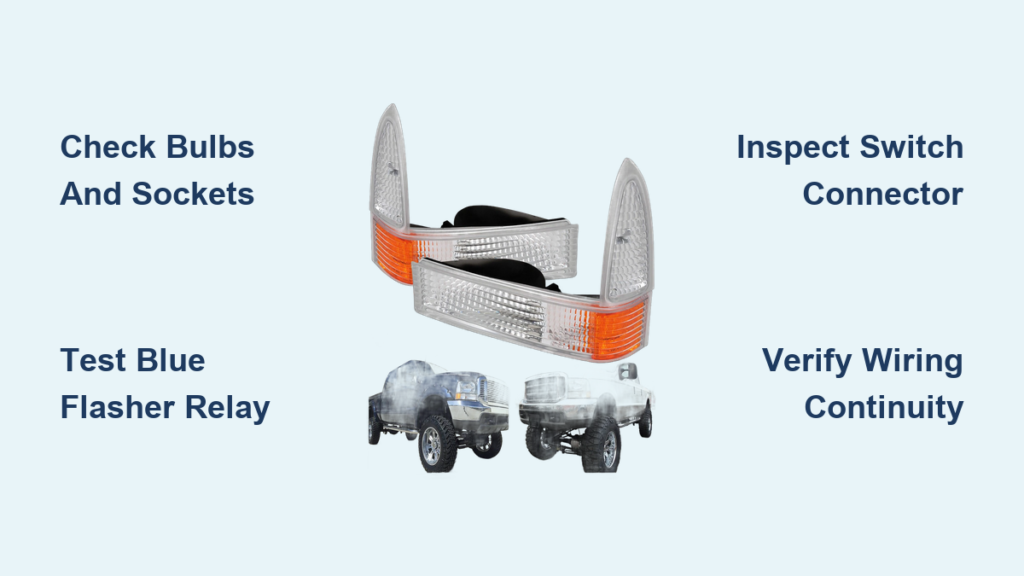
Your 1999 Ford F250 hazards flash perfectly, but the turn signals either stay dark or blink at half-speed. This frustrating mismatch is a well-documented issue on this model year and almost always points to a specific circuit failure rather than a complete electrical breakdown. The root cause typically lives in one of three places: the blue flasher relay, the multifunction switch connector, or the wiring between them. Because the hazard function shares bulbs and grounds with the turn signals, a working hazard system confirms your power supply is intact.
This guide walks you through a proven diagnostic sequence based on real failure patterns. You will learn how to isolate the fault efficiently and apply the correct fix without wasting money on parts that will not solve the problem.
Check Bulbs and Sockets First
Start with the simplest checks before moving to relays and switches. A single bad bulb or corroded socket can mimic larger electrical faults.
Inspect All Turn Signal Bulbs
Remove and examine every turn signal bulb on the truck. Look for a broken filament, blackening inside the glass, or bent base pins. Even a bulb that looks intact can be faulty. Test it with a multimeter or swap it with a known-good bulb from another socket.
The 1999 F250 uses standard 1157 dual-filament bulbs. Installing incorrect bulb types, especially LEDs without load resistors, can disrupt the thermal flasher timing and cause half-speed flashing or total failure.
Clean Corroded Sockets
Moisture intrusion is common in older trucks and creates resistance in the circuit. Spray electrical contact cleaner into each socket and scrub the contacts gently with a small brush. Reinstall the bulb and wiggle it slightly. If the signal flickers, the socket or bulb is loose and needs attention.
Test the Blue Flasher Relay

The flasher relay is the most common failure point for turn signal problems on the 1999 F250. This model uses a specific blue relay that controls hazards and turn signals through separate internal circuits.
Locate the Flasher Relay
Find the relay under the dashboard on the driver side, near the steering column. Check your owner manual or the fuse box cover for the exact location. It is typically labeled “Hazard” or “Turn.” The correct unit is a blue plug-in relay, not a standard black cube relay.
Swap and Observe Behavior
Relay diagnosis works best by substitution. Match the symptom to the likely cause:
- Hazards work, turn signals dead: This usually means the turn-signal side of the new relay is defective. Aftermarket blue relays often fail this circuit despite passing the hazard test.
- Both functions flash at half-speed: This points to an aged or degraded relay. The thermal timing element is wearing out, even if the relay was previously damaged or exposed to moisture.
Try reinstalling your old relay. If it restores half-speed flashing, the circuit is intact but needs a proper replacement. Avoid generic parts. Use an OEM-specified relay such as Standard Motor Products part FL8 or Ford OEM part F5TZ-13B352-A.
Confirm Relay Power and Ground
Use a test light to verify a constant 12V supply at the relay socket with the key off, and a solid ground with the key on. If your hazards work, power and ground are already confirmed. Skip this step unless both functions fail.
Inspect the Multifunction Switch Connector

The turn signal switch on the steering column is another known failure point, especially on trucks equipped with tilt steering. Constant column movement can loosen the electrical connector over time.
Access the Steering Column Harness
Remove the lower steering column cover by taking out two or three Phillips screws. Locate the large electrical connector plugged into the multifunction switch, usually near the ignition lock cylinder.
Check for Loose Connection
Grip the connector and gently tug. If it moves easily, it is likely loose. Disconnect it and reconnect firmly until you hear a click. Many owners report instant restoration of turn signals after this simple reseat.
Clean Internal Switch Contacts
The turn signal circuit passes through the four-way hazard switch inside the multifunction unit. Oxidation here can block turn signal current while allowing hazards to work normally. Cycle the hazard switch up and down 10 to 15 times to wipe the internal contacts. If signals start working afterward, plan to clean or replace the switch soon, as the failure will return.
Verify Wiring Continuity
If bulbs, relay, and switch connections all check out, test the signal wires running between the switch and flasher relay.
Identify Key Wire Colors
Two wires carry the turn signal command from the multifunction switch to the flasher relay:
- Blue wire: Carries the left turn signal
- White/Red wire: Carries the right turn signal
Test for Continuity
With the key off, set your multimeter to continuity mode. Probe one end at the multifunction switch connector on the Blue and White/Red pins. Probe the other end at the flasher relay socket. Activate the left or right turn signal lever. You should hear a beep indicating continuity.
No beep means there is a break in the harness, often near the steering column where flexing occurs. Repair any break with solder and heat-shrink tubing rather than electrical tape.
Check for Voltage Drop
With the key on and the turn signal engaged, measure voltage at the flasher relay input on the Blue or White/Red terminal. A reading within 0.5V of battery voltage (around 12.6V) is correct. Low voltage indicates high resistance in the switch or wiring, meaning the multifunction switch needs cleaning or replacement.
Replace with OEM-Spec Relay

Aftermarket blue flasher relays are notorious for failing turn signal function while allowing hazards to work. This pattern points to a parts quality issue, not a defect in your truck.
Why OEM Matters
The original Ford-spec relay has precise internal resistance and timing calibration. Generic relays may power the hazard side correctly but lack the proper thermal response for turn signals due to minor internal circuit differences. Buy a genuine Ford relay or a high-quality OEM-equivalent. Look for Standard Motor Products FL8 or Ford OEM part F5TZ-13B352-A. Install and test immediately. If turn signals still fail, double-check the multifunction switch connector.
Prevent Future Failures
Turn signal issues on the 1999 F250 often repeat due to design vulnerabilities. A few preventive steps can save you from future headaches.
Secure the Switch Connector
For tilt-steering models, apply dielectric grease to the multifunction switch connector pins. Use a zip-tie to anchor the connector to the column or harness, preventing vibration and movement. This simple fix addresses most intermittent failures.
Maintain Switch Contacts
Cycle the hazard switch once a month to keep internal contacts clean. It takes 10 seconds and prevents oxidation buildup.
Avoid LED Bulb Swaps Without Resistors
LEDs draw less current than incandescent bulbs. A thermal flasher relies on current draw to cycle properly. Low load results in slow or no flashing. If you upgrade to LEDs, install load resistors or use a hybrid flasher relay designed for LED compatibility.
When to Replace the Multifunction Switch
If all other tests pass but turn signals remain dead, the multifunction switch itself is likely faulty.
Signs of Internal Failure
Watch for these indicators:
- No continuity on Blue or White/Red wires
- Voltage present at switch input but not output
- Hazard cycling no longer restores function
- Worn lever feel or inconsistent activation
Replacement Steps
- Disconnect the battery negative terminal.
- Remove the steering wheel using a proper puller.
- Remove the airbag with caution if equipped.
- Unplug the switch and remove mounting screws.
- Install the new switch and reassemble.
Use a Motorcraft or OEM unit, as aftermarket switches often have poor internal contact quality. Expect to pay between $120 and $200 for the part.
Frequently Asked Questions About 1999 Ford F250 Turn Signal Problems
Why do my hazards work but turn signals do not on my 1999 F250?
This symptom indicates that power, ground, and bulbs are functional, but the specific circuit dedicated to turn signals has failed. The most common causes are a defective blue flasher relay, a loose multifunction switch connector, or oxidized contacts inside the hazard switch portion of the multifunction assembly.
What is the blue flasher relay and where is it located?
The blue flasher relay is the component that controls the flashing rate for both hazards and turn signals. It is located under the dashboard on the driver side, near the steering column. It is a blue-colored plug-in relay, distinct from the standard black cube relays used elsewhere in the truck.
Can a bad bulb cause turn signals to flash at half-speed?
Yes. Incorrect bulb types, LED bulbs without load resistors, or corroded socket connections can all change the circuit resistance. A thermal flasher relay depends on proper current draw to cycle at the correct speed. Low load or high resistance results in slow or half-speed flashing.
How do I know if my multifunction switch is bad?
Signs of a failing multifunction switch include no continuity on the Blue or White/Red wires, voltage present at the switch input but not at the output, and a worn or inconsistent turn signal lever feel. Cycling the hazard switch 10 to 15 times may temporarily restore function if the contacts are oxidized, but this is not a permanent fix.
Should I buy an OEM or aftermarket flasher relay?
OEM is strongly recommended. Aftermarket blue relays frequently fail the turn signal circuit while allowing hazards to work normally. This pattern suggests quality control issues in generic parts. Use Ford OEM part F5TZ-13B352-A or Standard Motor Products FL8 for reliable operation.
How much does it cost to replace the multifunction switch?
Expect to pay between $120 and $200 for an OEM or Motorcraft multifunction switch. Installation requires removing the steering wheel and airbag, which adds labor time if you choose to have a shop handle the job.
Key Takeaways for Fixing Your 1999 Ford F250 Turn Signals
The 1999 Ford F250 turn signal issue follows a predictable pattern: hazards work, turn signals do not, and the blue flasher relay or multifunction switch connector is usually to blame. Start your diagnosis with the bulbs and sockets, then move to the relay, the switch connector, and finally the wiring. Prioritize OEM-spec parts, especially for the flasher relay, and take preventive steps like dielectric grease and connector securing to avoid recurrence. With the right approach, your turn signals will work reliably for years to come.