

Your Ford F-350 diesel refuses to start with only a rapid clicking sound or dim lights. This common issue often stems from the unique dual-battery system failing to deliver the massive cranking power needed for cold weather starts.
This guide explains exactly how to jump start F350 diesel engines using either a portable jump box or a donor vehicle. You will learn the safe connection order, critical troubleshooting steps, and how to avoid damaging your truck electronics.
Why Your F350 Dual-Battery System Fails
The Ford F-350 diesel utilizes two 12-volt batteries wired in parallel to double the available amperage. This setup provides the high Cold Cranking Amps (CCA) required to turn over large displacement engines. However, a single weak battery can drag down the entire system voltage.
Signs of a Compromised Battery Pair
You may experience intermittent starting success or complete electrical failure. Look for these specific symptoms before attempting a jump:
* Rapid clicking sounds without engine turnover
* Slow or labored cranking speed
* Visible sparks when connecting cables
* Dashboard lights dimming significantly during start attempts
Expert Note: Even if one battery reads 12 volts at rest, it may collapse under the heavy load of a diesel starter motor. Always test both units individually if possible.
Cold Weather Impact on Diesel Starting
Freezing temperatures drastically reduce battery efficiency and increase engine resistance. Your F-350 batteries can lose up to 50% of their capacity when the mercury drops below freezing.
What Happens Below Freezing?
Thickened engine oil creates significant mechanical resistance while fuel gelling reduces combustion efficiency. Simultaneously, chemical reactions inside the battery slow down, decreasing total output.
- Engine oil viscosity increases resistance
- Battery chemical output drops sharply
- Fuel may gel slightly in extreme cold
Solution: Use heavy-duty jumper cables rated 4 AWG or lower to ensure maximum current delivery. A high-amperage portable jump starter is often more effective than a standard car battery in these conditions.
Essential Safety Steps Before Connecting Cables
Jump starting a Super Duty truck involves high currents that can cause sparks or electrical damage if handled incorrectly. Proper preparation minimizes risks to you and your vehicle electronics.
Critical Safety Rules
- Wear eye protection to guard against potential battery acid venting.
- Turn off all accessories including lights, radio, and heater fans.
- Inspect for damage such as swollen cases or frayed cables.
- Remove loose jewelry that could catch on moving engine parts.
Danger Zone: If you see sparks during connection, you likely have poor grounding or reversed polarity. Disconnect immediately and re-evaluate your setup.
Required Tools for F350 Jump Start
Not all equipment can handle the high demands of a diesel F-350. You must use tools rated for heavy-duty applications to ensure success.
Option 1: Portable Jump Box (Recommended)
The Noco Boost Pro GB150 is an ideal choice for these trucks. It delivers over 4,000 amps and includes built-in diagnostics to check battery health before starting. This method eliminates donor vehicle risks and costs approximately $300.
Option 2: Jumper Cables and Donor Vehicle
If using another vehicle, ensure your cables are thick gauge (2 AWG or 1 AWG). Thin cables will overheat and fail to transfer enough power. Your donor vehicle should preferably be another large truck or diesel with a strong, healthy battery.
Avoid: Dollar-store cables with thin wiring. They cannot deliver the necessary amperage and may melt during the process.
Method 1: Jump Start with Noco GB150
Using a portable lithium jump starter offers the safest and most reliable way to revive your F-350 diesel. This method provides consistent voltage without relying on another vehicle.
Connect to First Battery
- Ensure the Noco unit is switched OFF before connecting.
- Attach the red clamp to the positive (+) terminal of Battery 1.
- Attach the black clamp to the negative (-) terminal of Battery 1.
- Turn ON the jump box and check the display for a voltage reading.
✅ Good Sign: The display shows 12V or higher, indicating the battery holds a charge.
Connect to Second Battery
- Leave the Noco clamps on Battery 1.
- Use a second set of cables or test manually by touching red to positive (+) and black to negative (-) of Battery 2.
- Verify the voltage reads ≥12V on the second unit as well.
❌ Problem: If Battery 2 reads low, the interconnect cable between batteries may be faulty.
Start the Engine and Disconnect
Turn the key to start and hold for no more than 5 seconds. Let the engine run for at least 5 minutes to begin recharging the system. Turn off the Noco unit and remove the black clamp first, followed by the red clamp.
Method 2: Jump Start with Jumper Cables
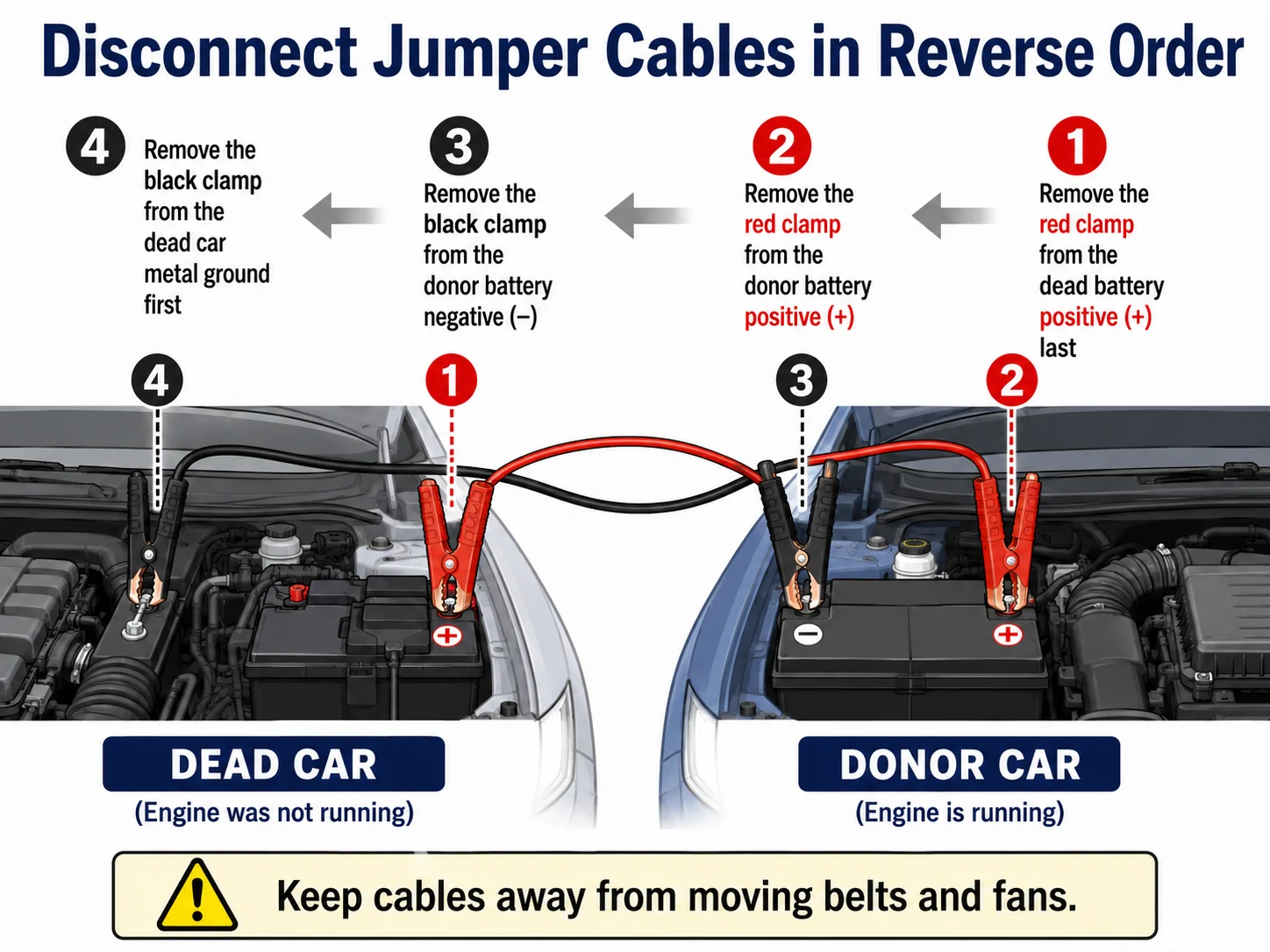
When a portable unit is unavailable, a donor vehicle can save the day if you follow the correct connection sequence. Precision is vital to prevent electrical arcs.
Correct Cable Connection Order
Follow this sequence exactly to avoid sparks and potential damage to sensitive electronics.
Step 1: Dead Battery Positive
Clip the red cable to the positive (+) terminal on the F-350 dead battery. Ensure the clamp has a solid metal-to-metal connection.
Step 2: Dead Battery Negative
Clip the black cable to the negative (-) terminal on the F-350 battery. Some guides suggest chassis grounding, but terminal connection is often required first in dual systems.
Step 3: Donor Battery Positive
Clip the other end of the red cable to the positive (+) terminal on the donor vehicle battery. Ensure this connection is secure before proceeding.
Step 4: Donor Ground Point
Clip the other end of the black cable to an unpainted metal surface on the donor engine, such as an alternator bracket. Do NOT connect this directly to the donor battery negative terminal to prevent sparks near hydrogen gas.
Start the Donor Vehicle and F350
Proper charging time before attempting a start increases your success rate significantly. Rushing this step often leads to failure.
- Start the donor truck and let it idle for 3–5 minutes.
- Rev the donor engine slightly to 1,500 RPM to boost alternator output.
- Attempt to start the F-350 diesel engine.
✅ Success: Let the F-350 run for 10+ minutes to allow the alternator to charge both batteries.
❌ Failure: If the engine does not crank, recheck all connections for cleanliness and tightness. Corroded terminals can block necessary current flow.
Safe Disconnection Sequence
Removing cables in the wrong order can cause dangerous electrical arcs or fry vehicle computers. Always reverse the connection order precisely.
Reverse the Connection Order
- Remove the black cable from the donor vehicle ground point first.
- Remove the red cable from the donor battery positive terminal.
- Remove the black cable from the F-350 battery negative terminal.
- Remove the red cable from the F-350 battery positive terminal.
Critical: Always remove donor-side cables first to break the circuit safely away from the disabled vehicle.
Why Your F350 Still Won’t Start

Even with proper jump-starting techniques, underlying issues may prevent ignition. Identifying these problems saves time and frustration.
Weak or Failed Batteries
A battery may show 12.6V but fail under load. Visit an auto parts store for a free load test on both batteries to confirm their health.
Bad Starter Motor
Listen for a loud single click or grinding noise without turnover. Tapping the starter gently with a wrench can sometimes free a stuck solenoid temporarily.
Failing Alternator
If the battery dies again shortly after driving, the alternator is likely not charging. Use a multimeter to verify voltage reads 13.8–14.7V while the engine runs.
Poor Ground Connections
Sparks or dim lights often indicate bad grounding. Clean ground straps connecting the battery to the chassis and engine block to ensure proper flow.
Common Mistakes to Avoid
Even experienced drivers make errors when dealing with heavy-duty diesel systems. Avoid these pitfalls to ensure a successful jump start.
1. Using Thin Jumper Cables
Thin cables cannot deliver the required amps, causing voltage drops and overheating. Always use heavy-gauge cables designed for trucks.
2. Connecting Negative to Donor Battery Terminal
Creating a spark near the battery poses an explosion risk due to hydrogen gas. Always ground to metal away from the battery.
3. Skipping Terminal Cleaning
Corrosion blocks current flow effectively. Use a wire brush to clean terminals until shiny metal is visible before connecting cables.
4. Not Testing Both Batteries
One dead battery can ruin the whole system performance. Always check each battery separately to identify the weak link.
Post-Jump Maintenance Tips
After a successful start, take proactive steps to prevent another breakdown. Proper maintenance extends battery life and reliability.
Drive for at Least 20 Minutes
Short trips do not fully recharge deep-cycle diesel batteries. Allow the alternator to replenish the charge over an extended drive.
Use a Battery Charger
If the truck sits idle, use a smart charger like the NOCO Genius5. This prevents sulfation and extends overall battery life significantly.
Replace Old Batteries
Consider replacement if batteries are over 3–5 years old. Use Group 65 or 66 AGM dual batteries rated for diesel engines with 900+ CCA each.
Prevent Future No-Starts
Proactive care avoids being stranded in inconvenient locations. Regular maintenance keeps your electrical system in top condition.
Monthly Terminal Inspection
Check for white or blue corrosion buildup monthly. Clean with a baking soda mixture and apply dielectric grease to prevent future oxidation.
Turn Off Accessories
Parasitic drains from CB radios, inverters, or dash cams can kill batteries overnight. Ensure all systems power down completely when the ignition is off.
Install a Battery Isolator
For trucks with auxiliary loads like winches or fridges, use an isolator. This protects your starting batteries from being drained by accessories.
Frequently Asked Questions About Jump Starting F350 Diesel
Can I jump start my F350 diesel with a regular car?
Yes, but the car must have a healthy battery and you must use heavy-duty cables. The car engine should run at high idle for several minutes before attempting to start the diesel.
Why does my F350 click but not start after jumping?
This usually indicates a bad starter motor, severely corroded cables, or batteries that cannot hold a load despite showing voltage. Check ground connections and test the starter.
Do both batteries need to be replaced in an F350?
It is highly recommended to replace both batteries at the same time. A new battery paired with an old one will cause the old unit to drag down the new one, leading to premature failure.
How long should I let the donor vehicle run before starting?
Allow the donor vehicle to run for 3 to 5 minutes with cables connected. This transfers enough surface charge to the dead batteries to attempt a start safely.
What gauge jumper cables do I need for a diesel F350?
You need heavy-duty cables rated 2 AWG or 1 AWG. Thinner cables cannot handle the high amperage required by diesel engines and may overheat or melt.
Key Takeaways for How to Jump Start F350 Diesel
Successfully jump starting your F-350 diesel requires understanding the dual-battery parallel system and using the right tools. Always prioritize safety by wearing eye protection, turning off accessories, and following the precise connection order to prevent electrical damage.
Regular maintenance including terminal cleaning and battery replacement every 3 to 5 years prevents most no-start scenarios. If jump starting becomes frequent, perform a full load test on both batteries and check your alternator output immediately.


