
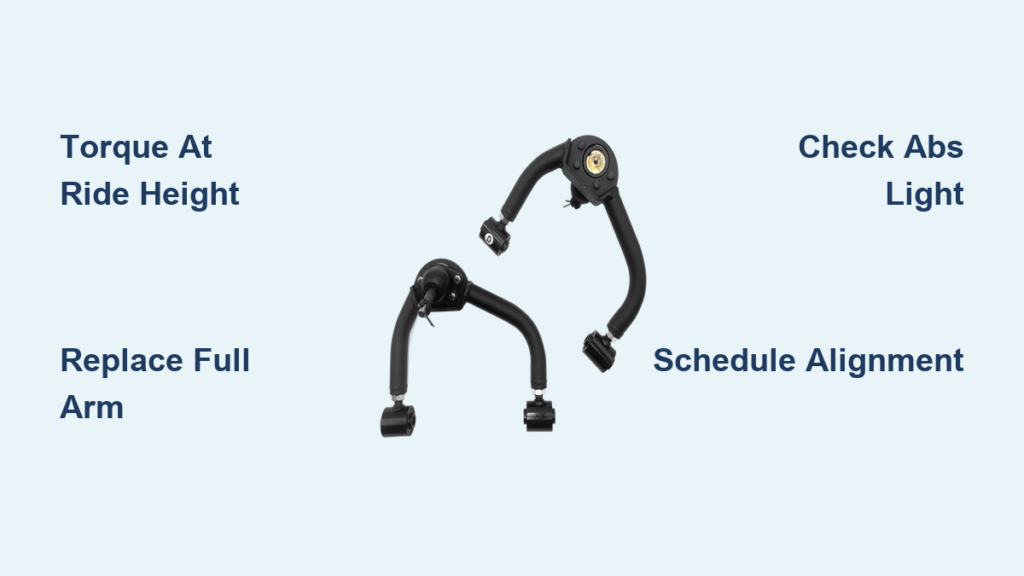
If your Ford F-150 is clunking over bumps, pulling to one side, or showing uneven tire wear, a failing upper control arm could be the culprit. Replacing it restores steering precision, ride quality, and safety, especially critical since the factory upper ball joint is non-serviceable and requires full arm replacement when worn. This guide walks you through every step of changing the upper control arm on 2004–2020 F-150 models, including torque specs, model-specific tips, and post-installation must-dos.
Diagnose Control Arm Failure Before Replacement
Recognize Common Symptoms
A worn upper control arm affects handling and tire life. Watch for these key signs:
- Clunking noise when hitting bumps or turning
- Steering wander at highway speeds
- Vibration in the steering wheel
- Uneven front tire wear, especially feathering
- Misalignment that will not hold after adjustment
- Visible bushing cracks or fluid leakage from ball joint
Jack up the front end and rock the tire top-to-bottom. Any play indicates ball joint wear, meaning replacement is needed.
Confirm the Problem
Inspect the following areas to verify failure:
- Check bushing condition for splits, bulges, or separation from metal sleeve
- Examine ball joint boot for tears or grease leakage
- Watch for excessive movement when prying between knuckle and control arm
The factory ball joint cannot be serviced once degraded. Replace the entire upper control arm.
Gather Required Tools for the Job
Essential Tool List
Use this checklist to avoid mid-job delays:
- Floor jack and jack stands rated for F-150 weight
- Torque wrench (1/2″ and 3/8″ drive)
- Breaker bar with extension
- Ratchets and swivel sockets
- Hammer (ball-peen or dead-blow)
- Pry bar
- Bungee cords or wire hooks
- Penetrating oil (PB Blaster recommended)
Socket Sizes Needed
| Size | Use |
|---|---|
| 8 mm | ABS bracket, sway bar shaft |
| 10 mm | Brake hose, grease fittings |
| 13 mm | Axle nut (4WD), ABS sensor |
| 15–16 mm | Strut top nuts |
| 18 mm | Sway bar link, lower strut bolt |
| 21 mm | Ball joint nut, control arm bolts, caliper bolts |
| 22 mm | Ball joint castle nut (some models) |
| 27–30 mm | Control arm bolts (older models) |
| 50 mm | Seized strut top nut |
Specialty Items
- Torx bit (T55 or E18) for lower strut bolts
- Clip removal tool for strut tower washers
- Grease gun for lubricating new zerk fittings
- Handheld vacuum pump for 4WD axle engagement
- Crayon or marker for marking cam washers and arm position
Spray all fasteners two days before starting. Rusty bolts are the number one cause of frustration.
Prepare Safely for the Repair
Safety First
Park on level ground, engage parking brake, and chock rear wheels. Never work under a vehicle supported only by a jack. Use jack stands on frame rails. Place removed wheels under the truck as emergency support. Wear safety glasses and gloves.
Pre-Work Steps
- Loosen lug nuts while the truck is on the ground
- Lift the front end using the designated jacking point on frame rail
- Secure with jack stands
- Remove front wheels
- Measure hub-to-fender distance to help restore ride height during reassembly
Marking original cam adjuster positions helps maintain rough alignment and reduces post-repair adjustment time.
Disconnect Critical Components
Remove ABS Wiring
Locate ABS connector near air filter housing on driver side. Pull red locking tab outward, then press secondary tab to release. Use 5 mm Allen key if stuck. Unclip ABS wire from knuckle and set aside.
Do not force the connector. Pry gently. Moisture damage is common. Inspect both ends.
Support the Brake Caliper
Remove 10 mm brake hose bracket bolt. Remove 21 mm caliper mounting bolts, starting with the top one. Hang caliper with bungee cord. Never let it dangle by the brake hose. Remove rotor if needed for better access.
Extra space makes tie rod and ball joint separation easier.
Separate Steering and Suspension Links
Disconnect Outer Tie Rod
Remove cotter pin and 21 mm nut. Leave nut threaded a few turns to cushion separation. Strike the knuckle near the taper with a hammer or use a pickle fork. Inspect tie rod end for wear before reuse.
Freeing the tie rod gives more room to maneuver the knuckle during ball joint removal.
Remove Sway Bar End Link
Remove 18 mm nut from top of link. Hold spinning stud with 8 mm wrench. Use large washer to compress rubber boot without damage. Leave link attached to sway bar. Only disconnect lower end.
Remove Strut Assembly
Why Remove the Strut
On 2009–2014 models, upper control arm bolts interfere with the coil spring. While some report success without removal, the risk of thread damage or bushing bind is high.
Remove the strut. This is especially important for first-time DIYers.
Full Strut Removal Steps
- Support lower control arm with floor jack
- Remove three 15–16 mm top strut nuts using clip tool to remove retaining washers if present
- Loosen 18 mm lower strut bolt
- Loosen sway bar link if still connected
- Pry strut downward with pry bar to clear lower control arm studs
- Carefully remove the strut
On 2015–2020 models, torque upper shock hardware first, then lower mounting bolts to 66 ft-lbs during reassembly.
Separate Ball Joint and Remove Old Arm

Free the Ball Joint
Loosen 21 mm or 22 mm ball joint nut with breaker bar. Do not remove fully. Leave threaded to prevent sudden collapse. Support lower control arm with floor jack. Strike side of knuckle to break taper. Once loose, secure knuckle with bungee cord to protect brake lines and CV axle.
Always support the lower control arm before disconnecting the ball joint.
Remove Control Arm Bolts
The upper arm uses two long through-bolts, typically 21 mm, 27 mm, or 30 mm. Hold one end with wrench while loosening the other. Apply penetrating oil if seized, which is common in bushing liners. Work bolts back and forth if stuck.
Do not lose the metal plates or washers. Reinstall in original orientation.
Install New Upper Control Arm
Prepare the New Arm
Confirm greaseable ball joint (zerk fitting) is present. Apply anti-seize to bushing sleeves and bolt shafts. Add blue thread locker to bolt threads. For lifted trucks (2–4 inches), use performance arms with corrected ball joint angle.
OPR arms ($80–$90) are direct OEM replacements. For lifts, consider DOM steel arms ($200–$300/pair).
Insert and Position
Slide new arm into frame mounting slots. Insert bushings, sleeves, and metal plates correctly. Hand-tighten bolts to prevent cross-threading. Align using crayon marks from old arm if available.
Reassemble Suspension Components
Reconnect Ball Joint
Align ball joint stud with knuckle hole. Install new castle nut. Torque to 85–111 ft-lbs (varies by year). Insert new cotter pin and bend securely.
If nut will not align with cotter pin hole, loosen slightly and reposition.
Reinstall Strut
Position strut into lower control arm. Insert lower bolt and tighten. Reinstall three top bolts. Reseat washers if used. Torque strut top nuts to 66 ft-lbs.
Reconnect Sway Bar and Tie Rod
Reattach sway bar end link. Torque to 26–30 ft-lbs. Reconnect tie rod end, torque to 85–111 ft-lbs, install new cotter pin.
4WD-Specific Reassembly
Reconnect Axle Shaft
Apply 24 inches of vacuum to IWE actuator large port using hand pump. This disengages axle for smooth insertion. Guide axle shaft through IWE and into hub. Lift suspension slightly with floor jack to help seat shaft.
Torque Axle Nut
Use pry bar across lug studs to prevent hub rotation. Torque to 30 ft-lbs (2015–2020) or 35 ft-lbs (OPR Arm spec).
Without disengagement, the axle will not slide in. Forcing it can damage components.
Reconnect Vacuum Hoses and ABS
Reattach vacuum lines to hub actuator. Tug to confirm secure fit. Route ABS wire behind brake line. Secure with 8 mm and 10 mm bolts. Reconnect ABS plug. Ensure locking tab clicks.
If ABS light is on, verify connector seating and wire routing.
Final Torquing at Ride Height
Why Torque at Ride Height
Torquing upper control arm bolts with suspension loaded prevents bushing bind, which causes premature wear and alignment drift.
Torquing Procedure
- Lower vehicle until wheels touch ground but weight is not fully on them
- Use floor jack under lower control arm to lift knuckle until original hub-to-fender distance is restored
- Torque upper control arm bolts to 111 ft-lbs (2009–2014) or 122 ft-lbs (2015–2020 and OPR Arm)
- Fully lower truck
- Re-check all fasteners including ball joint nut, strut bolts, sway bar links, and tie rod end
Some mechanics mark cam adjusters before removal to speed up alignment setup.
Reinstall Wheels and Lower Vehicle
Wheel Reinstallation
Mount wheel and hand-tighten all six 21 mm lug nuts. Lower vehicle completely. Torque lug nuts to 150 ft-lbs in criss-cross (star) pattern. Replace axle nut cap if reusable.
Post-Installation Must-Dos
Immediate Checks
Pump brakes several times to reseat caliper. Take short test drive at low speed. Listen for clunks or squeaks, steering vibration, ABS warning light, and 4WD engagement issues (if applicable).
Schedule Wheel Alignment
Alignment is mandatory. It affects caster, camber, and toe. Without it, you will experience uneven tire wear, steering pull, and poor handling.
For lifted trucks, a camber correction kit may be required to bring settings within spec.
Model-Specific Torque Specs
| Model Year | Control Arm Bolt | Axle Nut (4WD) | Caliper Bolt | Strut Top Nuts |
|---|---|---|---|---|
| 2004–2008 | 80–110 ft-lbs | N/A | N/A | 66 ft-lbs |
| 2009–2014 | 111 ft-lbs | N/A | 136 ft-lbs | 66 ft-lbs |
| 2015–2020 | 122 ft-lbs | 30 ft-lbs | N/A | 66 ft-lbs |
| OPR Arm | 122 ft-lbs | 35 ft-lbs | 184 ft-lbs | 66 ft-lbs |
OPR arms feature greaseable joints and pre-pressed bushings, making them ideal OEM replacements.
Troubleshoot Common Issues
Bolt Will Not Turn
Cause is seized bushing liner or rusted threads. Fix by soaking with penetrating oil, working back and forth, using heat if safe.
ABS Light On
Cause is sensor not seated or wire pinched. Fix by rechecking connector and routing. Ensure locking tab clicks.
Clunking After Repair
Cause is loose control arm bolts or ball joint not fully seated. Fix by re-torqueing all fasteners. Verify taper is fully engaged.
Axle Will Not Seat (4WD)
Cause is IWE not disengaged or hub misaligned. Fix by applying vacuum. Tap shaft gently with rubber mallet.
Uneven Tire Wear
Cause is no post-installation alignment. Fix by scheduling professional alignment immediately.
Frequently Asked Questions About Ford F-150 Upper Control Arm Replacement
How long does it take to replace upper control arm on F-150?
First-time DIYers should plan for 2–4 hours per side. Experienced mechanics can complete the job in about 2 hours. Factor in extra time if rust is present or if penetrating oil was needed beforehand.
Can I replace just the ball joint on Ford F-150 upper control arm?
No. The factory upper ball joint is non-serviceable. When it wears out, you must replace the entire upper control arm assembly. Aftermarket options like OPR arms include greaseable ball joints.
Do I need an alignment after changing upper control arm?
Yes. Alignment is mandatory after upper control arm replacement. Failure to align causes uneven tire wear, steering pull, and poor handling. For lifted trucks, a camber correction kit may also be needed.
What happens if I do not torque control arm bolts at ride height?
Torquing bolts with suspension unloaded causes bushing bind. This leads to premature bushing wear, alignment drift, and reduced handling performance. Always torque at ride height.
Can I do this repair on 2WD and 4WD F-150 models?
Yes. The procedure applies to both 2WD and 4WD models from 2004–2020. 4WD models require additional steps for axle shaft and IWE actuator. This guide does not apply to F-150 Raptor, which uses a different suspension system.
Key Takeaways for Replacing Your F-150 Upper Control Arm
Replacing the upper control arm on your Ford F-150 is a substantial DIY project that demands patience and precision. The factory ball joint is non-serviceable, so the entire arm must be replaced when wear appears. Gather all tools, apply penetrating oil 48 hours in advance, and follow torque specs specific to your model year. Always torque control arm bolts at ride height to prevent bushing bind and alignment issues. Lower vehicle, torque lug nuts to 150 ft-lbs in star pattern, and schedule professional wheel alignment immediately. Taking your time with this repair means safer handling, longer tire life, and confidence in every mile.


