
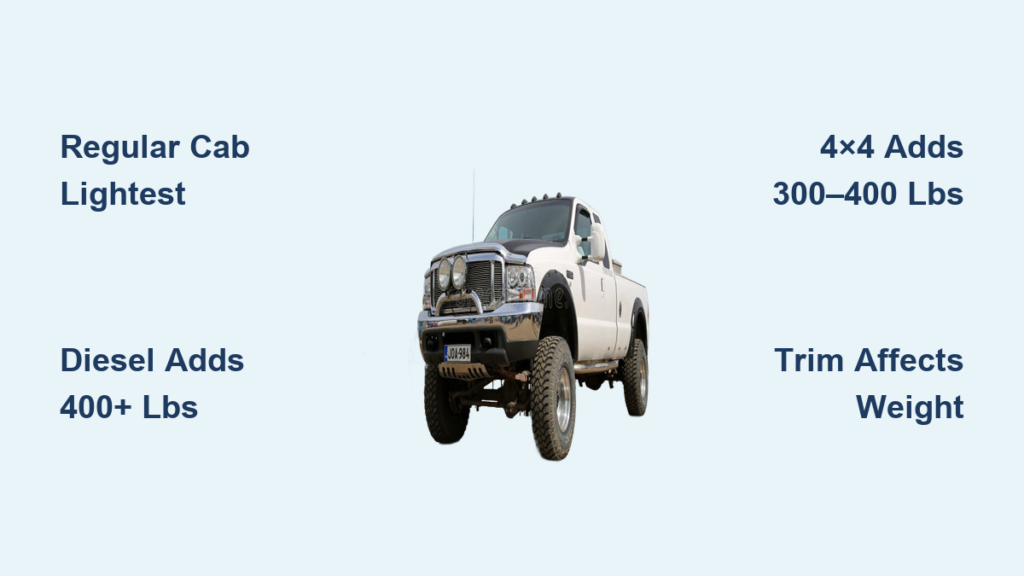
If you’re shopping for a Ford F-250 Super Duty, one of the most critical specs to understand is f250 curb weight. This number isn’t fixed. It varies dramatically based on configuration, ranging from 5,697 pounds in the lightest Regular Cab setup to a massive 8,627 pounds in a fully loaded Crew Cab diesel model. That’s nearly 3,000 pounds of difference between trims, which directly impacts payload, towing, and legal compliance.
Whether you’re hauling equipment, towing heavy trailers, or navigating job site restrictions, knowing your truck’s actual weight is essential. In this guide, we break down every factor that affects the F-250’s curb weight, including cab style, engine type, drivetrain, bed length, and trim level, using the latest 2025 and 2026 model data.
Curb Weight by Cab Style

The cab you choose has a major impact on overall weight. From stripped-down Regular Cab models built for work to luxurious Crew Cabs, each option adds or reduces mass based on structure and seating.
Regular Cab: Lightest for Maximum Payload
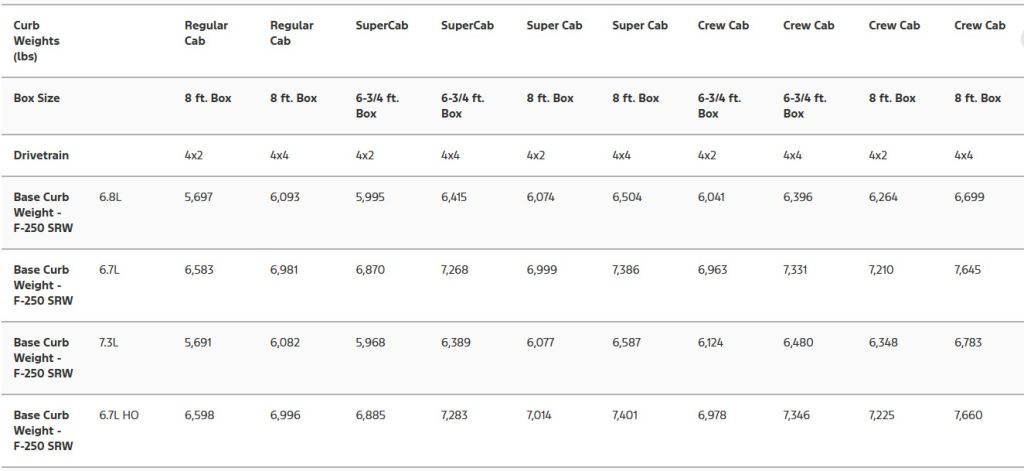
The Regular Cab is the leanest option for contractors and fleet operators who need every pound of payload capacity. Weighing in at 5,697 pounds (4×2, 8-foot bed, 6.8L gas engine), it’s the lightest F-250 available. With only three-passenger seating and no rear doors, this configuration minimizes weight while maximizing strength. It’s exclusively paired with an 8-foot bed, ideal for long materials like lumber or pipe.
Pro Tip: The Regular Cab’s low curb weight helps achieve the highest possible payload of up to 8,000 lbs with the right GVWR package.
Super Cab: Balance of Utility and Space
The Super Cab adds rear-hinged access doors and limited rear legroom, making it suitable for occasional passengers or locking up tools.
Weight figures for the Super Cab include:
– 6.75-foot bed: ~5,995 lbs (4×2, gas)
– 8-foot bed: ~6,104 lbs (4×2, gas)
That’s a 109-pound increase just from choosing the longer bed. While it seats up to six, the rear area is best used for storage. This model strikes a middle ground between capability and comfort, but it’s heavier than some Crew Cab configurations due to bed length.
Crew Cab: Most Popular, But Weight Varies
The Crew Cab is the top choice for families and users needing full four-door access and adult-friendly rear seats. However, weight depends heavily on bed choice.
Crew Cab weight figures include:
– 6.75-foot bed: ~6,041 lbs (4×2, gas)
– 8-foot bed: ~6,264 lbs (4×2, gas)
Surprisingly, the Crew Cab with a short bed is lighter than a Super Cab with an 8-foot bed, despite having a larger cabin. The reason is that bed length adds more weight than the extra doors and frame in the Crew Cab. For optimal weight efficiency with passenger space, the Crew Cab/6.75-ft bed combo is ideal.
Engine Impact on F-250 Weight
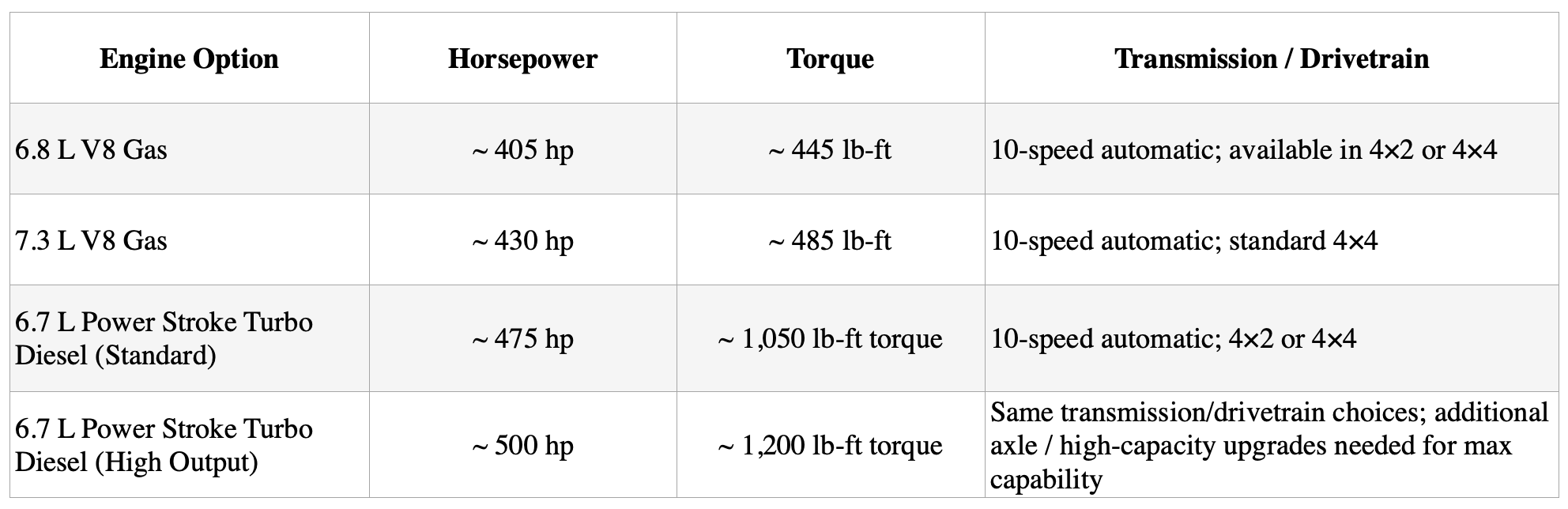
The engine you select is the single biggest factor after cab style affecting curb weight, and it comes with a trade-off: more power means more mass.
6.8L V8 Gas: Lightest Power Option
The base 6.8L V8 gasoline engine delivers 405 hp and 445 lb-ft of torque and serves as the benchmark for low curb weight. It’s standard across most trims and keeps the F-250 as light as possible, which is critical for maximizing legal payload. This engine is perfect for users who don’t tow massive loads but still need reliable power for daily hauling.
7.3L V8 Gas (“Godzilla”): +50–75 lbs
The optional 7.3L “Godzilla” V8 bumps output to 430 hp and 485 lb-ft of torque. While significantly more powerful, it adds only 50 to 75 pounds over the 6.8L. That’s a small penalty for the boost in performance, especially since it remains much lighter than diesel options. Best for users wanting strong towing (up to 19,500 lbs with fifth-wheel) without the diesel weight hit.
6.7L Power Stroke Diesel: +400–500 lbs
The 6.7L Power Stroke diesel brings massive torque at 1,050 lb-ft and enables up to 22,000 lbs of towing, but at a steep weight cost of +400 to 500 pounds over gas models.
The extra mass comes from:
– Reinforced engine block
– Twin turbochargers
– High-pressure fuel system
– Emissions components (DPF, DEF)
This reduces payload capacity significantly. A diesel model might lose 400+ lbs of payload compared to an identical gas truck with the same GVWR.
6.7L HO Power Stroke: Heaviest, Most Powerful
The High Output (HO) diesel cranks out 500 hp and 1,200 lb-ft of torque, enabling the maximum 23,000-pound towing capacity. It adds 425 to 525 pounds over gas engines. When paired with 4×4 and luxury trims, this engine pushes the F-250 close to 8,627 lbs curb weight, the heaviest configuration available.
Bottom Line: If you tow over 20,000 lbs, diesel pays off. If you don’t, you’re paying a heavy weight penalty.
4×2 vs 4×4: Drivetrain Weight Difference
Choosing four-wheel drive adds capability but also pounds.
Key drivetrain weight facts:
– 4×4 adds 300–400 lbs across all configurations
– Components responsible include the transfer case, front driveshaft, front differential, heavier front axle, and additional mounting hardware
For example, a Crew Cab with 6.75-ft bed and gas engine weighs ~6,041 lbs (4×2), while the same truck with 4×4 weighs ~6,350–6,450 lbs. That’s over 300 lbs less payload right out of the gate.
Consider 4×2 if you operate in flat, dry conditions and need every pound for cargo. Reserve 4×4 for snow, off-road, or low-traction environments where the benefit justifies the trade-off.
Trim Level Weight Differences
Luxury features add comfort but also hundreds of pounds.
XL to Limited: Up to +500 lbs
Moving from the base XL (vinyl seats, minimal tech) to high-end trims like King Ranch, Platinum, or Limited can add 300 to 500+ pounds due to:
– Leather seats with heating, ventilation, and massage
– Power adjustment mechanisms
– Premium audio systems (more speakers, amplifiers)
– Larger wheels (aluminum vs steel)
– Sunroof/moonroof
– Extra sound-deadening material
– Body cladding and chrome accents
Real-World Impact: Two F-250s with identical mechanical specs, one XL and one Platinum, can differ by half a ton in curb weight. That means the XL can legally haul 500+ lbs more cargo.
Expert Note: If payload matters, skip luxury trims. The weight savings often outweigh the comfort gains.
Bed Length: Short vs Long Weight Impact
Bed length is a key structural variable.
- 6.75-foot bed: Standard on most Super and Crew Cabs
- 8-foot bed: Available on all cab styles, adds 100–223 lbs
Specific differences include a Super Cab 8-ft bed that is 109 lbs heavier than the 6.75-ft version, and a Crew Cab 8-ft bed that is 223 lbs heavier. While the long bed offers 16 extra cubic feet of space, great for 4×8 sheets or long pipes, it reduces maneuverability and payload. In tight urban areas or crowded job sites, the short bed improves agility and keeps weight down.
How Curb Weight Affects Payload Capacity
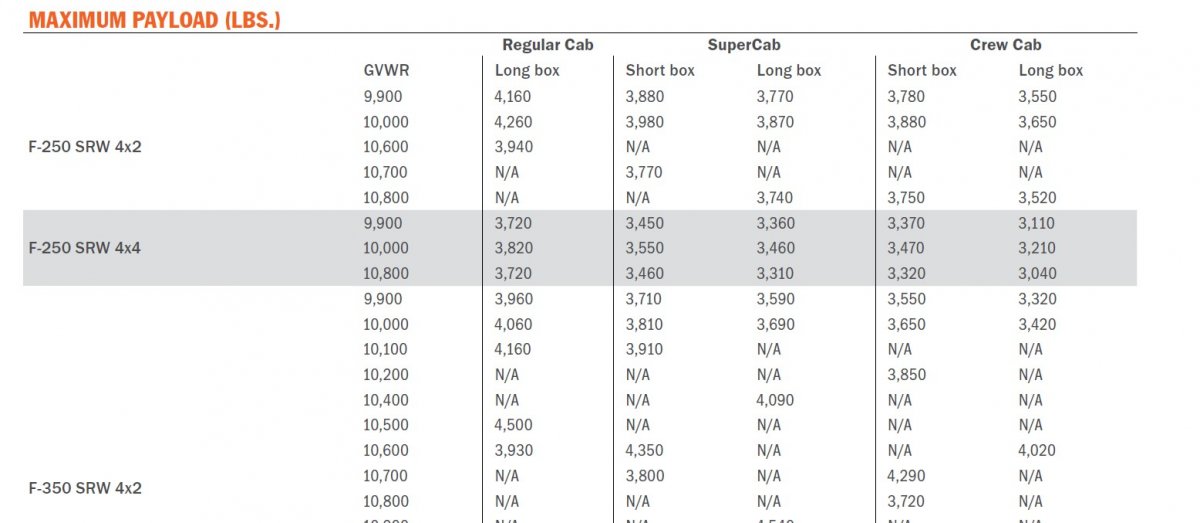
Payload equals GVWR minus curb weight. The F-250’s GVWR ranges from 10,000 to 14,000 lbs, depending on axle, suspension, and engine. But your usable payload depends entirely on curb weight.
Gas vs Diesel Payload Comparison
| Configuration | Curb Weight | GVWR | Payload |
|---|---|---|---|
| 6.8L Gas, Regular Cab | 5,697 lbs | 10,000 lbs | 4,303 lbs |
| 6.8L Gas, Crew Cab | 6,264 lbs | 10,000 lbs | 3,736 lbs |
| 6.7L Diesel, Crew Cab | 7,200 lbs | 10,000 lbs | 2,800 lbs |
Even with the same GVWR, the diesel model carries 936 lbs less cargo, just from engine and drivetrain weight.
Maximum Payload by Engine (2025 Models)
- 6.8L V8 Gas: Up to 8,000 lbs
- 7.3L V8 Gas: Up to 7,635 lbs
- 6.7L Diesel: Up to 6,952 lbs
- 6.7L HO Diesel: Up to 6,935 lbs
Key Insight: The lightest engine gives you the highest payload. Diesel trades cargo space for towing muscle.
Towing Capacity vs Curb Weight

Heavier trucks can tow more, but only if properly configured.
Max Towing by Engine
- 6.8L Gas: 17,300 lbs
- 7.3L Gas: 19,500 lbs (fifth-wheel)
- 6.7L Diesel: 22,000 lbs
- 6.7L HO Diesel: 23,000 lbs (max)
While diesel models are heavier, their superior torque and cooling systems allow for maximum trailer ratings. Features like Pro Trailer Backup Assist, Trailer Sway Control, Onboard Scales, and Integrated Brake Controller help manage these loads safely, even with the extra curb weight.
Axle Weight Distribution
Weight isn’t just total. It’s also about how it’s distributed.
Front Axle Load
- Ranges: 3,500–4,200 lbs
- Diesel engines shift more weight forward due to engine mass
- Improves traction when towing but risks exceeding Front Gross Axle Weight Rating (FGAWR)
Rear Axle Load
- Ranges: 2,700–3,300 lbs (curb)
- Increases with cargo in bed or trailer tongue weight
- Dual Rear Wheel (DRW) models improve rear load capacity
Pro Tip: Always check axle ratings, not just GVWR. Overloading one axle, even if total weight is under GVWR, is illegal and dangerous.
Measuring Weight: Tons and Regulations
For compliance, know your weight in tons.
- Curb weight in tons: 3.1 to 3.75 tons
- Fully loaded (GVWR): 5.75 to 7 tons
Many construction sites, bridges, and municipalities post weight limits in tons. A fully loaded F-250 may exceed 6-ton limits, so always verify local regulations, especially with heavy trailers.
Aftermarket Accessories: Hidden Weight Adders
Even small mods eat into payload.
| Accessory | Weight Added |
|---|---|
| Spray-in Bed Liner | 50–70 lbs |
| Undercover Toolbox | 50–100 lbs |
| Running Boards | 30–50 lbs |
| Snow Plow Prep | +300+ lbs (with plow) |
| Roof Rack | 40–80 lbs |
These are not included in factory curb weight. If you plan to add accessories, deduct their weight from your payload budget.
How to Find Your Exact F-250 Curb Weight
Due to the vast number of combinations, there is no single curb weight.
To get the precise number:
1. Check the window sticker (Monroney label): Lists exact curb weight for that VIN.
2. Visit Ford.com: Use the build and price tool to see estimated weights.
3. Look at the driver’s door jamb: Contains GVWR and axle ratings.
4. Weigh your truck: Use a certified scale (e.g., at a landfill or truck stop) for real-world numbers.
Warning: Never rely on averages when hauling near legal limits. Overloading can void warranties, lead to fines, or cause accidents.
Frequently Asked Questions About Ford F-250 Curb Weight
What is the lightest Ford F-250 curb weight?
The lightest 2025/2026 F-250 curb weight is 5,697 pounds, found in the Regular Cab configuration with a 4×2 drivetrain, 8-foot bed, and the base 6.8L V8 gas engine. This setup maximizes payload capacity at up to 8,000 lbs.
What is the heaviest Ford F-250 curb weight?
The heaviest F-250 configuration approaches 8,627 pounds. This occurs in a Crew Cab with an 8-foot bed, 4×4 drivetrain, 6.7L HO Power Stroke diesel engine, and a fully loaded Platinum or Limited trim.
How much does a diesel engine add to F-250 curb weight?
The 6.7L Power Stroke diesel adds approximately 400 to 500 pounds over the base 6.8L gas engine. The High Output version adds 425 to 525 pounds. This weight comes from the reinforced block, twin turbos, and emissions systems.
How much weight does 4×4 add to an F-250?
Four-wheel drive adds 300 to 400 pounds to curb weight, depending on configuration. The increase comes from the transfer case, front driveshaft, front differential, heavier axle components, and mounting hardware.
Does trim level affect F-250 curb weight?
Yes. Moving from the base XL trim to luxury trims like Platinum or Limited can add 300 to 500+ pounds due to leather seats, premium audio, sunroofs, larger wheels, and additional sound-deadening materials.
How do I find the exact curb weight of my specific F-250?
Check the Monroney window sticker for your VIN, which lists the precise curb weight. You can also look at the driver’s door jamb label for GVWR and axle ratings, or weigh your truck at a certified scale.
Key Takeaways for Choosing the Right F-250 Configuration
The f250 curb weight is not a static number. It’s a spectrum shaped by your choices, ranging from a lean 5,697-lb work truck to a luxurious 8,627-lb powerhouse. Every option has trade-offs between payload, towing, and comfort.
If maximum payload is your priority, choose the Regular Cab with the 6.8L gas engine and 4×2 drivetrain. If you need serious towing muscle, the 6.7L HO diesel delivers 23,000 lbs of capacity, but you’ll sacrifice 400+ lbs of payload. For families, the Crew Cab with the 6.75-ft bed offers the best balance of passenger space and weight efficiency.
Before loading up, always verify the exact curb weight of your specific VIN using the window sticker or door jamb label. This single step protects you from fines, warranty issues, and safety hazards.


