
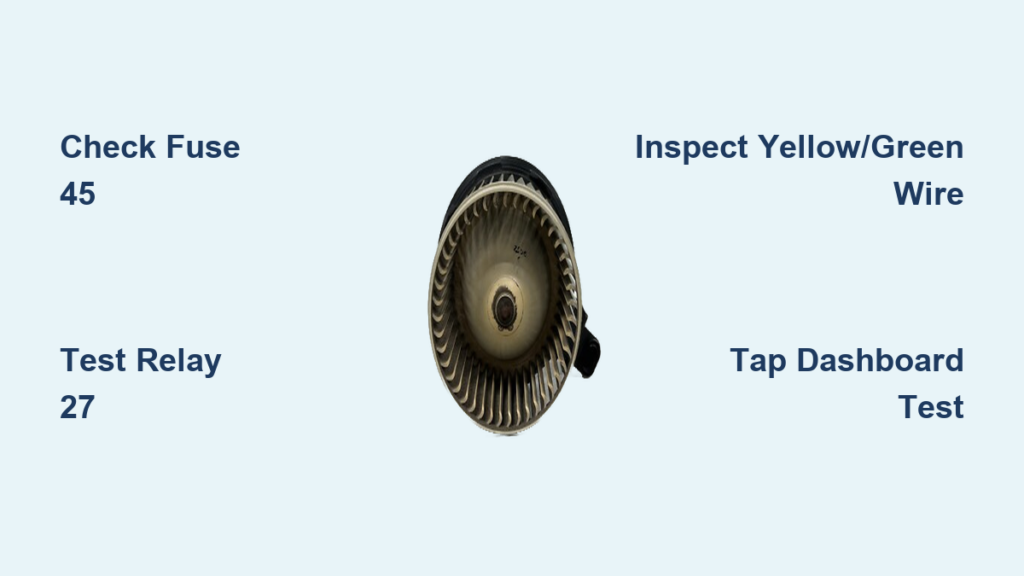
Is your 2008 Ford F-250 blowing warm air or producing no airflow at all? When the AC fan is not working, you’re dealing with one of the most common complaints for this model year. The good news is that most issues are diagnosable with basic tools and a clear troubleshooting path.
When the AC fan fails on your F-250, the root cause typically falls into one of three categories: electrical faults in the junction boxes or relays, mechanical failure of the blower motor, or broader AC system problems like refrigerant leaks. Understanding which category your issue belongs to can save time, money, and prevent unnecessary part replacements.
Check Fuses and Relays First

Before disassembling dash panels or buying new parts, verify the basics: power supply through fuses and relays.
Test Relay 27 and Fuse 45
The blower motor relay (Relay 27, 20A) in the engine compartment is the first suspect when the fan doesn’t run at any speed. This relay controls power delivery to the motor. If it’s faulty or not receiving a control signal, the fan won’t turn.
Equally important is Fuse 45 (5A) in the interior fuse panel. This tiny fuse supplies voltage to Terminal 86 of the relay, which is the control side. If Fuse 45 is blown, the relay won’t activate, even if the motor and wiring are fine.
Quick diagnostic steps:
– Turn the ignition to “ON.”
– Remove Relay 27 and inspect for burn marks.
– Use a multimeter to test for power at Terminal 86 (should have 12V with key on).
– Check Fuse 45 with a test light or continuity checker.
No power at Terminal 86? Trace back to Fuse 45. Blown fuse? Replace it, but investigate why it failed. A recurring blow may indicate a short in the control circuit.
Verify Climate Control Head Power
The climate control head (dash-mounted AC switch) sends the signal to turn on the blower. It needs power to function.
Fuse 15 (10A) in the interior panel powers the climate control module. If this fuse is dead, the system can’t communicate with the blower relay.
Test procedure:
– Locate Fuse 15 in the passenger compartment fuse box.
– Test for continuity and voltage.
– If no power, replace the fuse and retest fan operation.
If both Fuse 15 and Fuse 45 are intact but the fan still won’t run, move to the junction boxes.
Diagnose Junction Box Failures

When fuses and relays check out but the fan remains dead, the fault likely lies in the Battery Junction Box (BJB) or Smart Junction Box (SJB), which are common failure points on 2008 F-250s.
Inspect the Battery Junction Box
The BJB, located near the battery, routes power from the Central Junction Box to the blower motor relay. A break in this path kills fan operation.
Key wire to test: Yellow/Green
– This wire carries power from the Central Junction Box to the BJB input.
– Use a multimeter to check for voltage at the BJB input terminal with the key on.
– If power is present at the source but missing at the BJB, there’s likely a broken wire or internal BJB fault.
Visual signs of BJB failure:
– Burnt terminals
– Corrosion or moisture
– Rodent damage (chewed wires)
– Loose connections at the yellow wire input/output
A failed BJB can also cause simultaneous windshield wiper failure, as both systems share power paths. If your wipers died at the same time as the blower, the BJB is highly suspect.
Replace and Program the SJB
The Smart Junction Box (SJB), or interior fuse panel, acts as the brain for many electrical systems, including climate control.
If you’ve replaced the SJB and the fan still doesn’t work, here’s the likely culprit: it wasn’t programmed.
Critical fact: A new SJB must be programmed with a Ford dealer scan tool to recognize the vehicle’s configuration. Without programming, it won’t route signals to the blower motor relay, even if all fuses and wiring are perfect.
Symptoms of an unprogrammed SJB:
– No fan operation at any speed
– No response from climate control head
– Wipers may also fail
– OBD-II scanner shows communication errors
Solution: Have the SJB programmed by a Ford dealer or qualified technician with factory-level software. Don’t assume a plug-and-play replacement will work.
Test for Blower Motor Mechanical Failure
If power reaches the relay and wiring is intact, but the fan still won’t run, the blower motor itself may be failing mechanically.
Identify Shock-Sensitive Motor Failure
A classic sign of internal motor wear is temporary restoration of function when you hit the dashboard near the glove box.
Here’s how it works:
– The blower motor uses carbon brushes to transfer electricity to the spinning armature.
– Over time, these brushes wear down or the commutator becomes pitted.
– Vibration or impact can momentarily re-establish contact, making the fan spin again until it fails once more.
Diagnostic test:
– Turn the key to “ON” and set the fan to high.
– Tap firmly on the lower dashboard, just left of the glove box.
– If the fan kicks on briefly, the motor is mechanically faulty.
Other signs:
– Sudden failure after engine shutdown
– Intermittent operation that worsens over time
– Whining or grinding noise before failure
Replace the Blower Motor
When mechanical failure is confirmed, replacement is the only fix.
Average cost: $279 (parts and labor)
DIY difficulty: Moderate
Access: Requires removing dashboard components, including the glove box and lower dash panel.
Tips for DIY:
– Disconnect the battery before starting.
– Label all connectors and screws.
– Inspect the motor resistor and wiring harness during removal.
– Clean the evaporator housing if debris is present.
A new motor typically resolves the issue if the electrical supply is confirmed good.
Diagnose Fan Speed Control Issues

If your fan runs but changes speed on its own or won’t stay on one setting, the problem may be the fan speed control module.
Locate and Replace the Speed Control Unit
This module, located behind the glove box, regulates voltage to the blower motor based on your selected speed.
Failure symptoms:
– Fan surges between speeds
– Only one speed works (usually high)
– Fan turns off unexpectedly
Repair profile:
– Simple and fast (30 to 60 minutes)
– Access by removing the glove box and lower trim
– One electrical connector and two screws
Cost: $100 to $300 (parts and labor)
DIY-friendly: Yes, no programming required
Replace with an OEM or high-quality aftermarket unit to avoid repeat failures.
Rule Out Broader AC System Problems
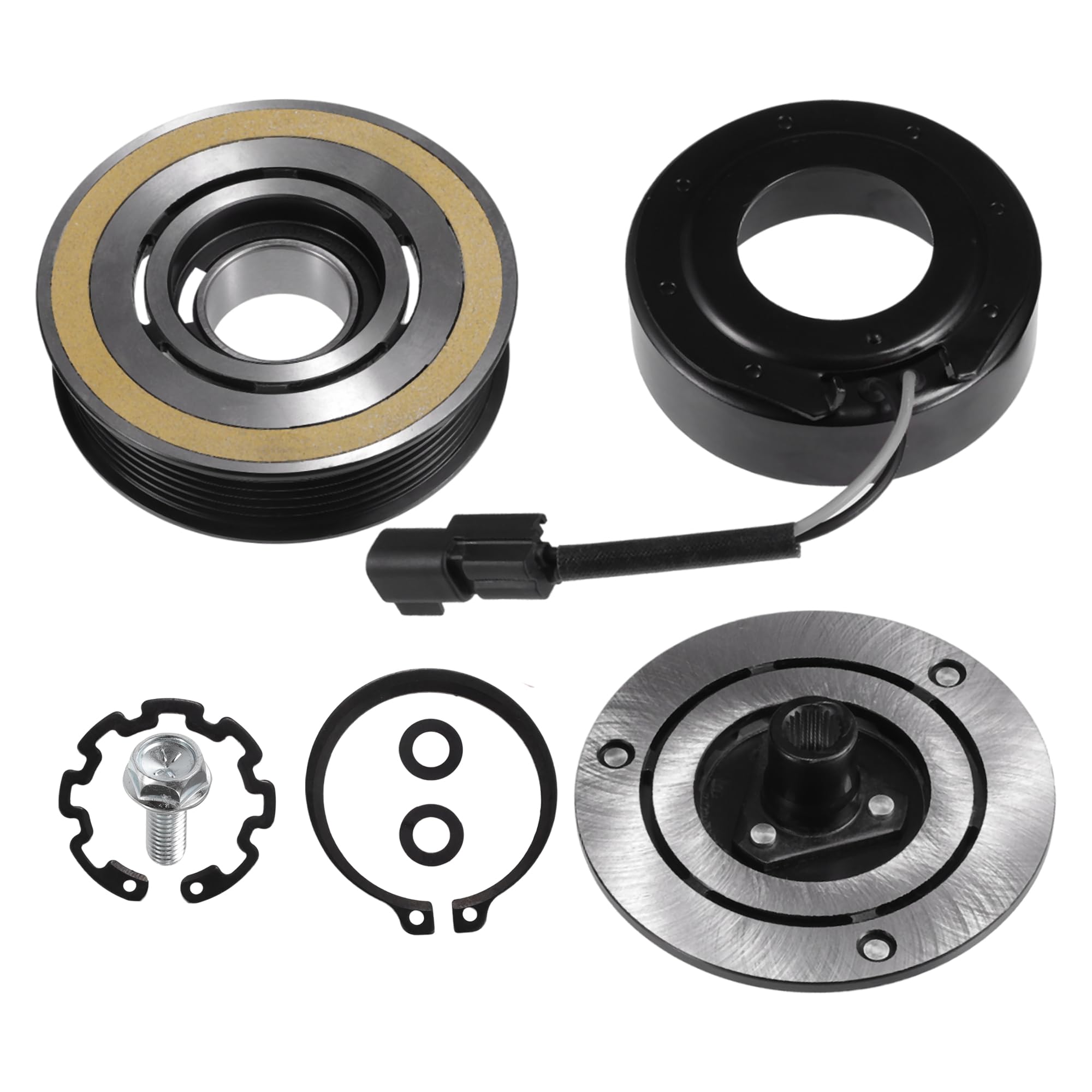
If the fan works but air isn’t cold, the issue isn’t the blower. It’s the cooling system.
Check for Refrigerant Leaks
Data shows 37% of 2008 F-250 AC issues are due to refrigerant leaks, making it the most common cause of poor cooling.
Leak indicators:
– Oily residue on AC lines, compressor, or hoses
– Hissing sound under the hood
– Gradual loss of cooling performance
– Compressor clutch cycles rapidly or won’t engage
Solution:
– Have the system inspected with a UV dye or electronic leak detector.
– Repair the leak (common sites: Schrader valves, hose connections, evaporator).
– Evacuate and recharge with correct refrigerant (R-134a).
Never “top off” refrigerant without finding the leak. This wastes money and harms the environment.
Test Compressor and Condenser
The AC compressor must engage to circulate refrigerant.
Check:
– Start the engine and turn AC to max.
– Look at the compressor pulley: the center clutch should click and spin.
– No engagement? Possible causes:
– Low refrigerant pressure (safety switch prevents operation)
– Failed compressor clutch
– Wiring fault or blown fuse
Condenser issues:
– Located in front of the radiator.
– Clogged with bugs, dirt, or debris? Airflow is restricted, reducing cooling.
– Clean with a hose and brush. Do not bend fins.
Also ensure the engine cooling fans are working. If they don’t turn on during AC operation, the condenser overheats.
Address Dual-Zone Climate Control Faults
If your F-250 has dual-zone climate control, you may experience uneven cooling, with cool air on the driver’s side and warm air on the passenger side.
Diagnose Temperature Imbalance
Possible causes:
– Failing blend door actuator: Controls airflow temperature. May need recalibration or replacement.
– Refrigerant imbalance: Uneven cooling due to partial blockage or low charge.
– Blocked condenser or evaporator: Restricts refrigerant flow.
– Faulty climate control module: Sends incorrect signals to actuators.
Diagnostic tip:
Use a scan tool to read actuator positions and compare to commanded values. A mismatch indicates a mechanical or electrical fault in the blend door system.
Follow a Step-by-Step Diagnostic Flow
Avoid “parts swapping” by following a logical troubleshooting sequence.
Start with Visual and Electrical Checks
- Inspect fuses: Fuses 15, 45, and Relay 27.
- Test relay terminals: Use a multimeter to check for 12V at Terminal 86 and Terminal 30 (key on).
- Trace the Yellow/Green wire: From Central Junction Box to BJB. Look for breaks or corrosion.
- Check grounds: Clean and tighten ground connections near the battery and firewall.
Move to Component Testing
- Listen for compressor engagement: If it clicks but doesn’t spin, suspect clutch or refrigerant level.
- Tap the dashboard: If the fan starts, replace the blower motor.
- Scan for codes: Use an OBD-II scanner to check for climate control or SJB communication errors.
Confirm System Performance
- Measure air temperature: Use a thermometer at the center vent. Should be 35 to 45°F when ambient is 70 to 80°F.
- Check refrigerant pressure: Requires gauges. Low pressure means a leak. High pressure means blockage or overcharge.
- Verify fan speed control: If erratic, replace the speed control module.
Prevent Future Failures
Keep your 2008 F-250’s AC system reliable with simple maintenance.
Clean Condenser Coils Regularly
Dirt and bugs reduce heat dissipation. Wash the condenser every spring or after off-road use.
Replace Cabin Air Filter
A clogged filter reduces airflow and strains the blower motor. Replace every 12,000 to 15,000 miles or as needed.
Inspect Wiring for Rodent Damage
Mice and rats love chewing on wiring in the engine bay. Check the BJB, SJB, and harnesses annually, especially if you park outdoors.
Address Electrical Issues Early
If fuses blow repeatedly or relays fail, investigate the root cause. High resistance or shorts can lead to junction box damage.
Frequently Asked Questions About 2008 F250 AC Fan Problems
Why does my 2008 F250 AC fan stop working when the wipers also fail?
This points to a shared electrical fault in the Battery Junction Box (BJB) or Smart Junction Box (SJB). Both systems draw power through similar circuits, so a break in the Yellow/Green wire or a junction box failure often disables both at once. Inspect the BJB for burnt terminals, corrosion, or rodent damage first.
How do I know if my blower motor or the relay is bad?
Test Relay 27 first by checking for 12V at Terminal 30 with the key on. If power is present but the fan doesn’t run, tap the dashboard near the glove box. If the fan kicks on briefly, the motor is mechanically worn. If no power reaches the relay, trace the Yellow/Green wire back to the BJB.
Do I need to program a new Smart Junction Box?
Yes. A replacement SJB must be programmed with a Ford dealer scan tool, or it won’t communicate with the climate control system. Without programming, the blower motor relay won’t receive activation signals, and the fan won’t run at any speed.
How much does it cost to fix an AC fan that isn’t working on a 2008 F250?
Professional blower motor replacement averages around $279 for parts and labor. Fan speed control unit replacement typically runs $100 to $300. Costs vary based on your location and whether you choose OEM or aftermarket parts.
Can a refrigerant leak cause the fan to stop blowing entirely?
No. A refrigerant leak affects cooling performance, not airflow. If the fan itself isn’t running, the problem is electrical or mechanical. If the fan runs but air is warm, then you should investigate refrigerant levels and check for leaks.
What does it mean when my AC fan changes speeds on its own?
This usually indicates a failing fan speed control unit, located behind the glove box. The module regulates voltage to the blower motor, and when it fails, the fan may surge between speeds or only work on high. Replacement is straightforward and takes 30 to 60 minutes.
Key Takeaways for Fixing Your 2008 F250 AC Fan

A non-working AC fan on your 2008 F-250 is more than a comfort issue. It can affect safety, visibility, and engine performance. By following this guide, you can quickly identify whether the fault is electrical (fuses, relays, junction boxes), mechanical (blower motor), or system-wide (refrigerant, compressor).
Start with Fuse 45, Relay 27, and the Yellow/Green wire path, which are the most common electrical failure points. If power is good, test for shock-sensitive motor failure by tapping the dashboard. And if you replace the SJB, don’t skip programming.
With accurate diagnosis, most repairs are manageable and cost-effective. Grab your multimeter, start with the basics, and you’ll have cool air flowing again before the next heatwave hits.


