
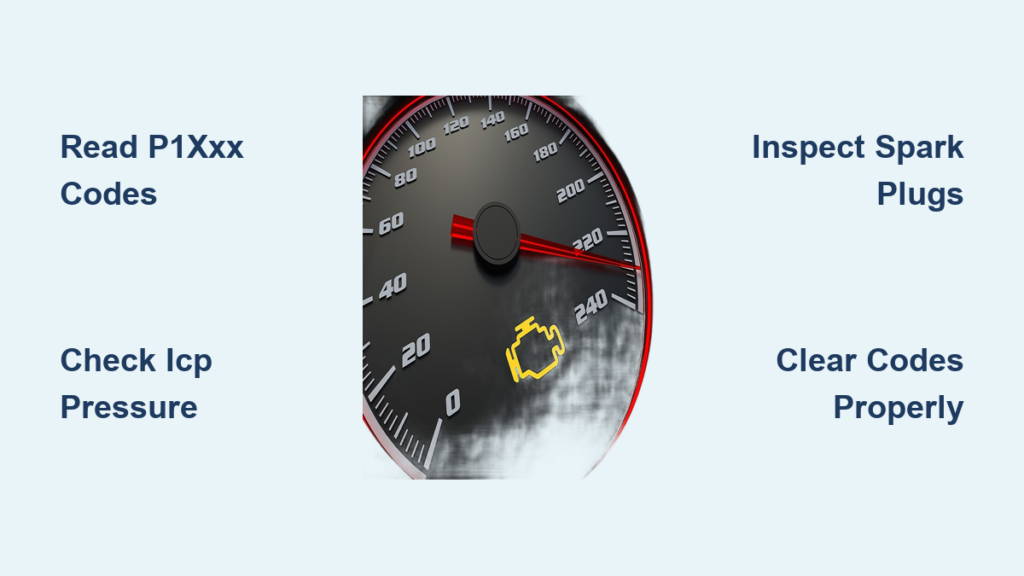
Your Ford F-250’s Check Engine Light just illuminated. Maybe it’s a steady glow, maybe it’s flashing. Either way, you’re not alone. Thousands of Super Duty owners face this warning every year, and while some triggers are minor, others can lead to expensive engine damage if ignored. Most Ford F250 check engine light codes follow predictable patterns, especially in Power Stroke diesel models.
This guide breaks down the most common Ford F250 check engine light codes, what they actually mean, and how to fix them without wasting money on unnecessary parts. You’ll learn how to diagnose the root cause instead of just the symptom. We will cover diesel-specific failures like ICP sensor issues and injector circuit faults, plus the infamous spark plug ejection in gas V8s.
Decode Your F250 Check Engine Light
The Check Engine Light (CEL), or Malfunction Indicator Lamp (MIL), activates when the Powertrain Control Module (PCM) detects a system parameter outside its normal range. On the F-250, especially diesel models, this can mean anything from a loose fuel cap to a failing High-Pressure Oil Pump (HPOP).
A steady light means a non-critical fault. The truck is drivable, but needs attention. A flashing light is urgent. It signals active misfires that can destroy your catalytic converter in minutes. Stop driving and diagnose immediately.
Every code stored in the PCM points to a specific system failure. Here is the key insight: the code is the symptom, not the cause. A P0171 (Lean Mixture) code might make you replace an O2 sensor, but the real issue could be a vacuum leak or failing fuel pump.
Always retrieve freeze frame data before clearing codes. This snapshot shows engine load, RPM, and temperature at the moment of failure, which is critical for diagnosing intermittent issues.
Read Codes With the Right Tool
Use an OBD-II scanner capable of reading manufacturer-specific codes (P1xxx series). Generic scanners may miss critical Ford Power Stroke faults like P1211 (ICP not controllable) or P1316 (IDM circuit issues).
• Basic scanners: Pull generic codes (P0xxx). Good for starters.
• Enhanced tools: Read live data, freeze frames, and Ford-specific P1xxx codes. Essential for diesel trucks.
• Professional scan tools: Access PCM communication, perform bi-directional tests, and monitor ICP/ICR pressure in real time.
Pro Tip: Auto parts stores offer free scans, but they often only read the code, not diagnose it. Don’t replace parts based solely on a free read.
Common Light Behaviors Explained
| Light Behavior | Meaning | Action Required |
|---|---|---|
| Steady On | Non-critical fault (e.g., loose gas cap, minor sensor issue) | Diagnose within 1–2 weeks |
| Flashing | Severe misfire with unburned fuel entering exhaust | Stop driving. Risk of catalytic converter meltdown |
| On Then Off | Intermittent fault. Code is in history memory | Retrieve code before it clears. Monitor for recurrence |
Top 6 Causes of F250 Check Engine Light
Over 40% of F-250 check engine light incidents stem from emissions, sensors, or fuel system issues. Here are the most frequent culprits and how to fix them.
Loose or Faulty Gas Cap
One of the top causes of CEL illumination, especially on older F-250s. A loose, cracked, or missing O-ring on the gas cap breaks the EVAP system seal, triggering evaporative emission codes like P0455 or P0456.
Fix:
• Tighten the cap until it clicks (3–4 clicks).
• Inspect the O-ring for cracks or dry rot. Replace if damaged.
• For newer models with “Easy Fuel” caps, check the filler neck O-ring.
Cost: $10–$25 for a new cap. Often free to fix.
Failing Oxygen (O2) Sensor
O2 sensors monitor exhaust oxygen levels. When they fail, fuel trim goes out of range, causing rich or lean conditions. Common codes include P0130–P0167, especially P0171/P0174 (System Lean).
Symptoms:
• Poor fuel economy
• Rough idle
• Hesitation during acceleration
Fix:
• Replace sensor (upstream sensors fail more often).
• Recommended every 50,000 miles as preventative maintenance.
Cost: $61–$90 (parts and labor).
Dirty or Failed MAF Sensor
The Mass Airflow (MAF) sensor measures incoming air. If dirty or faulty, it sends incorrect data to the PCM, causing misfires and poor fueling.
Common codes: P0101, P0102, P0103.
Symptoms: Stalling, rough idle, power loss.
Fix:
• Clean with MAF-safe cleaner (do not touch the wire).
• If cleaning fails, replace the sensor.
• Check for air leaks downstream of the MAF.
Cost: $120–$300 (replacement).
Catalytic Converter Failure
Usually a secondary failure caused by ignored misfires or O2 sensor issues. A clogged converter restricts exhaust flow, leading to power loss and high exhaust temps.
Codes: P0420, P0430 (Catalyst Efficiency Below Threshold).
Symptoms: Rotten egg smell, reduced power, glowing exhaust manifold.
Fix:
• Diagnose root cause first (misfires, fuel trim issues).
• Replace converter only after fixing the underlying problem.
Cost: $1,000–$2,500+ (OEM vs. aftermarket).
Ignition Coils and Spark Plugs (Gas Models)
Gas-powered F-250s with V8 engines are prone to coil and plug failures. Worn plugs increase coil strain, leading to misfires.
Codes: P0300–P0308 (Cylinder-specific misfires).
Symptoms: Rough idle, jerking under load, poor acceleration.
Fix:
• Replace all spark plugs and coils as a set.
• Use correct gap (typically 0.054″ for 5.4L/6.8L).
• Inspect boots for cracks.
Cost: $300–$600 (full set).
VCT Solenoid Failure
Variable Camshaft Timing (VCT) solenoids optimize valve timing. When they fail, timing drifts, causing rough idle and poor performance.
Codes: P0011, P0022, P0016.
Symptoms: Rattling at startup, loss of low-end torque.
Fix:
• Replace solenoid (located on timing cover).
• Clean oil passages, as debris is a common cause.
Cost: $150–$300 (parts and labor).
Diesel-Specific F250 Code Failures
Power Stroke diesel engines have unique systems (ICP, IDM, HPOP) that trigger specific codes. Misdiagnosing these can lead to costly, unnecessary repairs.
ICP Sensor and High-Pressure Oil System
The Injection Control Pressure (ICP) sensor monitors oil pressure used to fire fuel injectors. If pressure is too low or erratic, injectors won’t fire correctly.
Common codes:
• P1280: ICP Circuit Low
• P1281: ICP Circuit High
• P1211: ICP Not Controllable
• P1210: ICP Above Expected
Root Causes:
• Failed ICP sensor (most common)
• Leaking high-pressure oil lines or standpipes
• Worn HPOP (High-Pressure Oil Pump)
• Failed IPR (Injection Pressure Regulator) valve
Diagnosis:
• Check live ICP readings at idle and under load.
• Normal idle: 500–700 psi. Cranking: 500–1,000 psi.
• Use a mechanical gauge to confirm, since electrical readings can be misleading.
Fix:
• Replace ICP sensor first (inexpensive test).
• Inspect HPOP screen for debris.
• Replace IPR valve if pressure fluctuates.
Cost:
• ICP sensor: $80–$150
• IPR valve: $100–$200
• HPOP replacement: $800–$1,500
Injector Circuit and IDM Faults
The Injector Drive Module (IDM) sends high-voltage pulses to fire injectors. Faults here cause cylinder-specific issues.
Common codes:
• P1261–P1276: High-to-Low Side Shorts/Opens
• P1316: IDM Circuit Detected
• P1298: IDM Failure
Symptoms: Rough running, loss of power, white smoke at startup.
Root Causes:
• Failed IDM (common in 7.3L and 6.0L)
• Corroded connector at IDM or PCM
• Damaged injector harness (rodent damage, chafing)
• Shorted injector coil
Diagnosis:
• Inspect IDM connectors for moisture and corrosion.
• Check for 48V output from IDM with a multimeter.
• Perform cylinder contribution test via scan tool.
Fix:
• Replace IDM (aftermarket units available).
• Repair or replace harness.
• Test injectors with buzz test.
Cost:
• IDM replacement: $300–$600
• Harness repair: $200–$500
Turbocharger and Wastegate Codes
Turbo issues affect boost pressure and emissions.
Common codes:
• P0236, P0237, P0238: Turbo Boost Sensor
• P1247, P1248: Turbo Boost Pressure Low/Not Detected
• P1249, P1690: Wastegate Fail
Symptoms: Loss of power, black smoke, slow spool-up.
Fix:
• Check boost hoses for cracks and leaks.
• Clean or replace boost pressure sensor.
• Inspect wastegate actuator for sticking.
• Verify VGT (Variable Geometry Turbo) function.
Cost: $200–$800 depending on repair.
Gas Model: Spark Plug Ejection Risk
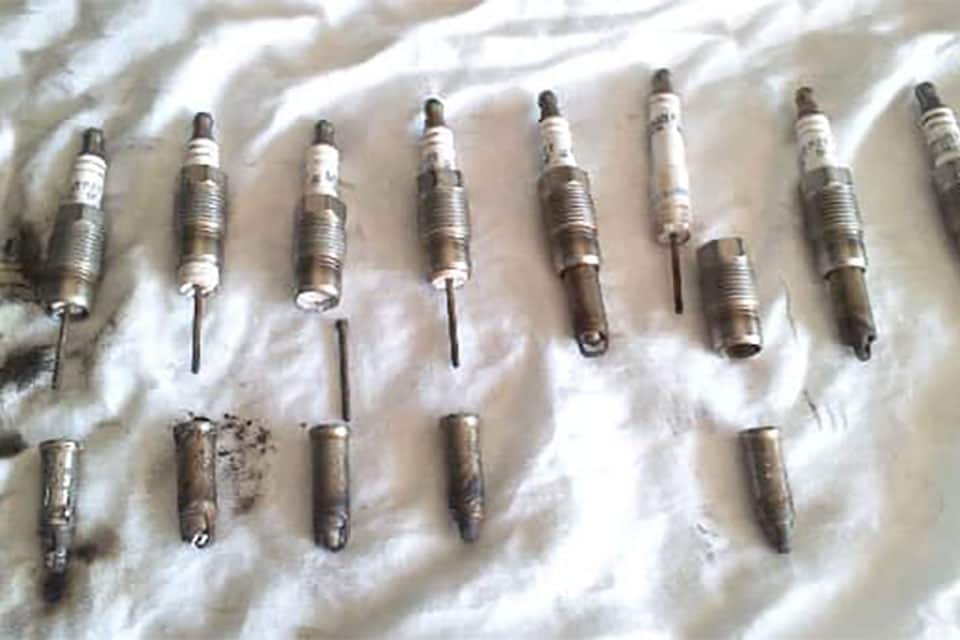
A known issue in 5.4L and 6.8L V8 gasoline F-250s is spark plug ejection, where plugs back out of the cylinder head due to insufficient thread engagement.
Symptoms:
• Loud tapping or knocking noise
• Misfire on one cylinder (e.g., P0301)
• Oil leaking around the plug well
Cause: Soft aluminum heads and inadequate thread depth.
Repair Options:
1. Time-Sert/ARC insert: Thread repair kit, which is the most reliable fix.
2. New cylinder head: For severe damage.
3. Ford TSB-recommended plugs: Use updated design with longer threads.
Cost:
• Thread repair: $500–$1,200
• Head replacement: $1,500–$3,000
Transmission-Related Codes
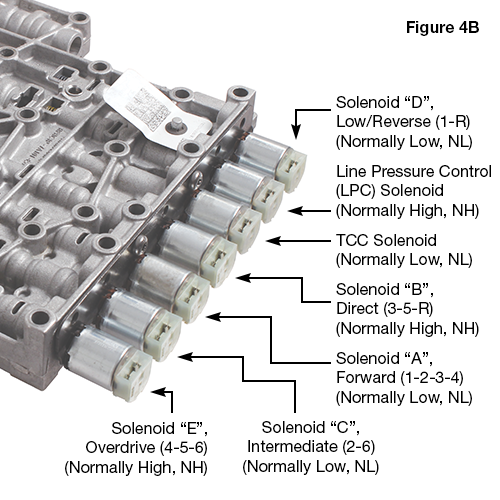
F-250 transmission codes often overlap with engine systems due to shared PCM control.
Common codes:
• P0705, P0707, P0708: TR Sensor (Transmission Range)
• P0712, P0713: Transmission Fluid Temp Sensor
• P0741, P0743: Torque Converter Clutch
• P0750, P0755: Shift Solenoid A/B
• P1783: Transmission Overtemperature
Fix:
• Check fluid level and condition (burnt smell means trouble).
• Inspect for wiring damage near solenoid pack.
• Use scan tool to test solenoid operation.
• Monitor transmission temp, since overheating kills clutches.
Cost: $150–$500 for solenoid pack; $2,000+ for rebuild.
Electrical and PCM Integrity Codes
These codes point to system voltage or PCM/IDM communication issues.
Critical codes:
• P0560, P0562, P0563: System Voltage Low/High
• P0603, P0605, P0606: PCM Memory/ROM/Processor Fault
• P1668: PCM-IDM Communication Error
• P1291–P1297: High-Side Circuit Shorts/Opens
Root Causes:
• Failing alternator or dual-battery system fault
• Corroded grounds or PCM connectors
• Water intrusion in IDM or PCM
• Bad battery cables
Fix:
• Test charging system (should be 13.5–14.8V).
• Inspect battery terminals and ground straps.
• Check for rodent damage in harnesses.
• Replace PCM/IDM if communication errors persist.
Cost: $200–$1,000 depending on component.
Resetting the Check Engine Light
The CEL may turn off automatically after 20–40 miles of normal driving if the fault was temporary (e.g., loose gas cap).
To manually reset:
1. Repair the underlying issue.
2. Use an OBD-II scanner to clear codes.
3. Drive through a full drive cycle (city + highway) to complete OBD monitors.
Warning: Clearing codes before diagnosis erases freeze frame data. Never do this first.
When to See a Professional
Seek expert help if:
• The light is flashing.
• You have multiple cylinder misfires.
• Power is reduced or transmission is slipping.
• You’ve replaced parts but the code returns.
• You suspect HPOP, IDM, or PCM failure.
Dealerships and diesel specialists have factory-level tools for bi-directional testing and data logging, which is worth the $88–$179 diagnostic fee.
Prevent F250 Check Engine Light Issues
Avoid costly repairs with smart maintenance:
Replace O2 Sensors at 50K Miles
Prevents long-term fuel trim issues and catalytic converter damage.
Inspect Gas Cap Regularly
Ensure O-ring is intact and cap clicks securely.
Change Fuel Filters (Diesel)
Water-in-fuel codes (P1140, P1139) are preventable with clean filters.
Monitor Live Data
Use a scan tool to check ICP, VGT position, and fuel trims monthly.
Check Wiring Harnesses
Look for rodent damage, chafing, or corrosion, especially near the firewall.
Address Misfires Immediately
A flashing CEL can destroy a $1,200 catalytic converter in under an hour.
Frequently Asked Questions About Ford F250 Check Engine Light Codes
What does a flashing check engine light mean on a Ford F250?
A flashing light signals an active misfire that sends unburned fuel into the exhaust. This can destroy your catalytic converter in minutes. Stop driving immediately and diagnose the issue before continuing.
Can I drive my F250 with the check engine light on?
If the light is steady, you can drive short distances but should diagnose within 1–2 weeks. If the light is flashing, stop driving as soon as possible to prevent catastrophic catalytic converter or engine damage.
How do I read Ford F250 check engine light codes without a scanner?
Without a scanner, you cannot read specific codes. Some auto parts stores offer free scans, but they may only read generic codes. For diesel Power Stroke models, you need an enhanced scanner capable of reading P1xxx manufacturer-specific codes.
What is the most common cause of check engine light on F250?
A loose or damaged gas cap is the most common cause, triggering evaporative emission codes like P0455 or P0456. O2 sensor failure and MAF sensor issues are also frequent triggers, especially in older models.
How much does it cost to diagnose Ford F250 check engine light codes?
Diagnostic fees range from $88–$179 nationally. Electrical diagnosis commands higher fees ($122–$179) due to complexity. Some dealerships offer complimentary multi-point inspections.
Will disconnecting the battery reset the check engine light?
Disconnecting the battery may clear codes temporarily, but it also erases freeze frame data and resets other modules like radio and idle relearn. Use an OBD-II scanner for proper code clearing after repairs.
Key Takeaways for Fixing Ford F250 Check Engine Light Codes
The Ford F250 check engine light is a warning, not a death sentence. Start with a proper scan using an enhanced OBD-II tool that reads Ford-specific P1xxx codes, especially for diesel models. Remember that the code is the symptom, not the cause. A lean code might mean a vacuum leak, not a bad O2 sensor.
For diesel trucks, pay close attention to ICP, IDM, and HPOP-related codes, as misdiagnosis here leads to expensive unnecessary repairs. For gas V8s, watch for spark plug ejection symptoms like tapping noises and single-cylinder misfires.
Your next step: Grab an enhanced OBD-II scanner, pull your codes, and check freeze frame data before clearing anything. If you see flashing light symptoms or multiple cylinder misfires, stop driving and call a diesel specialist.


