If your 1998 Ford F-150 wipers aren’t working, you are dealing with one of the most common electrical problems in this model year. The culprit is usually the Generic Electronic Module, not the switch or motor as many assume. This guide walks you through every diagnostic step to pinpoint the exact cause and restore your wipers, often for under $200.
Check Fuse 11 Power First
Fuse 11 is a 30-amp fuse that supplies power to both the wiper run park and hi-lo relays. Before diving into complex electronics, verify this fuse is receiving voltage.
Test Both Fuse Terminals Under Load
Use a test light or multimeter to probe both terminals of Fuse 11 in the central junction box with the ignition on. You should read 12 volts on both sides. A fuse can appear intact but still fail to conduct due to a cracked element or poor contact.
If the fuse is blown, inspect for short circuits in the wiper motor or wiring, water intrusion into the fuse panel, or aftermarket accessories that overload the circuit. Replace only with a 30-amp fuse.
Bypass Wiper Relays to Test Motor Function
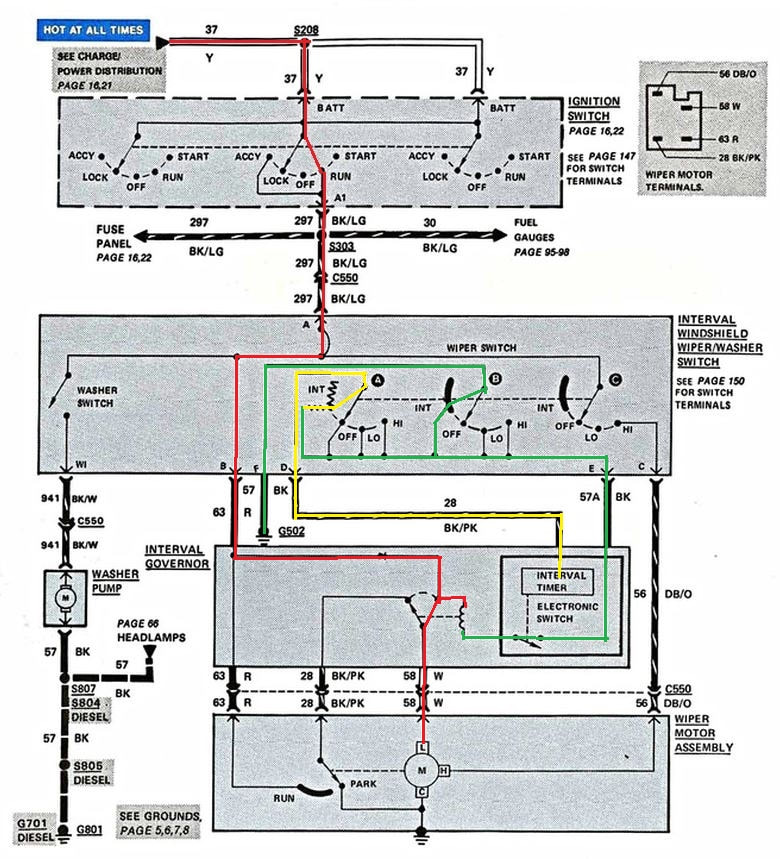
If Fuse 11 is powered, bypass the relays and test the wiper motor directly. This eliminates the GEM and switch from the equation, saving you from buying unnecessary parts.
Apply Power Directly to Relay Socket
Remove the Wiper Hi-Lo Relay from the fuse box. Using jumper wires, apply 12 volts to Pin 4 for low speed or Pin 5 for high speed. Ground the motor at G105, which is located on the rear-right fender apron.
If the wipers move smoothly at either speed, the motor and mechanical system are functional. The fault lies in the control circuit, most likely the GEM module. If there is no movement, check the motor ground, wiring continuity, or consider motor replacement.
Tighten Loose Wiper Arm Nuts
A surprisingly common cause of dead wipers is a loose 15mm nut connecting the wiper arm to the spindle. The motor runs, but the arms do not move or only twitch.
Quick Inspection and Fix
Turn off the ignition and pop off the plastic cover at the base of each wiper arm. Use a socket wrench to check the tightness of the 15mm nut. If loose, tighten it securely without over-torquing.
This fix has restored full operation in under 10 minutes, avoiding a $300 GEM replacement that was not needed. Apply medium-strength thread locker when reassembling to prevent future loosening.
Test Washer Pump for Shared Circuit Issues
The washer pump shares circuitry with the wipers. If it fails too, the problem is likely upstream in the GEM or power supply.
What Activation Reveals
Turn on the washer fluid switch. You should hear a brief hum from the pump and see wipers activate for 3 to 5 sweeps. No pump sound combined with no wiper sweep points to shared failure in the GEM, power, or ground.
If wipers work only during washer use, this indicates partial GEM function or signal misrouting. This behavior strongly suggests GEM module corruption, where the GEM misinterprets the washer ground signal as a continuous wiper command.
Scan for GEM Module Communication
The GEM controls wipers, lights, door chimes, and more. When it fails, multiple systems go haywire. The best way to test it is with an OBD-II scan tool.
Connect and Diagnose
Plug in a capable scanner and attempt to communicate with the GEM module with the ignition on. Look for module response, live data from the multi-function switch, and stored DTCs.
If the scanner cannot talk to the GEM and the motor works when bypassed, replace the module. A confirmed 1999 F-150 case showed no GEM communication, no switch input, and no DTCs, yet the PCM was fine.
Evaluate Multi-Function Switch Signals
Despite being a frequent suspect, the multi-function switch is rarely the true cause. But it must be ruled out properly.
Measure Resistance on Pink/Yellow Wire
Set your multimeter to ohms and probe the pink/yellow wire at the switch connector. Expected resistance values are approximately 47.6 kΩ for Off, 11.3 kΩ for Low, and 4.08 kΩ for High.
Test the light blue/orange wire for continuity to ground when activating the washer. Multiple owners replaced the switch with no improvement, confirming it is rarely the problem.
Inspect GEM Module for Damage

The GEM module is located behind the driver’s side kick panel or integrated into the fuse box. Remove it carefully and inspect for visible problems.
Visual Red Flags to Find
Look for corrosion or mineral deposits indicating water intrusion, burnt circuit traces or swollen capacitors, moisture inside the housing, and loose or bent connector pins.
Some users report temporary success after cleaning internal boards with isopropyl alcohol. However, this is often short-lived, and permanent replacement is recommended. In cold weather below zero degrees Fahrenheit, failure points to thermal contraction of cracked solder joints.
Replace Failed GEM Module
When diagnostics confirm GEM failure, replacement is the only reliable fix.
Choose the Right Part
Part numbers vary by trim and options. The Cardone Remanufactured GEM #78-8748F is a recommended option. Available at AutoZone, O’Reilly, and other auto parts stores, it often includes core exchange.
Most 1998 F-150 GEM modules are plug-and-play with no programming required. After installation, test all modes including low, high, intermittent, and washer sweep. Verify no door chime activates when wipers are turned on.
Prevent Water Intrusion Damage
Water is the silent killer of GEM modules and fuse panels. Stopping leaks early prevents costly repairs.
Maintain Critical Drain Points
Clear debris like leaves and pine needles from the cowl vent below the windshield monthly. Flush drains with a garden hose or compressed air every 3 months to prevent water pooling and seeping into the fuse box.
Inspect the urethane seal around the windshield for cracks, shrinkage, or gaps near the cowl area. A failing seal allows water to drip directly onto the GEM. Fixing a leak early can prevent $700 or more in GEM and fuse panel replacements.
Recognize GEM Failure Patterns
Certain symptoms are hallmarks of GEM failure in the 1998 F-150.
Key Warning Signs
The door chime activating when the wipers turn on is a smoking gun. The GEM misroutes signals between systems. Wipers running with the ignition off or relay clicking without ignition also point to internal shorts or corrupted logic.
Users report these exact behaviors before GEM replacement, followed by full restoration of function.
Avoid Common Misdiagnoses
Save time and money by skipping ineffective fixes that waste hundreds of dollars.
What Not to Replace First
Do not replace the multi-function switch first despite dealer recommendations. Switch failure is rare, and replacing it without testing wastes $100 to $200. Do not assume motor failure, as the motor is robust and works when bypassed.
Do not ignore mechanical causes. A loose 15mm nut takes 5 minutes to check and costs nothing. Always inspect before buying electronic parts.
Final Diagnostic Checklist
Use this sequence to ensure accurate diagnosis.
Step-by-Step Verification Process
Check Fuse 11 to confirm both sides are powered. Bypass the wiper relay to verify the motor runs. Tighten 15mm wiper arm nuts if any looseness exists. Test the washer pump to confirm activation. Scan for GEM communication and any response. Inspect the GEM for moisture or visible corrosion. Replace the GEM module if all else points to failure.
Full diagnosis takes 45 to 60 minutes with basic tools.
Frequently Asked Questions About 1998 Ford F-150 Wipers Not Working
Why do my 1998 F-150 wipers stop working completely?
The most common cause is GEM module failure. The Generic Electronic Module controls wiper functions, and when it fails, wipers stop working in all modes. This is far more common than switch or motor failure.
Can a blown fuse cause total wiper failure?
Yes, but it is rare. Fuse 11 supplies power to the wiper relays. However, in multiple confirmed cases, Fuse 11 was functional and powered yet wipers still did not work. Always check it first, but be prepared to dig deeper.
How do I know if the GEM is bad?
Key signs include no communication with the GEM via scan tool, wipers working only during washer use, door chime activating when wipers turn on, and relay clicking with the ignition off. The motor working when bypassed strongly confirms GEM failure.
Is the multi-function switch a common failure point?
No. Despite dealer recommendations, switch failure is rare. Many owners replaced the switch with no improvement. The GEM is the actual culprit in nearly all cases.
Can I fix the GEM myself?
Yes. Most 1998 F-150 GEM modules are plug-and-play with no programming required. Remove the kick panel, unplug the old module, install the new one, and reconnect. Basic tools are all you need.
How much does GEM replacement cost?
Remanufactured GEM modules cost $100 to $200. Professional installation may add labor, but DIY is straightforward. Compare this to $700 or more for dealer diagnosis and replacement.
Key Takeaways for Fixing Your 1998 F-150 Wipers
The 1998 Ford F-150 wiper system relies heavily on the GEM module. When wipers fail completely, especially with washer issues, door chime anomalies, or cold-weather sensitivity, focus your diagnosis there. Start with simple checks like Fuse 11 and the 15mm wiper arm nuts before moving to more expensive electronic testing.
By following this guide, you will avoid unnecessary part swaps and restore reliable wiper operation. The GEM module is the root cause in the vast majority of cases, and replacement is straightforward. Address water intrusion proactively to prevent future failures and protect your investment.