Choosing the wrong wheels for your Ford F-250 can lead to dangerous vibrations, lug failure, or even wheel detachment at highway speeds. The F250 bolt pattern has changed multiple times across generations, and getting it right is the foundation of safe wheel upgrades. This guide breaks down every F250 bolt pattern by year, explains hub bore and offset requirements, and shows you how to avoid costly fitment mistakes on any Super Duty build.
Whether you drive a 1999 Super Duty or a 2025 F-250, the specs below will help you identify the correct configuration, choose the right wheels for your use case, and install them safely with proper torque values.
F250 Bolt Pattern by Generation
The F-250 has used three distinct bolt patterns since 1953. Identifying which one your truck uses is the first step before buying any wheels or tires.
Classic 8×6.5 Inch (1953–1997)
Pre-Super Duty F-250 models used an 8×6.5 inch (8×165.1 mm) bolt pattern. This was the industry standard for 3/4-ton trucks from Ford, Dodge, and Chevrolet during this era.
Key specifications:
– Eight lug nuts on a 165.1 mm bolt circle
– Imperial 9/16″-18 lug threads
– Torque spec: 140–150 lb-ft
– Hub bore: approximately 124.9 mm (varies on vintage hubs)
Ford and Dodge wheels from this era often interchange due to similar hub bores. However, Chevrolet wheels have a smaller center hole and typically will not fit Ford or Dodge hubs without machining.
Light Duty 7×150 mm (1997–1999)
Ford offered a rare “Light Duty” F-250 from 1997 to 1999 based on the F-150 platform. These trucks used a 7×150 mm bolt pattern with seven lugs on a 150 mm circle.
This configuration is critical to identify because:
– It is not compatible with any 8-lug wheel
– Aftermarket support is extremely limited
– These trucks are often mistaken for true Super Duty models
Check your VIN or dealership records if your F-250 has seven lugs and was built between 1997 and 1999.
Super Duty 8×170 mm (1999–2026)
Starting in 1999, Ford launched the Super Duty line and standardized the 8×170 mm bolt pattern. This remains the current standard for all F-250 Single Rear Wheel (SRW) models through 2026.
This pattern applies to:
– 1999–2007 (First Gen)
– 2008–2010 (Refresh)
– 2011–2016 (Second Gen)
– 2017–2022 (Third Gen, aluminum body)
– 2023–2026 (Fourth Gen, P708)
Key specifications:
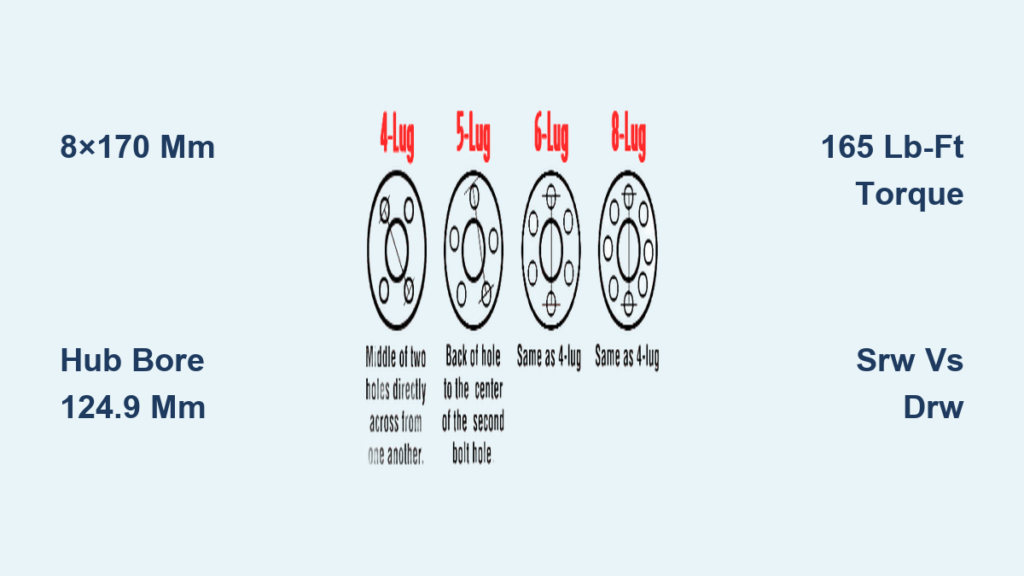
– Bolt pattern: 8×170 mm
– Hub bore: 124.9 mm
– Lug thread: M14 × 1.5 (metric)
– Torque spec: 165 lb-ft (224 Nm)
– Lug nut seat: 60° conical
All Super Duty generations from 1999 to 2026 share the same 8×170 mm pattern. A wheel that fits a 2003 F-250 will fit a 2025 model, as long as both are SRW.
Understanding the 1999 Split Year
The 1999 model year is a transitional year that causes frequent confusion. Three different configurations existed:
- 1999 F-250 Super Duty: Uses 8×170 mm
- 1999 F-250 Light Duty: Uses 7×150 mm
- 1999 F-250 Old Body Style: Some early 1999 models retained the older body style with 8×6.5 inch pattern
Verification by VIN is essential for any 1997–1999 F-250 before purchasing wheels.
Super Duty Hub Bore and Centering
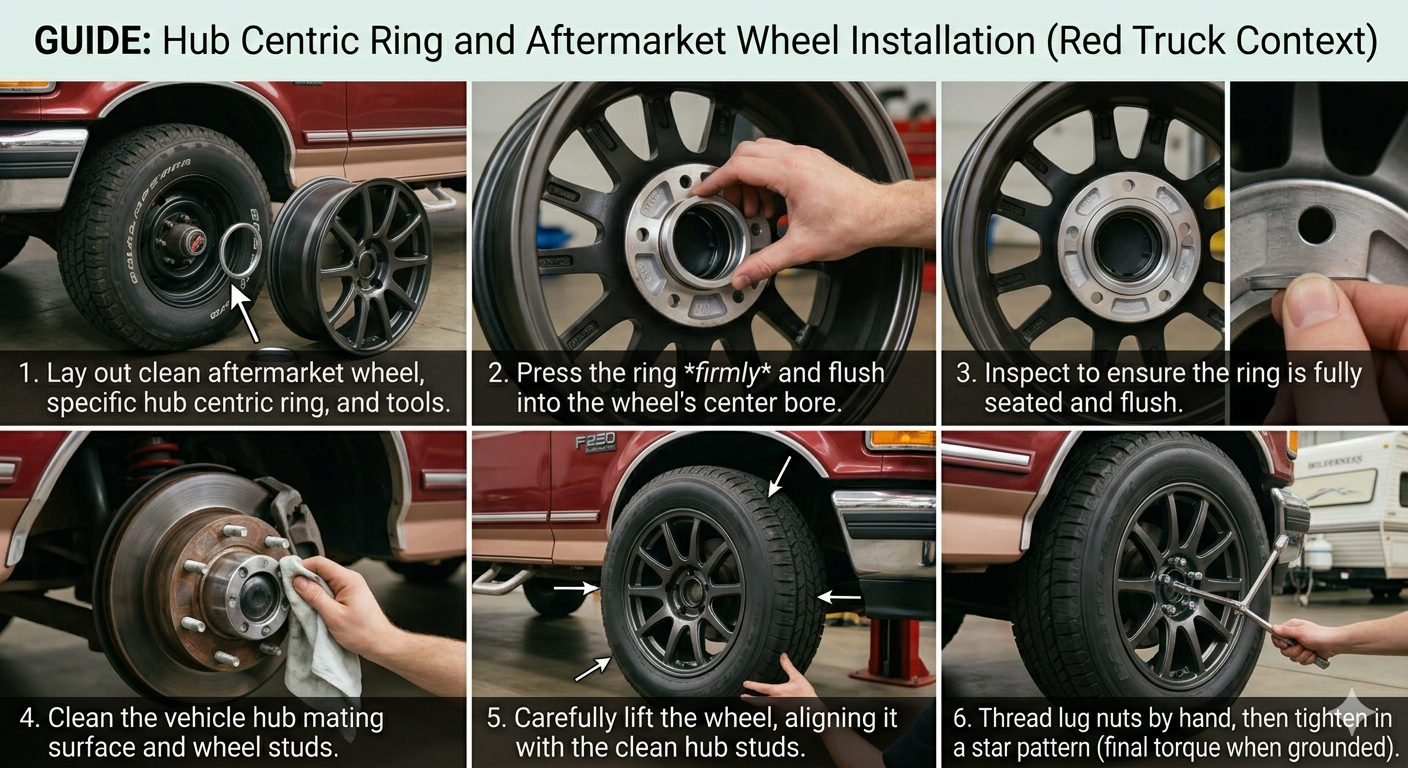
The hub bore (center bore) is just as important as the F250 bolt pattern. On Super Duty trucks, it measures 124.9 mm. This hole centers the wheel on the axle hub before the lug nuts take over.
Why Hub-Centricity Matters
If the wheel’s center bore is larger than 124.9 mm, the wheel floats on the lugs. That creates several problems:
– Lug nuts bear the entire load
– Increased vibration at highway speeds
– Uneven stress leading to stud fatigue
The solution is hub-centric rings. These plastic or aluminum spacers fit between the hub and wheel, ensuring perfect alignment. Never rely solely on lug nuts to center the wheel, even a slight wobble can cause premature wear.
Offset and Backspacing Explained

Offset determines how far the wheel sits in or out from the fender. It is measured in millimeters from the mounting surface to the wheel’s centerline.
Factory vs. Aftermarket Offset Ranges
- OEM offset: +40 mm to +50 mm (keeps the wheel tucked in)
- Aftermarket flush fit: +18 mm to +25 mm (wider stance, stable for towing)
- Aggressive negative offset: 0 mm to -12 mm (wheel protrudes, requires lift)
- Extreme stance: -25 mm to -44 mm (show builds, high rubbing risk)
Backspacing vs. Offset
Backspacing measures the distance from the mounting surface to the back of the wheel. Offset measures the distance from the mounting surface to the centerline. A 9-inch-wide wheel with -12 mm offset will sit further out than one with +40 mm, potentially interfering with fenders or control arms.
If the wheel sticks out past the fender flare, check for clearance during turns and suspension compression.
SRW vs. DRW Wheel Compatibility
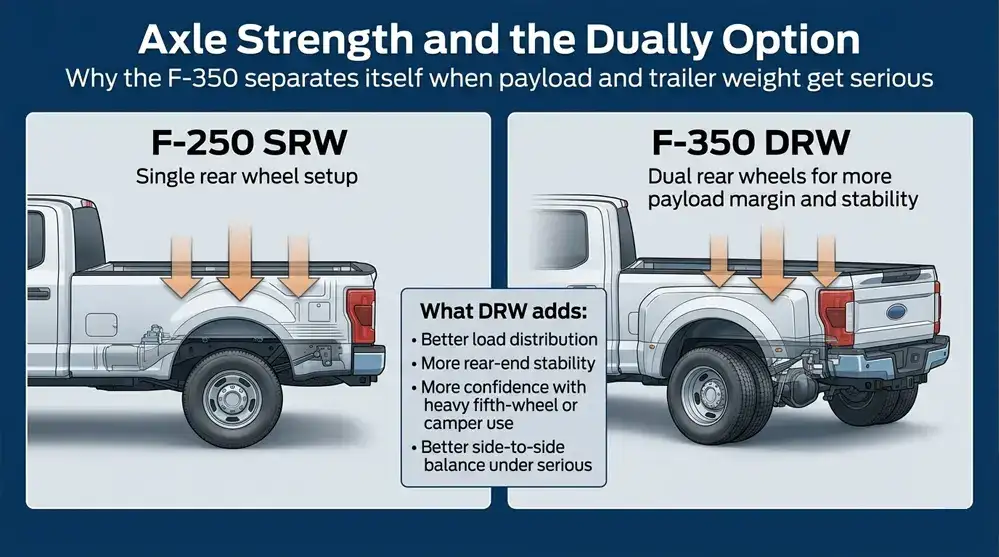
Single Rear Wheel (SRW) and Dual Rear Wheel (DRW) models are not interchangeable. Installing the wrong type causes uneven load distribution, tire rubbing, and overheating.
SRW (Single Rear Wheel)
- One wheel per side on the rear axle
- Standard 8×170 mm pattern
- Offset range: +18 to +40 mm
- Common widths: 7.5″ to 9″
DRW (Dual Rear Wheel / Dually)
- Two wheels per side
- Requires specific inner and outer wheels
- Inner wheel: high positive offset
- Outer wheel: lower positive offset
DRW owners must buy wheel kits designed specifically for dual setups. Never mix and match SRW and DRW components.
Best Wheel Sizes by Use Case

Choose wheel diameter based on how you use your truck, not just appearance.
17-Inch Wheels: Off-Road and Utility
Best for rock crawling, overlanding, and heavy-duty work. Taller sidewalls absorb impacts and allow you to air down for traction without bead separation.
Popular tire sizes:
– LT245/75R17
– LT265/70R17
– 35×12.5R17
Recommended wheels include Method 305 NV and Arkon Off-Road Lincoln (17×12).
18-Inch Wheels: Balanced Daily Driver
Best for commuting, light trails, and weekend adventures. This size offers good sidewall for comfort with a modern look.
Common sizes:
– LT275/65R18
– LT275/70R18
Top picks include Hostage D531 and Kipardo custom fitments.
20-Inch Wheels: Towing and Highway Stability
Best for heavy towing, fleet operations, and long-haul driving. Reduced sidewall flex improves load control and steering response.
Go-to tires:
– LT275/65R20
– 35×12.5R20
Recommended options include Kipardo 80227 and 80327.
22-Inch and Larger: Show and Stance
Best for urban builds and show trucks. Trade-offs include harsh ride quality, high curb damage risk, and minimal off-road capability.
Typical setups:
– 35×12.5R22
– 37×13.5R24 (requires 6″+ lift)
A single 24-inch forged wheel can cost $1,700 or more.
Installation: Torque and Safety Steps
Installing wheels incorrectly on an F-250 can lead to catastrophic failure. Follow these steps precisely.
Torque Specifications
| Era | Torque Spec |
|---|---|
| Classic (1953–1997) | 140–150 lb-ft |
| Super Duty (1999–2026) | 165 lb-ft (224 Nm) |
Step-by-Step Installation
- Clean the hub and wheel mounting surface to remove rust, dirt, and brake dust
- Align the wheel and hand-tighten lugs, ensuring the hub bore seats fully
- Tighten in a star pattern to prevent warping and uneven stress
- Torque to spec using a calibrated torque wrench (do not use an impact wrench alone)
- Re-torque after 50 miles, which is critical for new wheels or tires
Over-torquing stretches wheel studs. Under-torquing causes loosening. Both can result in wheel loss.
Wheel Construction: Cast vs. Flow-Formed vs. Forged

Wheel construction affects strength, weight, and price. Choose based on your load demands and terrain.
Cast Alloy Wheels
Molten aluminum is poured into a mold. These wheels are affordable and widely available but heavier and less impact resistant. Best for daily drivers and light use. Price range: $200–$400 per wheel.
Flow-Formed (Rotary Forged)
The barrel is spun, stretched, and compressed under pressure. This creates a stronger, lighter wheel than cast at mid-range cost. Best for overlanding and mixed-duty use. The Method 701 Bead Grip Trail is a top choice, offering 20% lighter weight than cast with better durability.
Forged Monoblock Wheels
Machined from a single solid block of aluminum under extreme pressure. These are the strongest, lightest, and most expensive option (up to $1,750+ per wheel). Best for extreme towing, rock crawling, and commercial fleets. Forged wheels resist cracking under repeated stress, making them ideal for 18,000-lb GVWR applications.
Common Fitment Mistakes to Avoid
Confusing 8×170 with 8×165.1
Both are 8-lug patterns but not interchangeable. The 4.9 mm difference prevents proper stud alignment. Measure your bolt pattern or use a bolt pattern gauge before ordering.
Ignoring Offset
Slapping on -44 mm wheels without a lift causes fender rubbing, radius arm contact, and accelerated bearing wear. Match offset to your suspension setup.
Skipping Hub-Centric Rings
Using wheels with a 140 mm bore on a 124.9 mm hub requires rings. The consequence of skipping them is vibration at 60 mph and uneven lug wear.
Mixing SRW and DRW Wheels
DRW trucks need paired inner and outer wheels. SRW wheels will not space correctly and create tire contact, overheating, and blowouts.
Thread Mismatch
Older F-250s use 9/16″-18 imperial threads. Super Duty models use M14 × 1.5 metric threads. Never force metric nuts on imperial studs or vice versa.
How to Verify Fitment Before Buying
Use this checklist before ordering wheels:
- Confirm model year and platform (1999+ likely means 8×170; 1997–1999 requires verification)
- Check axle type (SRW or DRW)
- Measure hub bore (target 124.9 mm for Super Duty)
- Determine use case (off-road, towing, or show)
- Validate load rating (wheel must meet or exceed GAWR)
- Check clearance (will it rub on stock suspension?)
Online fitment tools from retailers like Hardrock Offroad or Jim Burke Ford filter by F-250 year and 8×170 spec to simplify verification.
Frequently Asked Questions About F250 Bolt Pattern
What bolt pattern does a 1999 F-250 Super Duty use?
The 1999 F-250 Super Duty uses the 8×170 mm bolt pattern with M14 × 1.5 metric lug threads. However, 1999 was a split year, so some Light Duty models used 7×150 mm and some old body style trucks retained the 8×6.5 inch pattern. Always verify by VIN.
Are 8×170 and 8×165.1 wheels interchangeable?
No. Despite both being 8-lug patterns, the 4.9 mm difference in bolt circle prevents proper stud seating. Forcing the wrong wheel can cause stud failure, vibration, and wheel detachment. These patterns are not interchangeable under any circumstances.
What is the hub bore size on a Super Duty F-250?
The hub bore on all Super Duty F-250 models (1999–2026) is 124.9 mm. If you install aftermarket wheels with a larger center bore, you must use hub-centric rings to ensure proper centering and prevent vibration.
What torque spec should I use on F-250 lug nuts?
For Super Duty models (1999–2026), torque lug nuts to 165 lb-ft (224 Nm). For Classic models (1953–1997), use 140–150 lb-ft. Always use a calibrated torque wrench and tighten in a star pattern. Re-torque after 50 miles.
Can I put SRW wheels on a dually F-250?
No. SRW and DRW wheels are not interchangeable. DRW trucks require specific inner and outer wheels with specialized offsets to maintain proper dual tire spacing. Installing SRW wheels on a DRW axle causes uneven load distribution, tire overheating, and potential failure.
What wheel size is best for off-road F-250 builds?
17-inch wheels are preferred for off-road use because taller tire sidewalls absorb impacts, allow airing down for traction, and resist bead separation. Popular sizes include 35×12.5R17 on wheels with -12 to +1 mm offset.
Key Takeaways for F250 Bolt Pattern Fitment
The F250 bolt pattern depends entirely on your truck’s generation. 1999–2026 Super Duty models all use 8×170 mm with a 124.9 mm hub bore and M14 × 1.5 threads. Pre-1999 trucks may use 8×6.5 inch or the rare 7×150 mm Light Duty pattern, so always verify by VIN.
Remember these critical points:
– Torque Super Duty lug nuts to 165 lb-ft and re-check after 50 miles
– Use hub-centric rings when aftermarket wheel bores exceed 124.9 mm
– Match offset to your suspension setup and use case
– Never mix SRW and DRW wheels
– Buy from verified brands like Method, Fuel, Kipardo, Arkon, and Black Rhino
Choosing the right wheels for your F-250 is about safety, durability, and performance. Know your bolt pattern, respect the specs, and your truck will roll strong for years.