Your Ford F-150’s tailgate button stops working. No click, no response, just silence. But the key fob or dash button still opens the tailgate fine. You’re not alone. The F-150 tailgate button not working issue affects models from 2015 to 2024, especially Lariat, King Ranch, and XLT trims. While the rest of your truck runs perfectly, this one button fails. The good news? Most fixes are simple, affordable, and DIY-friendly. This guide cuts through the confusion with proven causes and real-world solutions from thousands of owner reports and technical data.
Decode Your Symptoms First
Start by checking which controls still work to narrow down the problem fast.
Test All Opening Methods
Check each opening method systematically. If your key fob opens the tailgate, the actuators and power are good. If the interior dash button works, the main system is functional. If the keypad or FordPass app works, the lock and unlock logic is intact. If only the tailgate-mounted button fails, the problem is isolated to the button circuit, wiring, or software input. This narrows your focus to five key areas: wiring, software, switch, fuse, or grounding.
Try the Double-Press Trick
For 2021 to 2024 models, Ford silently rolled out a double-press requirement to prevent accidental opening while driving. Many owners think their button failed when it just needs two quick presses. Press the tailgate button twice in rapid succession. If it opens, the issue is software-based, not hardware. This change was not consistently communicated by dealers or in owner manuals. Test both locked and unlocked states since some trucks require double-press only when locked.
Listen for Clues
Pay attention to sounds when pressing the button. Three beeps indicates obstruction detected, low battery, or software fault. A clicking noise means the actuator is trying but lacks power or torque. No sound at all means no signal is reaching the actuator, likely a wiring or fuse issue. Delayed response suggests a worn switch or corroded connector. These cues help you skip unnecessary part replacements.
Check Fuse 138 Under Load
A blown or weak fuse 138 is a common but overlooked cause of tailgate button failure.
Locate and Test Fuse 138
Fuse 138 is a 10-amp fuse in the Battery Junction Box on the right side of the engine compartment. Do not rely on visual inspection alone. A fuse can look intact but fail under load. Open the BJB cover and find fuse 138 using the diagram on the lid. Use a multimeter in voltage mode and probe both sides of the fuse while pressing the tailgate button. If no voltage appears on one side, the fuse is faulty or the circuit is open. Even if the fuse tests good, check for corrosion or loose connections in the BJB since moisture and road salt can degrade contacts over time.
Inspect Recall 19S48 Wiring Splices
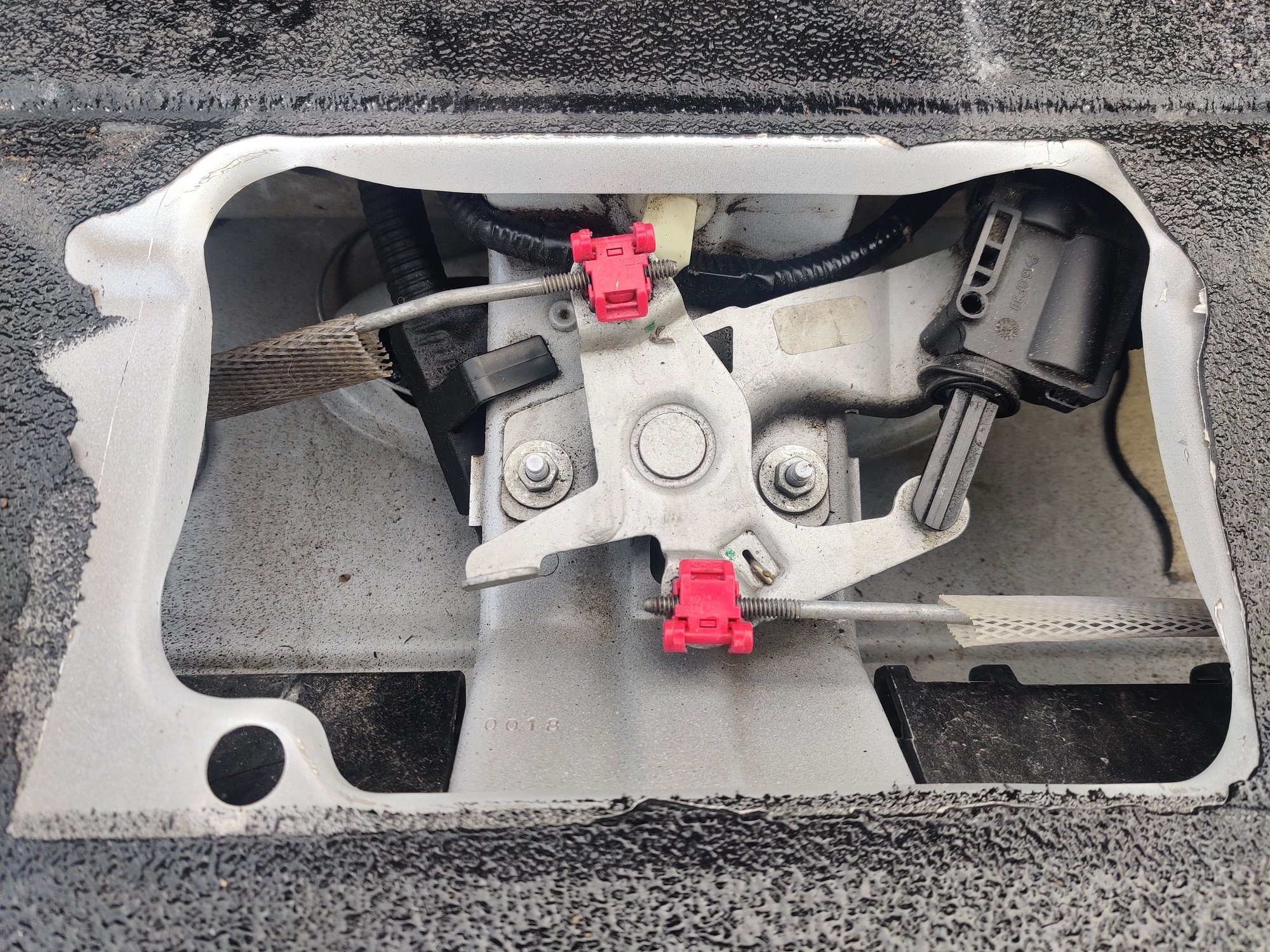
Ford issued Recall 19S48 to prevent unintended tailgate opening while driving. The fix required dealers to cut and re-splice two wires behind the spare tire, but many made mistakes leading to post-recall failures.
Find the Splice Location
Remove the spare tire and locate connector C4003, the main harness near the frame rail. Follow the wires at least 2 inches away from the connector since this is where splices should be. Look for splices that are too close to the connector, which are prone to stress. Check for electrical tape instead of heat shrink, which allows moisture to enter. Look for missing dielectric grease, which leads to corrosion. Check for cut or bypassed wires, which create an open circuit.
Repair Damaged Splices
If you find damaged splices, gather these tools: heat shrink tubing, soldering iron or crimp connectors, dielectric grease, and wire strippers. Cut out the damaged splice, strip and reconnect wires securely, seal with heat shrink tubing, and apply dielectric grease to prevent future corrosion. Re-route the harness if it’s rubbing against sharp edges.
Test the Tailgate Button and Wiring
If the fuse and wiring check out, test the button and actuator directly.
Remove Interior Tailgate Panel
Access the button and actuator by opening the tailgate and removing the eight screws on the sides and bottom. Pop out the two retaining rods and unclip the panel to lift it off. Do not force it. Use a plastic trim tool to avoid damaging the clips.
Check Voltage at Actuator
Locate the actuator connector behind the panel. Set your multimeter to DC voltage and have an assistant press the tailgate button. Probe the connector pins. You should see 12V signal when the button is pressed. No voltage means the problem is upstream, likely wiring, BCM, or fuse. Voltage present means the actuator or latch is faulty.
Replace the Tailgate Button Connector
If no voltage reaches the actuator, the button itself may be failing. Watch for these symptoms: intermittent response, delayed opening, or only works after multiple presses. Replace the connector with an OEM part costing around $65 to $83.
Diagnose Actuator and Latch Issues
Sometimes the button works but the tailgate still won’t open.
Listen for Clicking or Straining
If you hear clicking or motor strain but the tailgate won’t open, the actuator is weak or failing. This happens due to motor wear over time, water intrusion, or overload from misaligned latches. Replace the actuator, which costs around $80. Lubrication won’t fix a weak motor.
Check Latch Alignment and Resistance
Even a strong actuator can’t open the tailgate if the latches are binding. Press the button while gently pushing the tailgate toward the cab. Try lifting upward slightly. If it opens with pressure, the latch pins are misaligned. Use a Torx wrench to loosen the latch bolts, reposition them to align with the striker pins, then retighten and test.
Eliminate Mechanical Interference
Sometimes the problem isn’t electrical at all.
Fix Twisted Rubber Bumpers
Rubber bumpers at the top corners of the tailgate can rotate out of position and create resistance. The system detects this as an obstruction and refuses to open. Inspect both bumpers and rotate them back to factory orientation with the flat side facing up. Test the button afterward.
Check Tonneau Cover Fit
A tight or misaligned tonneau cover can prevent full latching. The first press detects resistance and refuses to release. The second press overrides and the tailgate opens. Realign or loosen the tonneau rails and ensure the tailgate fully latches when closed.
Reset Software and Modules
Software glitches can disable the tailgate button without any hardware damage.
Perform a BCM Reset
Turn off the ignition and open the hood. Disconnect the 12V positive terminal and wait 15 seconds. Reconnect and tighten, then test the button. This resets the Body Control Module and clears temporary faults.
Check Valet Mode
Valet mode disables the tailgate release but sometimes doesn’t reset properly. Enable valet mode via settings, then disable it, and test the button.
Update FordPass and Firmware
After OTA updates, some trucks lose tailgate button function. Open the FordPass app, log out and back in, and reset the vehicle connection. Request a manual software update at the dealership if needed.
Prevent Future Failures
Regular maintenance prevents expensive repairs down the road.
Seal and Protect Recall Splices
After working on Green/White or Brown/Yellow wires, use heat shrink tubing, not tape. Apply Motorcraft XG-12 dielectric grease to all connectors and route the harness away from sharp edges.
Annual Harness Inspection
Once a year, remove the spare tire and inspect connectors and splices for corrosion. Clean and re-grease if needed. Check the tailgate hinge wiring for chafing.
Monitor Software After Updates
After any dealer service, test all tailgate functions. Verify button behavior and reset the FordPass app if the connection is lost.
Consider Manual Tailgate Conversion
If you’ve had repeated failures, consider converting to a manual tailgate.
When to Switch to Manual
Manual tailgates have no wiring, fuses, or software to fail. They are immune to recalls and updates. The benefits include lower long-term maintenance. The cost is $100 to $200 for a kit, plus optional paint to match. DIY installation takes 1 to 2 hours.
Is It Worth It?
Electronic tailgates are convenient but prone to wiring, software, and actuator issues. Manual tailgates are less convenient but infinitely more reliable. For work trucks, off-road use, or long-term ownership, manual conversion is a smart investment.
Final Diagnosis and Repair Summary
Most Common Causes Ranked
The most common causes in order are: faulty recall splices on the Green/White or Brown/Yellow wires, especially post-19S48. Software change requiring double-press that was not communicated. Failing tailgate button connector from mechanical wear. Weak actuator that clicks but won’t open. No power due to fuse 138 that must be tested under load.
Step-by-Step Fix Order
Start by trying the double-press on 2021 and newer models. Disconnect the battery for 15 seconds. Test fuse 138 with a multimeter. Inspect wiring behind the spare tire. Check for voltage at the actuator. Replace the button or actuator if needed. Convert to manual if chronic issues persist.
Cost and DIY Feasibility
Double-press test costs $0 with high DIY feasibility. Battery reset costs $0 with high DIY feasibility. Fuse 138 check costs $0 with high DIY feasibility. Resoldering splices costs $10 to $30 and requires advanced skills. Replacing the button costs $65 to $83 with medium difficulty. Replacing the actuator costs around $80 with medium difficulty. Manual conversion costs $100 to $200 with high DIY feasibility. Dealership repairs can cost $350 or more, mostly in labor, while most fixes are under $100 and DIY-friendly.
Frequently Asked Questions About F-150 Tailgate Button Issues
Why does my F-150 tailgate button not work but the key fob does?
This indicates the problem is isolated to the button circuit, wiring, or software input rather than the actuator or main power system. The actuators and power are functioning normally since the key fob still works.
How do I fix the double-press requirement on my 2021-2024 F-150?
Try pressing the tailgate button twice in rapid succession. If this works, your button is functioning correctly. The software simply changed to prevent accidental opening. You can also use FORScan to reprogram the BCM and restore single-press preference.
Where is fuse 138 located on my F-150?
Fuse 138 is a 10-amp fuse in the Battery Junction Box on the right side of the engine compartment. You must test it with a multimeter under load since visual inspection is not reliable.
Can I fix the Recall 19S48 wiring splice issue myself?
Yes, with advanced DIY skills. You need heat shrink tubing, soldering equipment or crimp connectors, dielectric grease, and wire strippers. Cut out damaged splices, reconnect wires securely, seal with heat shrink, and apply dielectric grease.
When should I convert to a manual tailgate?
Consider conversion if you have chronic electronic failures, prioritize reliability over convenience, use the truck for work or off-road purposes, or want to avoid future software and wiring issues.
Key Takeaways for Fixing Your F-150 Tailgate Button
The F-150 tailgate button issue is not random. It follows clear patterns that you can diagnose and fix. Start with software checks like the double-press trick and battery reset, then move to hardware verification including fuse 138 testing and voltage checks at the actuator. Inspect wiring behind the spare tire for recall-related splice damage. Avoid unnecessary part replacements by verifying voltage and signals first. Most fixes cost under $100 and are DIY-friendly, while dealership repairs can run $350 or more. If you experience chronic failures, manual tailgate conversion offers the most reliable long-term solution with no electrical or software dependencies.