Choosing the right Ford F250 bed size is one of the most important decisions you’ll make when buying a Super Duty truck. The 6.75-foot short bed and 8-foot long bed options directly affect how much you can haul, how easily you maneuver, and whether your truck fits in your garage. With consistent dimensions from 2017 through 2026, Ford has standardized its F-250 bed sizes across gas and diesel models, making configuration comparisons straightforward.
This guide covers everything from interior width between wheel wells to overall vehicle length. Whether you haul plywood, mount a slide-in camper, or tow a fifth-wheel trailer, understanding these specs will help you pick the perfect bed for your needs.
Short Bed vs. Long Bed: Key Differences

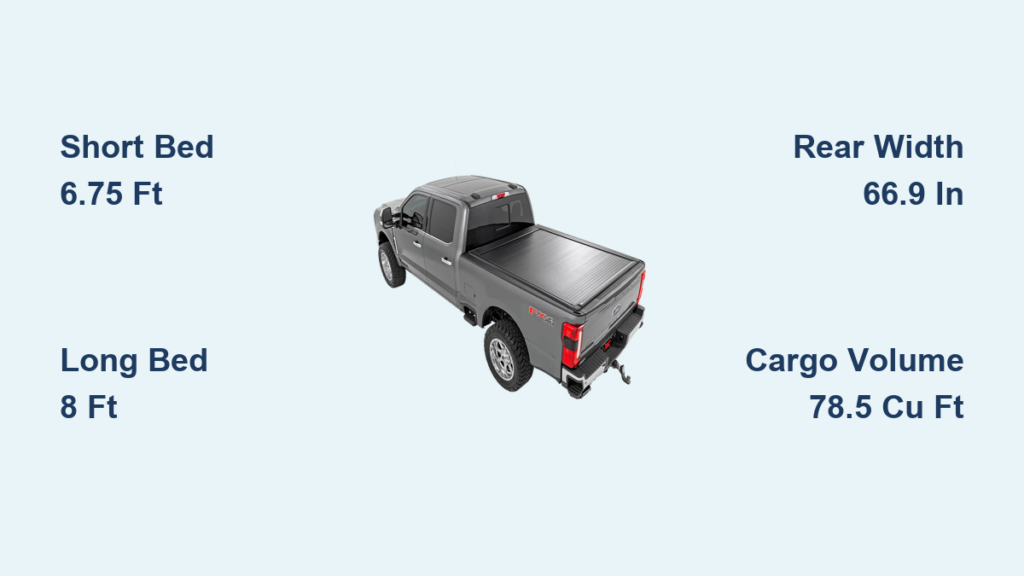
The Ford F-250 Super Duty offers two fixed bed lengths: the 6.75-foot (81.9″) short bed and the 8-foot (98.1″) long bed. Both deliver rugged utility but serve different purposes.
The short bed prioritizes maneuverability and urban usability. It’s ideal for contractors who need cargo space without the bulk, or drivers who want better visibility and tighter turning in traffic. Despite being shorter, it still holds 65.4 cubic feet of cargo, enough for most job materials.
The long bed delivers maximum hauling capacity at 78.5 cubic feet. It’s the go-to for construction crews, farmers, and RV enthusiasts who regularly transport full 8-foot lumber or drywall. Its extended length also improves stability when fifth-wheel towing.
Which Cab Fits Which Bed?
Not all cabs can pair with both bed sizes. Your cab choice locks in certain bed options:
| Cab Type | 6.75-Foot Bed | 8-Foot Bed | Notes |
|---|---|---|---|
| Regular Cab | Not Available | Standard | Only available with 8-foot bed |
| SuperCab | Available | Available | Most flexible combo |
| Crew Cab | Available | Available | Most popular; best rear seating |
Regular Cab buyers get the 8-foot bed only, ideal for fleet work where passenger space isn’t a priority. SuperCab and Crew Cab owners enjoy full flexibility to balance passenger room and bed length.
Real-World Cargo Capacity
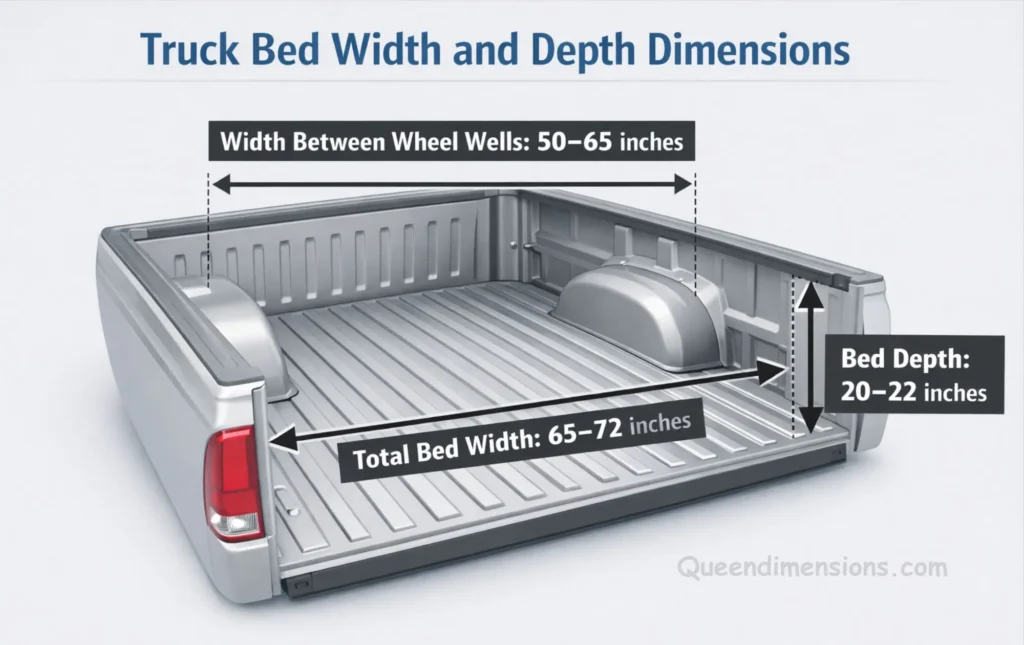
While total volume matters, usable space often comes down to width between wheel wells and floor length.
- Inside width between wheelhouses: 50.5 inches, fits standard 4×8 sheets of plywood flat across the bed.
- Inside floor width: 66.9 inches, allows full-width cargo placement outside wheel well constraints.
- Bed height: 21.1 inches, provides ample depth for stacking materials.
Both bed sizes share identical cross-sectional dimensions; only length differs.
Measure Bed Interior Dimensions Accurately
When loading large items, knowing exact internal measurements prevents guesswork.
Short Bed Interior Specs (6.75-Foot)
- Inside floor length: 81.9 inches
- Top-of-rail length: approximately 80.3 inches
- Floor width: 66.9 inches
- Wheel-to-wheel width: 50.5 inches
- Height: 21.1 inches
- Cargo volume: 65.4 cu. ft.
Perfect for lumber up to 8 feet (with tailgate down), standard pallets (48″ wide), and compact job boxes.
Long Bed Interior Specs (8-Foot)
- Inside floor length: 98.1 inches
- Top-of-rail length: approximately 96.4 to 97.6 inches
- Floor width: 66.9 inches
- Wheel-to-wheel width: 50.5 inches
- Height: 21.1 inches
- Cargo volume: 78.5 cu. ft.
Advantages include full 8-foot sheets lying flat inside the bed, extra 16.2 inches of floor length, and better weight distribution for heavy loads.
Pro Tip: Always measure your largest cargo before buying. Even with 50.5″ clearance, bed liners or stake pockets can reduce usable width by 1 to 2 inches.
Check Garage Fit Before Buying
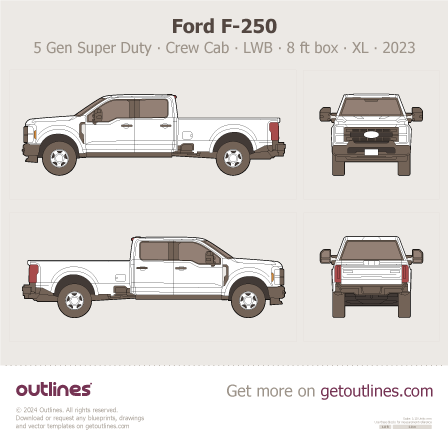
One of the most common mistakes is buying a Crew Cab with an 8-foot bed and discovering it won’t fit in a standard 20-foot garage.
Will Your F-250 Fit in a 20-Foot Garage?
| Configuration | Overall Length | Garage Fit? | Clearance |
|---|---|---|---|
| Regular Cab + 8-ft Bed | 231.8″ (19.3′) | Yes | ~10″ |
| SuperCab + 6.75-ft Bed | 238.2″ (19.85′) | Yes | ~22″ |
| Crew Cab + 6.75-ft Bed | 250.0″ (20.8′) | No | +10″ over |
| SuperCab + 8-ft Bed | 254.4″ (21.2′) | No | +14″ over |
| Crew Cab + 8-ft Bed | 266.2″ (22.18′) | No | +26″ over |
Only Regular Cab and SuperCab with short bed reliably fit in a standard 20-foot-deep garage. Crew Cab models require a deeper garage or driveway parking.
Maneuverability Impact
Shorter wheelbase means tighter turns. The Crew Cab 6.75-ft has a 159.7″ wheelbase, while the Crew Cab 8-ft extends to 175.9″. Turning radius increases by up to 3 feet with the long bed. Urban drivers, delivery crews, and job sites benefit from the 6.75-foot bed’s superior agility.
Understand Payload and Towing Effects
Bed size doesn’t change towing capacity, but it does affect payload and trailer handling.
Does Bed Length Affect Payload?
Yes, slightly. The long bed adds weight due to extended frame and steel construction.
| Configuration | Max Payload (Approx.) | Notes |
|---|---|---|
| Regular Cab + 8-ft | Up to 4,268 lbs | Highest payload |
| SuperCab + 8-ft | Up to 4,204 lbs | Strong commercial use |
| SuperCab + 6.75-ft | Up to 4,015 lbs | Slight drop due to short bed frame |
| Crew Cab models | Varies by trim | Heavier cab reduces payload vs SuperCab |
Switching from short to long bed typically reduces payload by approximately 100 lbs due to added structural weight.
Towing: Short Bed vs. Long Bed
Towing capacity is unchanged between bed lengths with the same engine and drivetrain. However, fifth-wheel and gooseneck towing favors the 8-foot bed. It provides more clearance between cab and trailer during sharp turns, reduces risk of cab damage, and allows use of stationary hitches without sliding mechanisms.
Warning: Using a 6.75-foot bed for fifth-wheel towing requires a sliding hitch or extreme caution when turning. Without one, the trailer overhang can strike the cab.
Compare Bed Features and Utility Upgrades
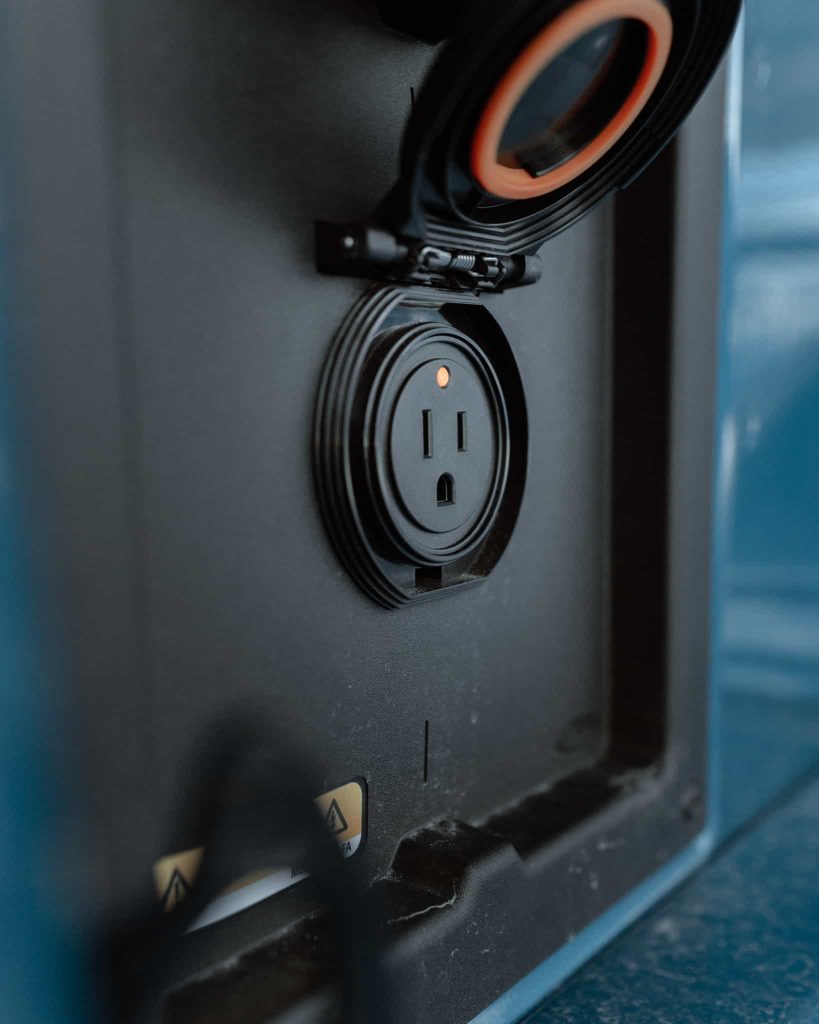
Both bed sizes come with advanced features to boost functionality.
Standard and Available Bed Features
- Rear Corner Steps: Molded into bumper corners for easy bed access
- LED Bed Lighting: Bright overhead lights in front corners
- BoxLink™ System: Cleats and tracks for tie-down straps and dividers
- Tailgate Options: Standard manual, power tailgate with camera, or WorkSurface tailgate with ruler and clamp pockets
- Pro Power Onboard: Up to 2.0 kW in-bed outlets to power tools, lights, or appliances
- Onboard Scales: Optional real-time payload monitoring via dashboard
- Power Take-Off (PTO): For operating hydraulic equipment directly from engine
These features are available on both bed sizes, so utility isn’t compromised by choosing shorter length.
Best for Slide-In Campers?
Both beds support slide-in campers, but payload is key. The short bed has a lower max payload, so verify camper weight carefully. The long bed offers higher payload potential and better weight balance. Always check the yellow payload sticker on the driver’s door jamb before installing.
Pro Tip: Use the 50.5-inch wheel-to-wheel width to position camper feet securely over frame rails.
Know Exterior Dimensions for Parking
Total length, width, and height determine where you can park and drive.
Overall Dimensions by Configuration
| Feature | All Models |
|---|---|
| Width (excl. mirrors): | 80.0 inches |
| Width (incl. mirrors): | 105.9 inches |
| Height range: | 78.9″ – 81.6″ |
| Ground clearance: | 9.2″ – 10.2″ |
Most F-250s clear a 7-foot garage door, but lifted models or those with roof lights may not. Always measure if clearance is tight.
Wheelbase by Setup
| Configuration | Wheelbase |
|---|---|
| Regular Cab + 8-ft | 141.4″ |
| SuperCab + 6.75-ft | 147.8″ |
| Crew Cab + 6.75-ft | 159.7″ |
| SuperCab + 8-ft | 164.1″ |
| Crew Cab + 8-ft | 175.9″ |
Longer wheelbases improve ride smoothness but reduce maneuverability.
Choose Based on Your Needs

Who Should Choose the 6.75-Foot Bed?
- Daily drivers who want a full-size truck with better handling
- Urban contractors needing cargo space without garage issues
- Families using Crew Cab for passengers and occasional hauling
- Towing bumper-pull trailers (no fifth-wheel)
This bed fits tighter spaces, parks more easily, delivers slightly better fuel efficiency, and enjoys high resale demand.
Who Should Choose the 8-Foot Bed?
- Construction crews hauling full sheets of lumber or drywall
- Farmers and ranchers moving feed, fencing, or equipment
- Fifth-wheel RV owners needing cab clearance
- Commercial fleets prioritizing utility over comfort
This bed offers maximum cargo volume, flat 8-foot loading, superior towing stability, and ideal support for slide-in equipment.
Frequently Asked Questions About Ford F250 Bed Size
How wide is the bed between the wheel wells?
50.5 inches, the same for both bed sizes. Standard 48-inch-wide pallets fit perfectly.
Does the 6.75-foot bed fit a 4×8 sheet?
Yes, but only diagonally or with the tailgate down. For flat, in-bed transport, choose the 8-foot bed.
Can I tow a fifth-wheel with a short bed?
Yes, but only with a sliding hitch. The 8-foot bed allows safer turning without modifications.
Is there a 5.5-foot bed on the F-250?
No. Unlike the F-150, the F-250 only comes in 6.75-foot and 8-foot beds.
Do bed sizes change in 2026?
No. The 2026 F-250 retains the same 6.75-ft and 8-ft bed dimensions as 2017–2024 models.
Does bed length affect fuel economy?
Slightly. The 8-foot bed adds weight and drag, but engine and driving habits have a bigger impact.
Key Takeaways for Choosing Your Ford F250 Bed Size
The Ford F250 bed size decision ultimately comes down to balancing use case against convenience. The 6.75-foot bed wins for daily usability, garage fit, and urban maneuverability. The 8-foot bed dominates in hauling capacity, flat-load capability, and fifth-wheel towing stability.
Before finalizing your choice, measure your largest typical cargo, check your garage depth, and test-drive both configurations if possible. Match your cab and bed wisely, because once you’re hauling 4×8 sheets or backing into a tight job site, there’s no room for compromise. Visit your local Ford dealer to see both options in person and confirm exact specs for your preferred trim.