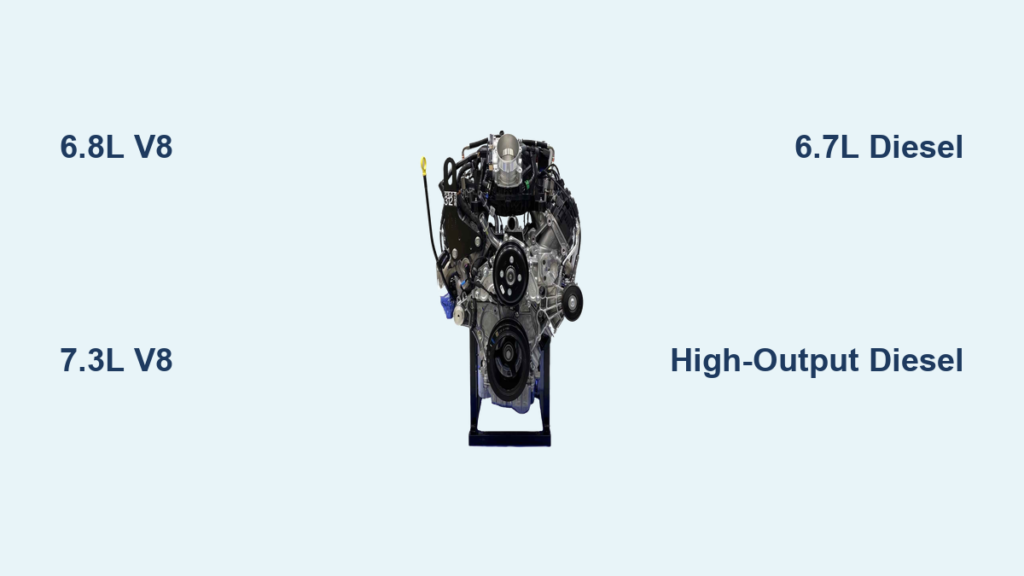
Picking the wrong F-250 engine size can leave you underpowered for heavy hauls or overspending on capability you never use. Ford’s Super Duty lineup now offers four distinct engines, ranging from a capable 6.8L gas V8 to the torque-monster 6.7L High-Output Power Stroke® diesel producing 1,200 lb.-ft. Each engine serves a specific purpose, whether you’re towing a fifth-wheel RV across states or loading 4,200+ lbs of materials into the bed.
This guide breaks down every current F-250 engine size, compares real-world towing and payload numbers, and matches each powertrain to the jobs it handles best. By the end, you’ll know exactly which engine fits your truck-buying checklist.
Current F-250 Engine Options (2024–2026)
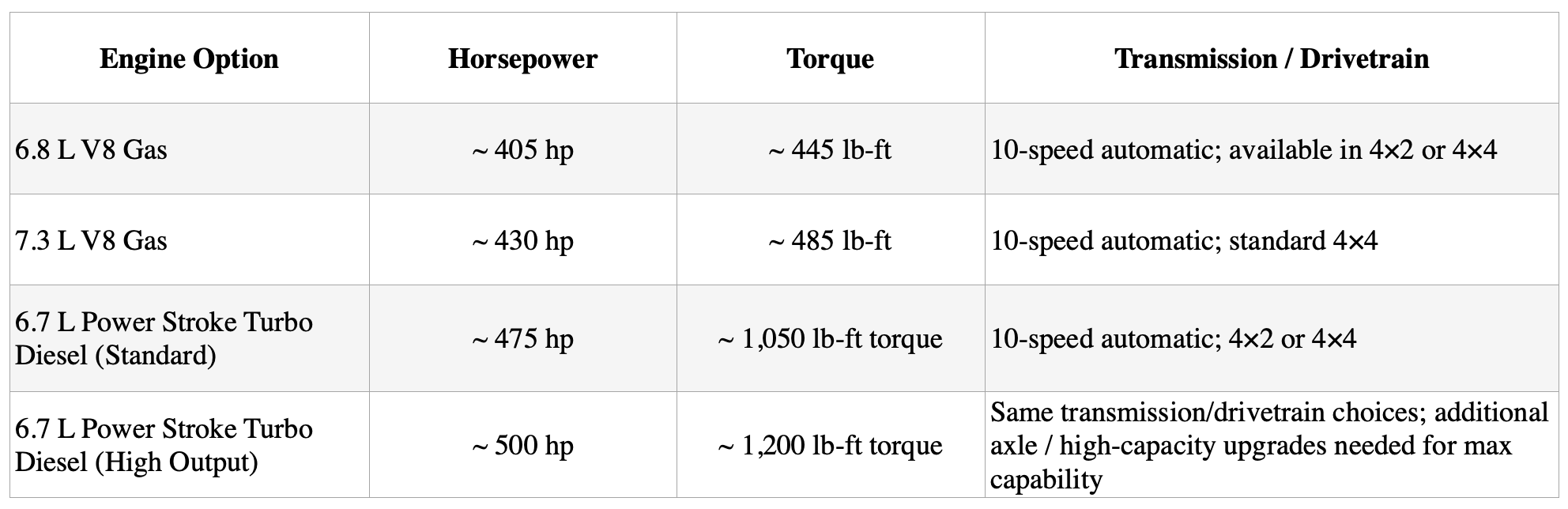
Ford’s modern four-engine portfolio replaced the older three-engine setup, giving buyers more flexibility across work and lifestyle needs.
6.8L V8 Gas Engine
The 6.8L V8 is the standard engine on XL, XLT, and Lariat trims from 2024 through 2026. It replaced the older 6.2L V8 with stronger output and smoother delivery.
- Horsepower: 405 HP @ 5,500 RPM
- Torque: 445 lb.-ft. @ 4,000 RPM
- Transmission: 10-speed automatic
- Drivetrain: 4×2 and 4×4 available
- Max Towing (2025): 17,300 lbs (conventional and fifth-wheel)
- Max Payload (2025): 4,240 lbs
This engine hits the sweet spot for buyers who tow occasionally but haul frequently. It delivers the highest payload among current options while keeping upfront costs reasonable.
Pro Tip: The 6.8L V8’s 4,240+ lb payload rating makes it ideal for contractors loading heavy toolboxes, pavers, or landscaping materials.
7.3L V8 Gas Engine (“Godzilla”)
Nicknamed “Godzilla” for its massive displacement, the 7.3L V8 is Ford’s largest gas engine and comes standard on King Ranch and Platinum trims.
- Horsepower: 430 HP (2020–2024) or 475 HP (2025–2026)
- Torque: 475 lb.-ft. (2020–2024) or 485 lb.-ft. (2025–2026)
- Configuration: OHV pushrod with port fuel injection
- Construction: Cast-iron block, forged-steel crankshaft, four-bolt main bearings
- Max Towing (2025): 18,200 lbs conventional / 19,500 lbs fifth-wheel
- Max Payload: 4,246 lbs
The pushrod design prioritizes low-end torque and mechanical simplicity. Fleet operators and heavy haulers favor this engine for its durability under continuous stress.
Why It Matters: The cast-iron block resists warping and cracking far better than aluminum, especially during sustained heavy loads or extreme temperatures.
6.7L Power Stroke® Standard-Output Diesel
For serious towing capability, the 6.7L Power Stroke® diesel in standard-output form delivers torque figures that gas engines can’t match.
- Horsepower: 475 HP
- Torque: 1,050 lb.-ft. @ 1,600 RPM
- Transmission: 10-speed automatic
- Max Towing (2025–2026): 22,000 lbs conventional / up to 22,900 lbs fifth-wheel
- Max Payload: 4,048 lbs
Key upgrades since 2020 include a 36,000-psi fuel injection system and an electric variable-geometry turbocharger. These improvements sharpen throttle response and cold-weather starting.
Real-World Benefit: Peak torque arrives just off idle, so this engine pulls steep grades with heavy trailers without constant downshifting.
6.7L High-Output Power Stroke® Diesel
The High-Output (HO) diesel sits at the top of the F-250 powertrain hierarchy, delivering the highest tow rating in the lineup.
- Horsepower: 500 HP
- Torque: 1,200 lb.-ft. @ 1,600 RPM
- Max Towing (2026): 23,000 lbs fifth-wheel/gooseneck
- Max Payload: 3,918 lbs
Payload drops slightly compared to other engines due to added diesel components, but no other F-250 matches its pulling authority. It’s available across all trims for buyers who need maximum capability.
Expert Note: Reaching 23,000 lbs requires a fifth-wheel or gooseneck hitch. Bumper-pull configurations cap at 22,000 lbs.
Legacy Engine: 6.2L V8 (2020–2021)
Before the 6.8L V8 arrived, the 6.2L 2-valve SOHC flex-fuel V8 served as the standard F-250 powerplant.
- Horsepower: 385 HP
- Torque: 430 lb.-ft.
- Transmission: TorqShift® G 6-speed automatic
- Max Towing: 15,000 lbs
This engine remains reliable for used buyers, but it falls short of current models in both power and transmission refinement. The 6-speed unit shifts more frequently under load compared to today’s 10-speed.
Engine Availability by Trim Level
Ford restricts certain engines based on trim hierarchy, so your trim choice affects which F-250 engine size you can select.
XL, XLT, and Lariat Trims
- Standard Engine: 6.8L V8
- Available Upgrades: 7.3L V8, 6.7L standard diesel, 6.7L HO diesel
- Best For: Buyers wanting full engine flexibility without premium luxury features
King Ranch and Platinum Trims
- 6.8L V8: Not available
- Standard Engine: 7.3L V8
- Available Upgrades: Both 6.7L diesel variants
- Why: Ford reserves its largest gas and diesel engines for premium trims, matching buyer expectations for high performance
Key Takeaway: If the 6.8L V8 is your target, stick with XL, XLT, or Lariat. If you want the 7.3L or diesel, King Ranch and Platinum deliver them as standard or optional.
Transmission and Drivetrain Pairings
Every current F-250 engine shares the same transmission, but drivetrain availability varies.
10-Speed TorqShift® Automatic
- Replaces the older 6-speed in 6.2L models
- Optimizes gear spacing for towing and fuel economy
- Reduces shift shock and gear hunting on inclines
The wider gear ratio spread keeps the engine in its optimal power band, especially when pulling heavy loads.
Drivetrain Options
- 6.8L V8: 4×2 and 4×4
- 7.3L V8: Primarily 4×4 in 2025–2026; 4×2 available in select earlier configurations
- Diesel Engines: 4×2 and 4×4 across all trims
Note: The 7.3L’s shift toward 4×4-only availability reflects its positioning as a heavy-duty workhorse for rough terrain and job sites.
Towing and Payload Comparison
Your job type determines whether maximum towing or maximum payload matters more.
Max Towing by Engine
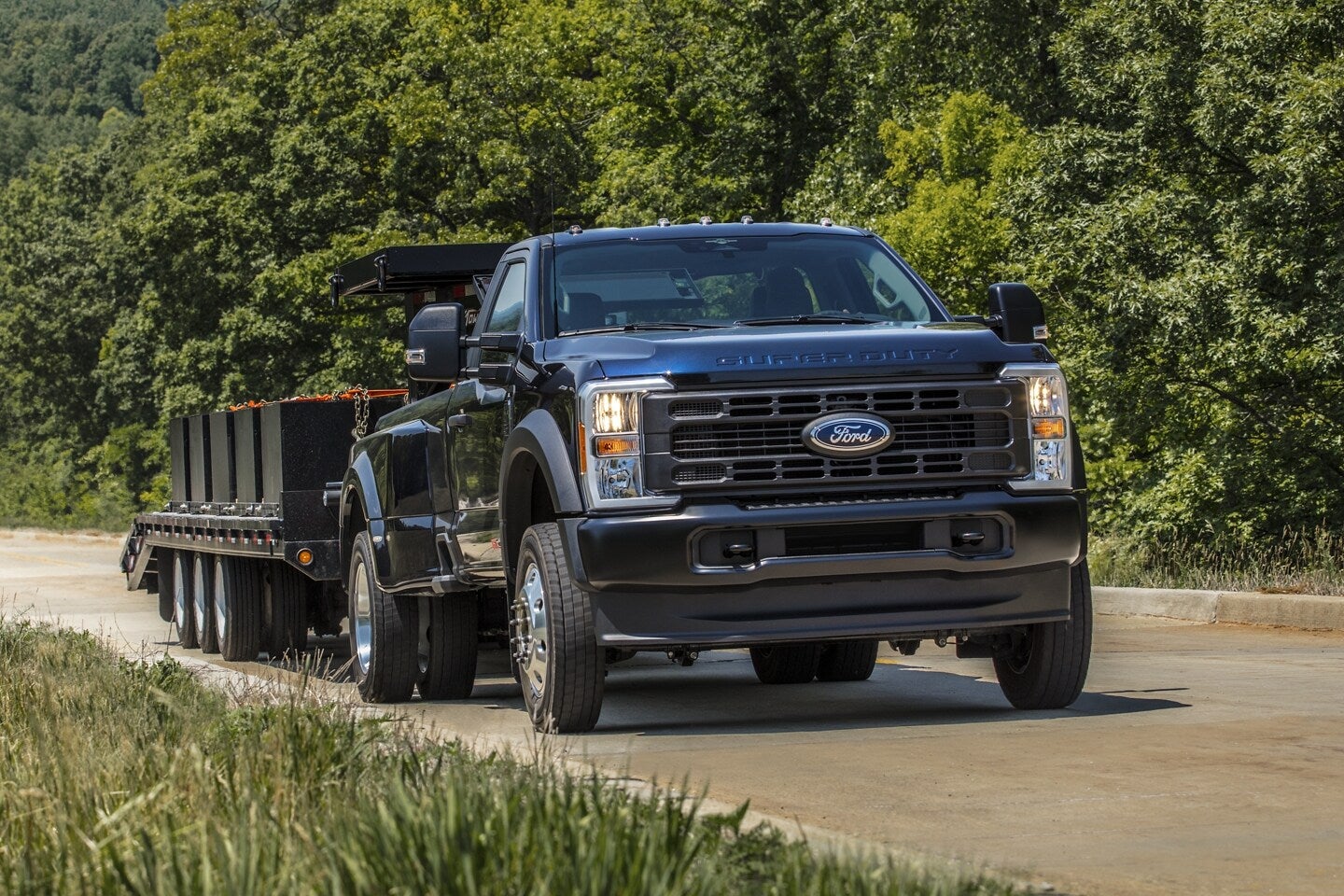
| Engine | Max Fifth-Wheel/Gooseneck Towing |
|---|---|
| 6.8L V8 | 17,300 lbs (2025) |
| 7.3L V8 | 19,500 lbs (2025) |
| 6.7L Diesel (Std) | 22,900 lbs (2026) |
| 6.7L Diesel (HO) | 23,000 lbs (2026) |
Bottom Line: Diesel engines unlock the highest tow ratings. The HO diesel is the only F-250 engine rated for 23,000 lbs.
Max Payload by Engine

| Engine | Max Payload |
|---|---|
| 6.8L V8 | 4,268 lbs (2024) |
| 7.3L V8 | 4,246 lbs |
| 6.7L Diesel (Std) | 4,048 lbs |
| 6.7L Diesel (HO) | 3,918 lbs |
Critical Insight: Gas engines deliver higher payload because they weigh less. For bed-heavy hauling, the 6.8L or 7.3L V8 is the stronger choice.
Performance Technologies
Ford equips the F-250 with smart features that help every F-250 engine size perform at its peak.
Drive Modes
- Standard Modes: Normal, Eco, Slippery, Tow/Haul
- Off-Road Modes (Tremor® Package): Rock Crawl, Trailer Control
Tow/Haul mode adjusts shift logic to minimize gear hunting on climbs and manage downshifting on descents.
Towing Assist Features
- Smart Hitch: Guides trailer coupler alignment
- Tailgate Camera: Provides close-up hitching view
- Trailer Reverse Guidance: Simplifies backing maneuvers
- Onboard Payload Scales: Displays real-time bed weight
Pro Tip: Check payload scales before departure to confirm you’re within GVWR limits and avoid fines or mechanical strain.
Gas vs. Diesel: Which F-250 Engine Size Fits Your Needs?
The gas-versus-diesel decision shapes both your budget and daily driving experience.
Choose Gas If:
- You need maximum payload over 4,200 lbs
- You want lower upfront cost
- You drive fewer annual miles
- You prefer simpler maintenance
Best for: Contractors, landscapers, and occasional haulers.
Choose Diesel If:
- You regularly tow over 15,000 lbs
- You value fuel efficiency under load
- You drive long distances with trailers
- You need maximum low-RPM torque
Best for: RV owners, farmers, and commercial operators.
Durability Note: Both the 7.3L gas and 6.7L diesel use forged internals and reinforced blocks designed to withstand heavy stress over hundreds of thousands of miles.
Cab and Bed Configurations
Engine choice doesn’t restrict cab or bed options. All engines support the following:
- Regular Cab: 3 passengers, 8-ft bed
- SuperCab: 6 passengers, 6.75-ft or 8-ft bed
- Crew Cab: 6 passengers, 6.75-ft or 8-ft bed
Crew Cab offers the most interior cargo space at 53.4 cu.-ft., making it ideal for storing tools or transporting a work crew.
Frequently Asked Questions About F-250 Engine Size
What Is the Largest F-250 Engine by Displacement?
The 7.3L V8 gas engine has the largest displacement at 7.3 liters. The 6.8L V8 and 6.7L diesel follow in size.
Which F-250 Engine Has the Most Horsepower?
The 6.7L High-Output Power Stroke® diesel leads with 500 HP. The 7.3L V8 reaches 475 HP in 2025–2026 models.
Which F-250 Engine Produces the Most Torque?
The High-Output diesel generates 1,200 lb.-ft. of torque, making it the most torque-rich F-250 engine ever offered.
Can I Get the 6.8L V8 on a Platinum Trim?
No. The 6.8L V8 is not available on King Ranch or Platinum trims. These models come standard with the 7.3L V8.
Does the 7.3L V8 Use a Turbocharger?
No. The 7.3L V8 is naturally aspirated. It generates power through displacement and pushrod efficiency rather than forced induction.
What Transmission Comes With Every F-250 Engine?
All current F-250 engines (2024–2026) pair with a TorqShift® 10-speed automatic transmission.
Key Takeaways for Choosing Your F-250 Engine Size
The right F-250 engine size depends entirely on what you haul and how often. For maximum payload and budget-friendly operation, the 6.8L V8 or 7.3L V8 delivers strong results without diesel costs. For unmatched towing and low-end grunt, the 6.7L High-Output Power Stroke® diesel stands alone at 23,000 lbs capacity.
Before visiting a dealer, list your typical tow weights, payload needs, and annual mileage. Match those numbers to the engine specs above, then test-drive your top two choices. With the right engine selected, your F-250 becomes a true powerhouse ready for job sites, highways, and everything in between.