Your Ford F-250 won’t start on a freezing morning, and you’re stuck wondering if you grabbed the wrong battery. The Ford F-250 Super Duty uses different battery sizes depending on model year, engine type, and electrical demands. While Group 65 and Group 31 are the most common fitments, installing the wrong size or underpowered battery leads to poor cranking, shortened lifespan, and failure in extreme conditions.
This guide breaks down exactly which battery size fits your F-250, what performance specs matter most, and how to choose between gas and diesel requirements. Whether you’re replacing a dead battery or upgrading for towing reliability, you’ll get model-specific recommendations based on real fitment data and performance benchmarks.
Choose the Right Battery Group Size

The correct battery group size ensures a secure fit, proper terminal alignment, and compatibility with your truck’s hold-down system. While several group sizes physically fit the F-250 battery tray, only a few meet the power demands of modern Super Duty engines.
Group 65: Most Common Fitment
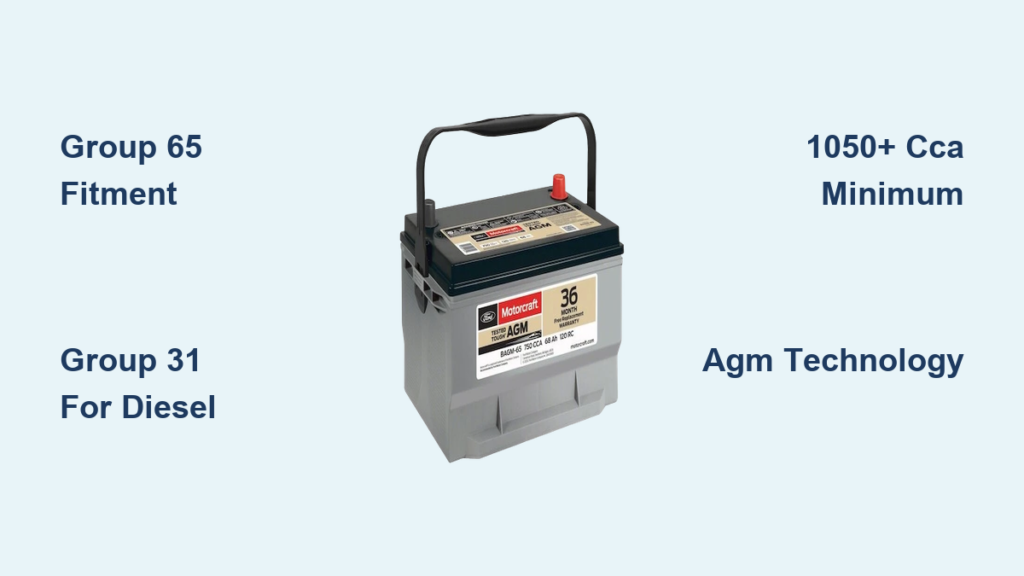
Group 65 is the standard battery size for many Ford F-250 models, especially gasoline-powered versions from 2005 onward. It is widely available, affordable, and fits securely in the factory tray.
- CCA Range: 650–950
- Terminal Type: Top posts
- Best For: Gas models, lighter-duty use
- Reserve Capacity: 140–170 minutes
AGM versions of Group 65 offer better vibration resistance and cold cranking performance, making them ideal for harsh environments or frequent short trips.
Pro Tip: Even if your truck came with a flooded Group 65, upgrading to an AGM version improves longevity and starting power, especially in cold weather.
Group 31: Recommended for Diesel and Newer Models
If you drive a diesel-powered F-250 or a 2009+ model, Group 31 is the recommended upgrade. It delivers higher cranking power and reserve capacity needed for turbocharged engines and advanced electronics.
- CCA Range: 1,050–1,200+
- Terminal Type: Top posts
- Best For: 6.7L Power Stroke diesel, start-stop systems, heavy electrical loads
- Reserve Capacity: 160–190 minutes
Despite being longer, Group 31 batteries fit in the F-250 tray when mounted with the correct orientation.
Warning: Never install a standard flooded battery in a diesel F-250. The high compression requires 1,000+ CCA, and only AGM batteries reliably deliver that.
Group 59: Budget-Friendly Alternative
Group 59 is a smaller, lower-cost option that fits some F-250s, particularly older models or lighter-duty trims.
- CCA Range: 540–590 (flooded)
- Best For: Short commutes, warm climates, temporary replacement
- Limitation: Not suitable for diesel engines or cold weather
While it may fit, Group 59 lacks the power and reserve capacity for demanding applications. Use only as a stopgap or in non-critical conditions.
Other Compatible Group Sizes
Several other battery groups can work in the F-250, but they are less common or better suited for niche uses:
- Group 35: Used in 2005–2008 V8 models; 900 CCA recommended
- Group 34: AGM versions offer 750–800 CCA; fits but lacks power for diesels
- Group 24F: 710 CCA AGM; compact fit, lower output
- Group 47 (H5): 680 CCA; more common in European vehicles, not ideal for F-250
Avoid Marine/RV Dual Purpose Batteries unless specifically rated for engine starting. Many deep-cycle batteries cannot deliver the burst of power needed to crank a large-displacement engine.
Match Battery Specs to Your Engine
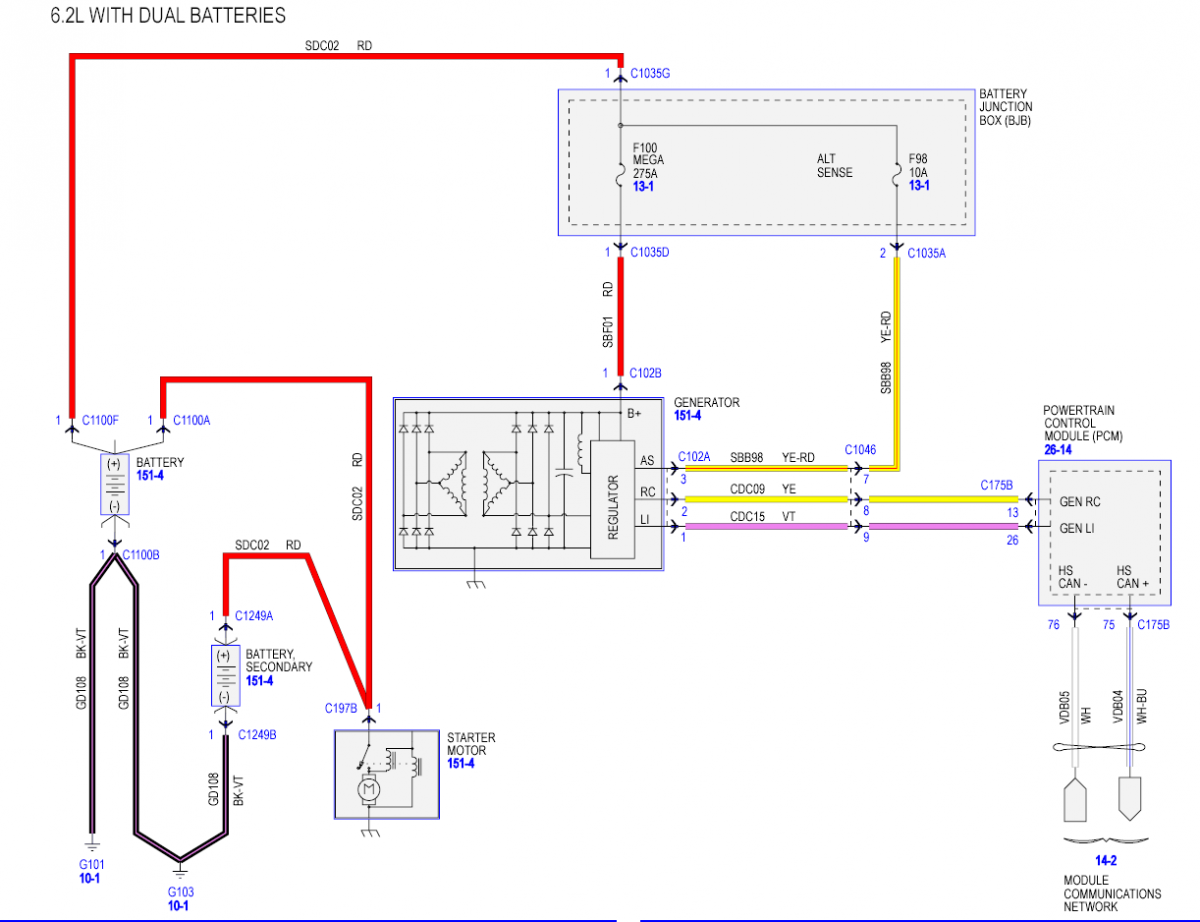
Not all F-250s have the same power needs. Gas and diesel engines require vastly different battery performance. Choosing based on CCA and reserve capacity, not just size, is essential.
Gas vs. Diesel: Power Requirements
| Engine Type | Minimum CCA | Recommended Battery | Reserve Capacity |
|---|---|---|---|
| 5.4L / 6.2L Gas | 750 | Group 65 AGM | 150+ min |
| 6.7L Power Stroke Diesel | 1,050 | Group 31 AGM | 180+ min |
Diesel engines have higher compression ratios, requiring significantly more cranking power. A weak battery causes hard starts, glow plug strain, and premature failure.
Expert Note: Even if your diesel F-250 physically accepts a Group 65, it will not provide reliable starts in cold weather. Stick with Group 31 AGM for diesel applications.
Start-Stop Systems Demand AGM or EFB
F-250s from 2020 onward equipped with start-stop technology cycle the engine on and off frequently. This requires a battery that can handle deep discharges and rapid recharging.
- Required Technology: AGM or EFB (Enhanced Flooded Battery)
- Why It Matters: Standard flooded batteries degrade quickly under repeated cycling
- Consequence of Wrong Choice: Battery failure within 12–18 months
If your truck has start-stop, verify the replacement battery supports it. AGM is preferred; EFB is acceptable for lighter use.
Know the Key Performance Metrics

Battery labels are packed with numbers. Knowing which ones actually matter for your F-250 saves you from buying the wrong battery.
Cold Cranking Amps (CCA): Start Power
CCA measures how many amps a battery can deliver at 0°F for 30 seconds while maintaining voltage. This is the single most important spec for cold weather performance.
- Gas F-250: Minimum 750 CCA
- Diesel F-250: Minimum 1,050 CCA
- Cold Climate Tip: Add 100–200 CCA if you live in sub-zero regions
Don’t Be Fooled by CA or MCA: Cranking Amps (CA) and Marine Cranking Amps (MCA) are tested at warmer temperatures and inflate performance numbers. Always compare CCA.
Reserve Capacity (RC): Run Time Off-Engine
RC indicates how long the battery can power accessories without the alternator running.
- Standard Target: 150+ minutes
- Heavy-Duty Recommendation: 180+ minutes (Group 31 AGM)
- Use Case: Towing campers, plowing, off-grid operation
If you frequently use onboard equipment with the engine off, high RC prevents deep discharges that shorten battery life.
Battery Technology: Flooded vs. AGM
The type of battery matters as much as its size and rating.
Flooded Lead-Acid: Basic and Affordable
- Cost: $81–$183
- CCA: 540–850
- Lifespan: 3–5 years
- Best For: Light-duty gas models, budget replacements
Drawbacks: Prone to acid leaks, lower vibration resistance, poor performance in extreme temps.
AGM: Superior for Heavy-Duty Use
- Cost: $185–$470
- CCA: 750–1,200+
- Lifespan: 4–6 years with proper care
- Best For: Diesel engines, cold climates, start-stop systems
AGM batteries are sealed, spill-proof, and handle vibration far better, which is critical for trucks with heavy payloads or off-road use.
Pro Tip: AGM batteries require a compatible charging system. Most modern F-250s support them, but avoid mixing AGM with flooded in dual setups unless regulated properly.
Lithium (LiFePO4): Aftermarket Upgrade
- Weight: Up to 50% lighter than lead-acid
- Cycle Life: 6,000+ deep cycles
- Cost: $149–$580 (100–200Ah models)
- Use Case: Dual-battery systems, off-grid camping, winch recovery
Lithium batteries excel in deep-cycle applications but require voltage regulation and low-temp charging protection. Not all F-250 charging systems support them without modification.
Model-Year Specific Battery Guide
Battery requirements evolved with F-250 updates. Use this chart to find the best fit for your truck.
| Model Year | Recommended Group | Minimum CCA | Technology | Notes |
|---|---|---|---|---|
| 2005–2008 | Group 35 or 65 | 900 | Flooded/AGM | V8 gas engines; Group 65 is upgrade path |
| 2009–2010 | Group 31 or 65 | 1,050 | AGM | Diesel models require Group 31 |
| 2011–2014 | Group 31 | 1,100 | AGM | Higher electrical load from tech features |
| 2015–2019 | Group 31 | 1,200 | AGM | Critical for 6.7L turbo diesel |
| 2020–2023 | Group 31 | 1,200 | AGM/EFB | Start-stop system compatibility required |
Always Verify Fitment: Use your VIN or owner’s manual to confirm. Trim levels and engine options affect battery specs.
Install and Maintain for Longevity
Even the best battery fails early without proper installation and care.
Correct Installation Steps
- Disconnect Negative First: Prevents short circuits.
- Remove Old Battery: Inspect tray for corrosion or damage.
- Clean Terminals and Tray: Use a wire brush and baking soda solution.
- Place New Battery: Ensure correct orientation.
- Secure Hold-Down Clamp: Prevents vibration damage, which is critical for AGM.
- Connect Positive First, Then Negative: Restores circuit safely.
- Test Voltage: Should read 12.6V+ when fully charged.
Warning: Never skip the hold-down. A loose battery can crack, leak, or cause a fire.
Extend Battery Life
- Avoid Deep Discharges: Don’t leave lights on or use high-draw accessories with engine off.
- Drive Regularly: Short trips prevent full recharging; take longer drives weekly.
- Check Charging System: Have alternator output tested if battery dies frequently.
- Clean Terminals: Corrosion increases resistance and reduces performance.
Maintenance Schedule: Test battery every 6 months, especially before winter.
Troubleshoot Common Battery Issues
Recognize the signs of a failing battery early.
Symptoms of Failure
- Slow Cranking: Engine turns over sluggishly, especially in cold weather
- Dim Headlights: Brightness drops when idling
- Electrical Glitches: Dashboard warnings, radio resets, or power windows slow
- Swollen Case: Indicates overcharging or heat damage
If you notice these, get a free load test at AutoZone, O’Reilly, or NAPA.
When to Replace
- Age: Over 3–5 years old, even if working
- Failed Test: Can’t hold charge or deliver rated CCA
- Physical Damage: Cracks, leaks, or bulging case
Core Charge Reminder: Most stores charge a $22 refundable core fee when buying a new battery. Return your old one to get it back.
Where to Buy and What to Pay
Battery prices vary widely by type and performance.
Price Ranges
- Economy Flooded: $81–$125
- Standard Flooded: $125–$183
- Premium AGM: $185–$260
- High-Performance AGM: $316–$470+
- Lithium (LiFePO4): $149–$580
Best Value Pick: EverStart Platinum AGM (Group 65) at approximately $189, offering excellent CCA, RC, and a 3-year warranty.
Top Performance Pick: Odyssey Extreme Group 31, delivering 1,200 CCA, 190 RC, and built for extreme durability.
Most standard batteries are available for same-day pickup. High-end models may require shipping.
Frequently Asked Questions About Ford F-250 Battery Size
What is the most common battery size for a Ford F-250?
Group 65 is the most common battery size for Ford F-250 gas models, while Group 31 is standard for diesel and 2009+ models. Both fit the factory battery tray with proper hold-down hardware.
What CCA does a Ford F-250 diesel need?
A 6.7L Power Stroke diesel F-250 requires a minimum of 1,050 CCA, with 1,200 CCA recommended for reliable cold-weather starting. Group 31 AGM batteries meet this requirement.
Can I use a Group 65 battery in a diesel F-250?
Physically, a Group 65 may fit some diesel F-250s, but it does not provide enough cranking power for reliable cold starts. Diesel engines require Group 31 AGM with at least 1,050 CCA.
Does my 2020+ F-250 need a special battery?
Yes. F-250s from 2020 onward with start-stop technology require AGM or EFB batteries. Standard flooded batteries fail prematurely under the frequent cycling of start-stop systems.
How long does a Ford F-250 battery last?
Most F-250 batteries last 3–5 years, depending on climate, usage, and battery type. AGM batteries typically last 4–6 years with proper maintenance.
How much does a Ford F-250 battery cost?
Prices range from $81 for economy flooded batteries to $470+ for high-performance AGM options. Most owners spend between $185 and $260 for a quality AGM replacement.
Key Takeaways for Choosing Your Ford F-250 Battery Size
The right Ford F-250 battery size depends on your engine, model year, and usage demands. Gas models typically use Group 65 AGM, while diesel and newer trucks need Group 31 AGM for reliable starts and system support. Always prioritize CCA, reserve capacity, and battery technology over simply matching the old battery’s group number.
Before purchasing, verify fitment using your VIN or owner’s manual, especially if your truck has start-stop technology or a 6.7L Power Stroke diesel. With proper selection and basic maintenance, your F-250 will start strong for years, regardless of weather or workload.